

Water content
Water content specifies the amount of water contained in a given material. It is represented by the concept of proportion, which starts from zero, i.e. the product is completely dry, up to the porosity value at its saturation point. It is a property widely used in industry, in various components such as wood, plastics or minerals and in markets such as the food industry.
If you need to perform analysis to determine water content, INFINITIA Industrial Consulting offers you our extensive laboratory experience, where we can perform tests and assays tailored to your needs.
Talk to a specialist
Request a free initial consultation; contact a consultant from our team of specialists

What is water content?
What is it?
The water or moisture content of a material shows the proportion of water in that product. To achieve this, there are various procedures that will be more suitable depending on the sample to be studied.
In fact, water is present in virtually all substances in nature and the choice of measurement methods will depend on how well they match the properties of the materials, the amount of sample available and other factors such as the required accuracy.
The importance of determining water content
Benefits

Methods for determining water content
Types
Thermogravimetric analysis (TGA)
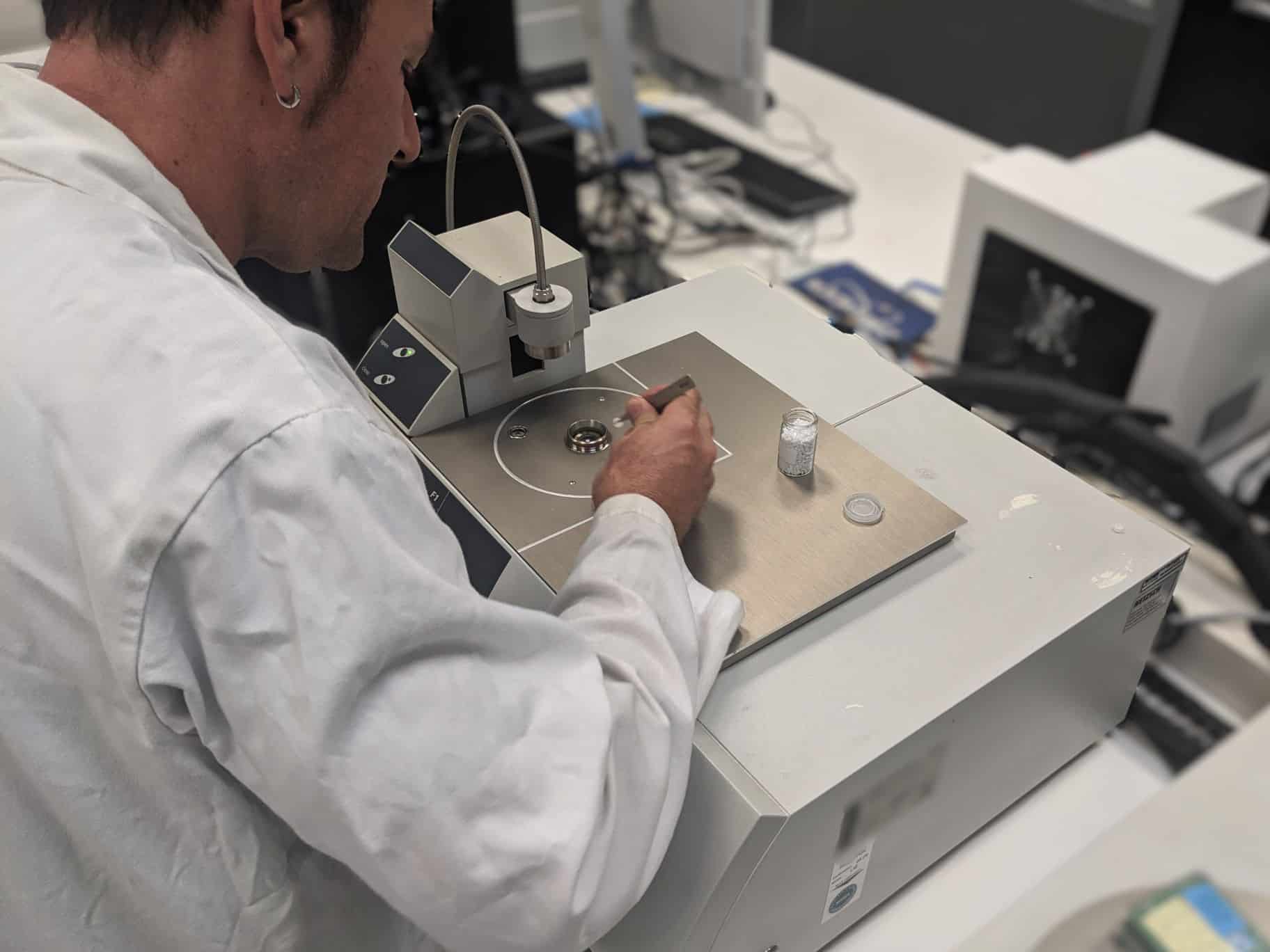
One test for measuring water content is thermogravimetric analysis (TGA), which involves measuring the mass of the sample over a period of time during which the temperature varies.
Spectroscopic analysis and other techniques
Another method to determine the water content is spectroscopic analysis, but it is not the only one; refractrometry, gas chromatography or other tests can also be applied.
Karl Fischer Method
One of the most common methods for water determination is the Karl Fischer method. This procedure makes it possible to quantitatively determine how much water exists in solid, liquid and gaseous materials. Thus, the Karl Fischer method is applied in different industries such as food, chemicals, pharmaceuticals and cosmetics.
This procedure, invented by the German chemist after whom it is named in 1935, uses volumetric titration to determine the traces of water in a given material. It is an accurate method, which also does not require large quantities of samples to do its job and has a wide measurement range. In addition, it can be automated and is easy to prepare.
Specifically, the Fischer method consists of dissolving or suspending the sample in a water-free solvent, such as dry methanol, to which an iodine-containing reagent is added. In this procedure, the water will react with the reagent until it is consumed and the free iodine will be detected. A platinum electrode will perform the final volumetric titration.