
What was the challenge or problem to solve?
Parts simplification consists of redesigning a product so that it performs the same functions with fewer components and joints, thus reducing manufacturing and assembly costs. That is what a client needed who had developed a device with the help of another company.
The work was approached as a product development project focused on the mechanical development of the device and, specifically, on the optimisation and simplification of parts: the overall design had to be kept and the number of parts reduced to make production and assembly cheaper.
OPTIMISATION AND SIMPLIFICATION OF PARTS
Does your product work, but has too many parts and screws and is expensive to assemble? Discover our parts optimisation and simplification service

Reducing production costs without changing the overall design
The client had an already developed device and did not want to change its overall design. What they needed was to reduce the cost of producing and assembling it, and the way to achieve this was to reduce the number of parts.
Reducing parts is one of the most direct ways to make a product cheaper, because the saving is repeated in every unit manufactured: each component removed no longer needs its own manufacturing process, quality control, storage and assembly operation.
That condition set the limits of the redesign: the improvements had to be made inside, in the shape of the parts and the way they were joined, keeping the appearance and functions of the product. In addition, the optimisation had to meet the original functional requirements and improve the manufacturability of the device, that is, make it easier to manufacture.
Excess parts and fasteners in the initial design
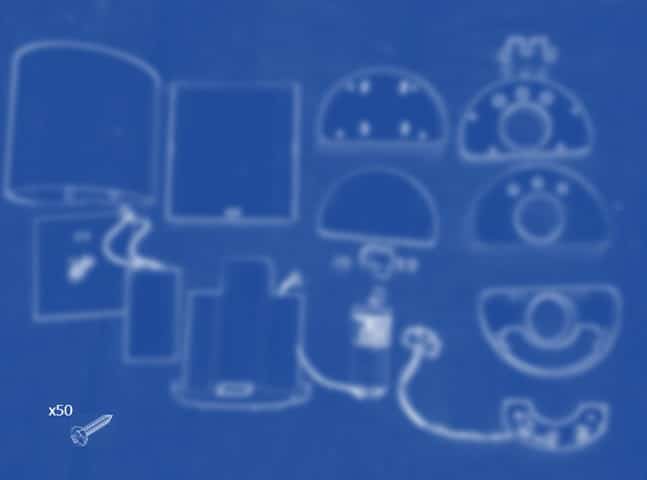
After assessing the design proposed by the client, INFINITIA determined that it was complex: it had an excessive number of parts and fastening elements, which made assembly costly and laborious.
Fastening elements are often one of the points that make assembly most expensive. Each screw means one more operation, a tightening to control and a reference to buy, and when several different types coexist the risk of assembly errors also increases.
Every extra part and every extra screw is paid for twice, when it is manufactured and when it is assembled, in every unit produced.
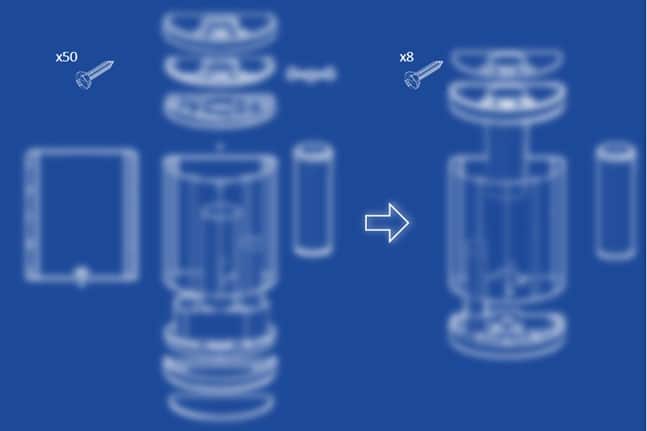
Specifically, the device consisted of more than nine parts and around forty screws of different references. Each different reference adds stock management and assembly operations. The aim was to turn that assembly into a design with fewer parts and a more efficient fastening system, without compromising the functionality of the device.
Parts simplification as a measurable objective
The challenge had a clear success criterion: significantly reduce the number of parts and screws while keeping the functions of the product.
Having a measurable objective, such as the number of parts or screws, makes it possible to compare each redesign proposal with the starting design objectively, without relying only on the impression that one design is simpler than another.
To achieve this, it was necessary to identify which components were truly essential and which could be unified, something that requires a thorough understanding of how each part of the device works. With that analysis as a starting point, the redesign could be based on data rather than assumptions, and the result could be compared directly with the original design.
TELL US ABOUT YOUR CASE
Do you want to make your product cheaper to assemble without changing its appearance? Send us the current models or drawings and we will propose how to simplify it
How was it addressed or what was the solution?
The solution followed a four-phase process: analysis of the original design, redesign of the parts, manufacturing of prototypes, and assembly and testing of the demonstrators.
Each phase relied on design and manufacturing tools that made it possible to iterate quickly, so that the result could be validated before moving on to industrialisation.
Analysis of the original design with CAD software
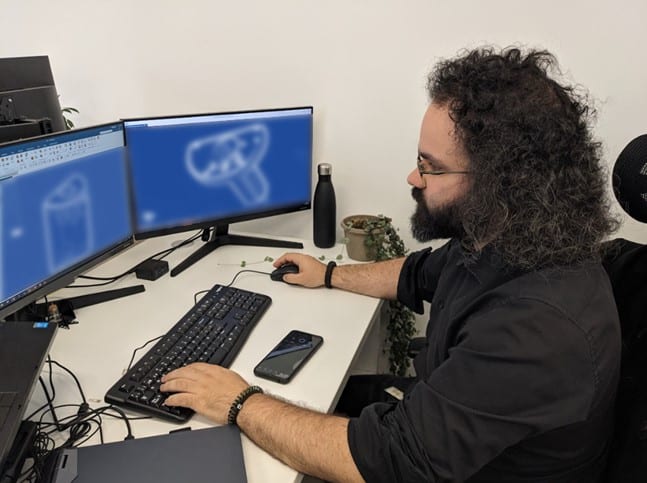
The first step was a detailed analysis of the original design and the client’s specific needs. Professional 3D design and modelling using CAD software was used to examine the device.
In this type of analysis, the CAD model makes it possible to separate what each part does from the shape it has. By identifying the function of each geometry, it becomes easier to see which parts can be merged into one without losing any of those functions.
This analysis identified the essential functionalities and grouped the geometries needed to meet the client’s requirements. The result was a complete understanding of the device and a clear list of essential components, the basis for deciding which parts could be joined or removed.
Redesign with fewer parts and more efficient fastening
With the functionalities and geometries clear, the device was redesigned. Drawing on the Product Development team’s experience in part design and fastening mechanisms, elements were unified and superfluous components removed.
Unifying parts is not just a matter of joining geometries: it must be checked that the resulting part can be manufactured, that it does not complicate the assembly of the others and that it still allows access to the areas that need it. That is why each unification is assessed within the whole assembly and not in isolation. The new design required fewer parts and fewer fasteners, and fastening was solved with a single type of screw.
Unifying parts and using a single type of screw simplifies assembly, reduces references and makes every unit of the product cheaper to manufacture.
The device went from more than nine parts and around forty screws of different references to just four parts and eight identical screws.
Parts simplification validated with demonstrator prototypes
The new geometries were manufactured through rapid prototyping with additive manufacturing. 3D printers of different technologies made it possible to iterate the designs until the optimal solution was reached without high costs or long lead times.
Additive manufacturing produces a part directly from its 3D model, without moulds or tooling. This makes it well suited to redesign phases, in which a geometry may change several times before it is accepted.
The demonstrator prototypes were then assembled and tested. With professional post-processing and aesthetic finishing equipment, models were obtained that allowed the client to present the product to shareholders and investors as if it were the final device.
Reducing parts and screws without touching the overall design makes manufacturing and assembly cheaper and keeps intact the product the client already knows.
The simplification reduced manufacturing and assembly costs and made assembly easier. The same approach was applied in the product redesign to reduce costs and enable industrialisation and in the redesign of an incubator to reduce manufacturing costs, and the keys to this type of work are summarised in the design of assemblies.