
What was the challenge or problem to solve?
Design-for-manufacturing product redesign means reviewing the architecture of a design that already works in order to reduce its complexity and allow it to be manufactured repeatably and economically, without losing the function it fulfilled. This project started from exactly that point: a product that solved its problem well, but that was not viable to take to production as it was conceived.
The distance between a product that works and a product that can be manufactured is one of the most common gaps in industrial development. INFINITIA got involved within its industrial product development service with an objective defined from the outset: to reduce the number of parts of the assembly as much as possible in order to make a more affordable industrialisation possible.
A non-industrialisable product and why it holds back manufacturing
Industrialising a product means preparing it to be manufactured repeatably, with controlled processes, suppliers, materials and costs, and not just once in an artisanal way. The client had a product that solved its problem, but that could not be industrialised. The function was resolved and validated; what did not fit was its architecture against any reasonable production scenario.
This is a frequent situation when a design is born from functional need and progresses through partial solutions. Each new requirement is solved by adding an element, and the assembly ends up made of a high number of parts that coexist well in a hand-assembled unit, but that drive up cost and uncertainty as soon as manufacturing hundreds or thousands of units is considered.
The client did not need, therefore, a different product, but the same product expressed in another way: a design equivalent in performance and radically simpler, able to survive contact with a real production process and with an acceptable unit cost. It needed to unblock the phase that separated the company from manufacturing and selling what it had already proven to work.
Reducing the number of parts to make industrialisation cheaper
Reducing the number of parts, also called component consolidation, consists of integrating into a single element functions that were previously distributed across several parts. It is one of the design decisions with the greatest impact on the manufacturing cost of an industrial product.
The reason is that each part carries a chain of costs that is not visible on the drawing. It needs its own tooling, takes up a reference in the bill of materials, requires a supplier and incoming inspection, generates stock and adds at least one assembly operation. The sum of all those items usually weighs more on the final cost than the part’s own material.
To this is added an equally relevant technical effect: each joint between parts introduces a tolerance that accumulates. The dimension chains of an assembly with many elements widen the dimensional variability of the finished product and force individual tolerances to be tightened, which makes each component more expensive. In addition, each interface (a fit, a screw, a weld, an adhesive) is a potential point of failure in service.
Every part that disappears from an assembly eliminates a piece of tooling, a reference, an assembly operation and a potential point of failure. That is why component consolidation acts directly on industrial cost.

Technical feasibility of the design to simplify without losing function
The technical feasibility of a design is the verification that the proposed geometry can be manufactured with a real process and material, meeting the required function within acceptable costs and lead times. That is where the difficulty lay: reducing parts as much as possible while taking that feasibility into account and, at the same time, enabling efficient production.
Simplifying is easy on paper and hard in practice. A single part with a geometry that no process can reproduce is not progress, it is a displaced problem. Each technology imposes its own constraints: draft angles and uniform wall thickness in moulding, tool accessibility in machining, minimum radii or forming directions. Integrating several functions into a single element requires respecting all those rules at once.
Design for manufacturing and assembly (DFM/DFA) is the methodology that incorporates those production-process constraints from the design phase, instead of discovering them when the tooling is already ordered. INFINITIA’s mechanical product development team works with this approach: the part is always conceived in the context of the process that will manufacture it and the cost it will bear.
In short, each simplification proposal had to pass three filters at once: keep the original function intact, be manufacturable with a specific industrial process and end up cheaper than the starting point. An alternative that failed in any of the three was not an alternative.
How was it addressed or what was the solution?
INFINITIA’s Product Development team structured the project in chained phases: a preliminary research study, a conceptualisation with several alternatives, the detailed design of the selected concept and the manufacture of a prototype to validate the idea. Each phase answered a specific question and conditioned the next.
The common thread was the same from start to finish. The most economical manufacturing possible was not treated as a goal that appears at the end, with the design already closed, but as the criterion with which all decisions were made from the first phase. That approach characterises the work of product design and innovation within INFINITIA’s product development service.
Preliminary study and conceptualisation towards three design alternatives
The project began with a preliminary study of research aimed at extracting conclusions applicable to the redesign. Products similar to the client’s were studied and, from them, aspects such as the technical feasibility of each solution, its complexity and its suitability for the problem were evaluated. This technical benchmarking does not seek to copy geometries, but to identify patterns: which functions tend to be integrated into a single element and which processes are used for that type of product.
The usefulness of this phase is twofold. It narrows the solution space before investing design hours, avoiding exploring lines that others have already discarded, and it provides objective criteria for the following phases. Thus, conceptualisation starts from well-founded conclusions and not from intuitions, following the same principle of the preliminary study and maturation of an idea in any industrial development.
With those conclusions and through an ideation process, the team generated three different design alternatives, all capable of meeting the objectives, and presented them to the client. Conceptualisation is the phase in which a set of requirements is translated into architecture proposals: how the functions are distributed among elements and which manufacturing process is assumed behind each option.
Generating several design alternatives and contrasting them with the client turns the selection of the concept into a reasoned technical decision, not a bet.
3D CAD design to define a manufacturable part
Once the concept was selected, it was defined technically. That definition was carried out taking into account the design constraints associated with the manufacturing process and the material chosen to produce the part, so that no geometric decision was disconnected from production reality.
Technically defining a product means specifying everything a drawing and a model must contain for the part to be manufactured without interpretations: geometry, wall thicknesses, radii, tolerances, finishes and acceptance criteria.
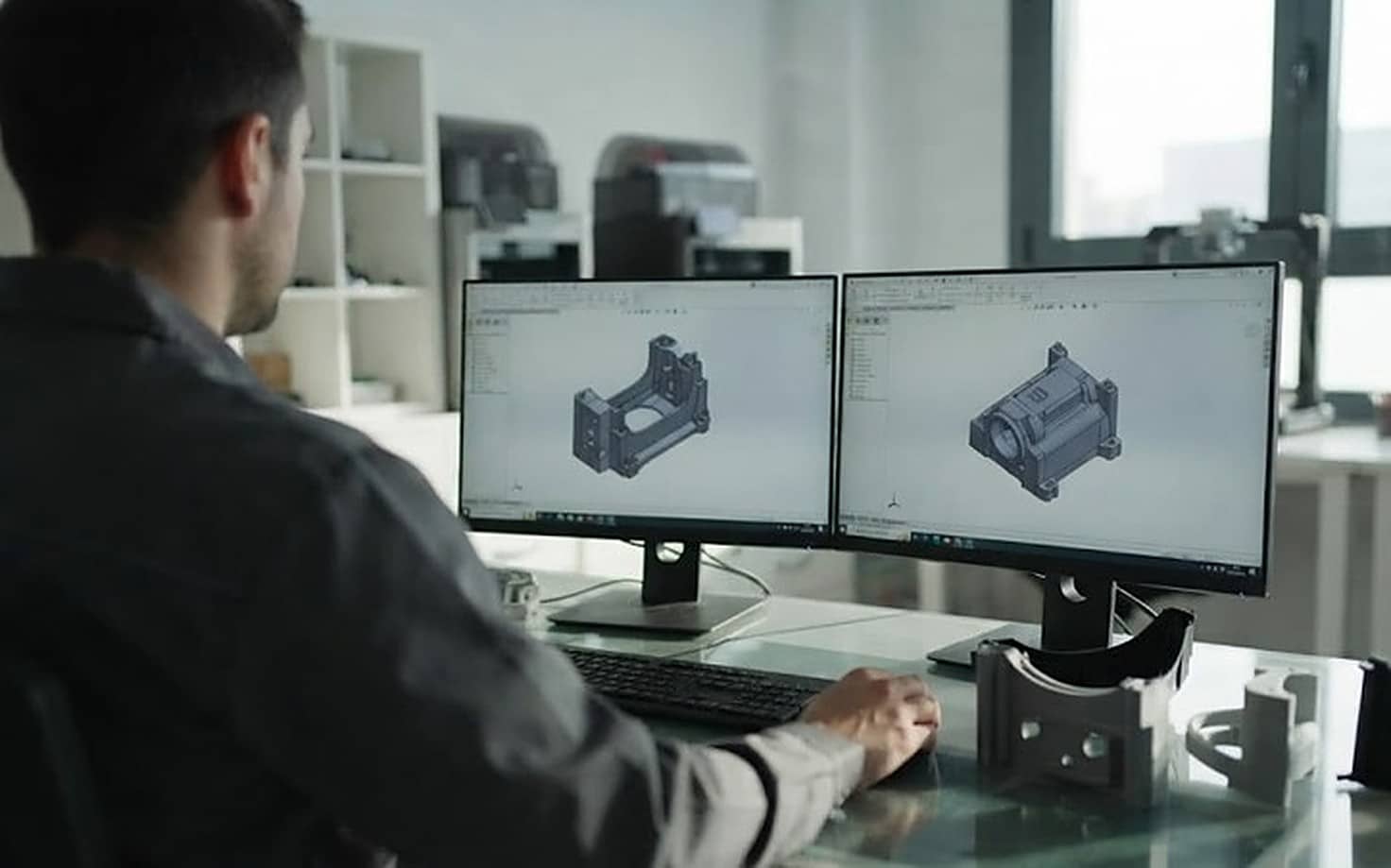
With the product defined, a digital model was developed in depth using professional 3D design and CAD modelling software. Parametric modelling links each dimension to a design intent, so that a modification propagates in a controlled way throughout the geometry. In a part-consolidation project this is decisive, because iterations are constant and each change affects several functions integrated into the same element.
A well-built CAD model is not just a three-dimensional representation: it is the technical document that tells the manufacturer what to do, with what margin and under what criterion the part is accepted or rejected.
Rapid prototyping and additive manufacturing to validate the part
To validate the idea, a prototype was manufactured with rapid prototyping and additive manufacturing techniques. Additive manufacturing is the set of processes that build a part by adding material layer by layer from a digital model, as opposed to methods that start from a block or a mould.
Resorting to these techniques responds to a direct reason: they make it possible to have a prototype in a short time and at low cost, without the need to manufacture tooling. That is what allows the client to physically validate the proposed solution, handle it and check its behaviour before committing any investment in production.
Rapid prototyping makes it possible to physically validate a redesign before investing in tooling, when correcting a decision still costs design hours and not a whole mould.
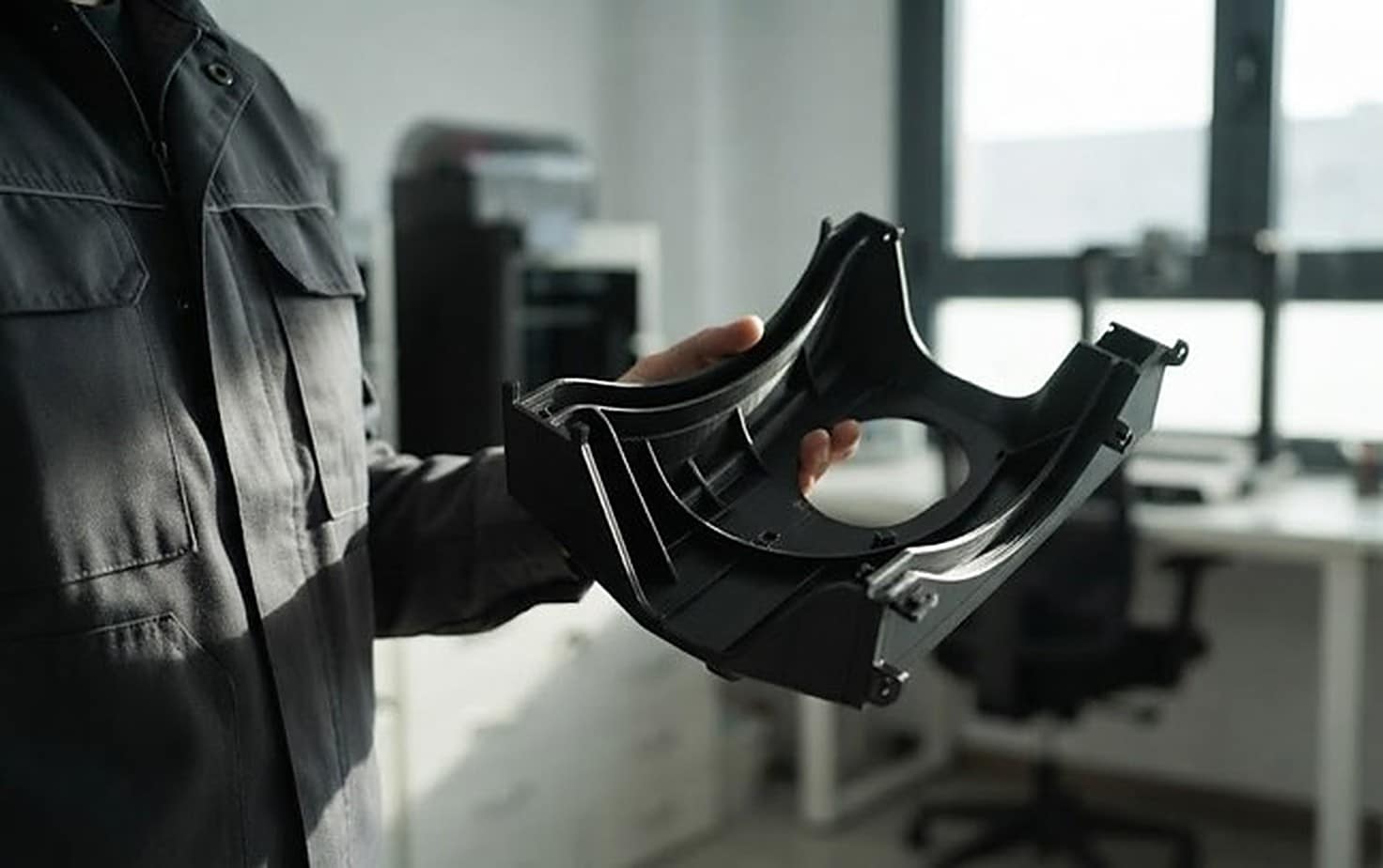
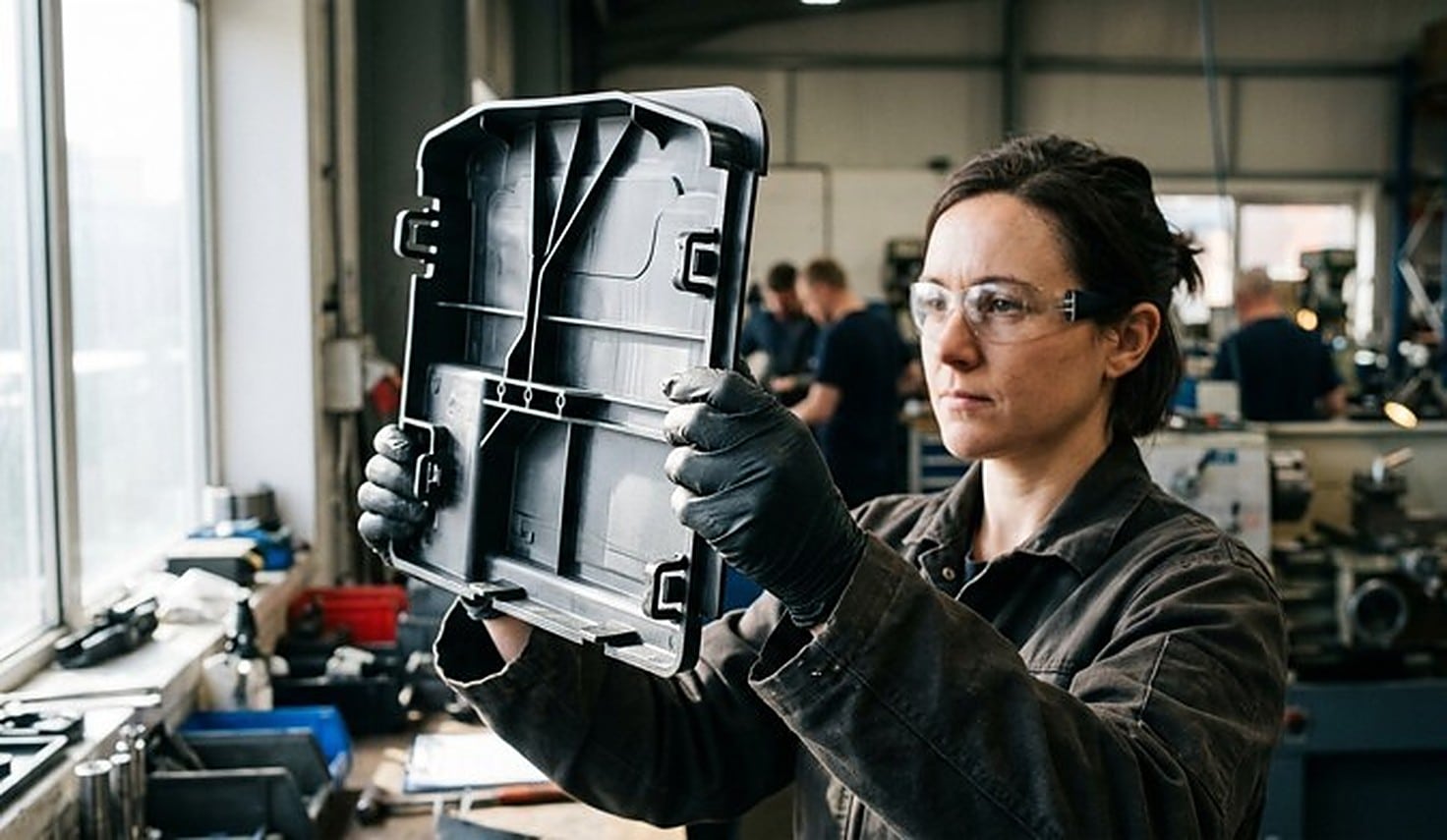
On the prototype, a verification phase aimed at detecting possible improvements was also carried out, thus closing the cycle of industrial prototyping. The result of the project was a fully industrialisable design, made of a single part, that perfectly fulfilled the function of the original product.
The reduction in the number of parts reached its technical limit, and what started as a solution that worked but could not be manufactured ended up as a design ready to be produced in a controlled and efficient way. Between a product that solves its problem and a product that can be manufactured there are two distinct milestones, and design-for-manufacturing redesign is the engineering work that joins one to the other.