
What was the challenge or problem to solve?
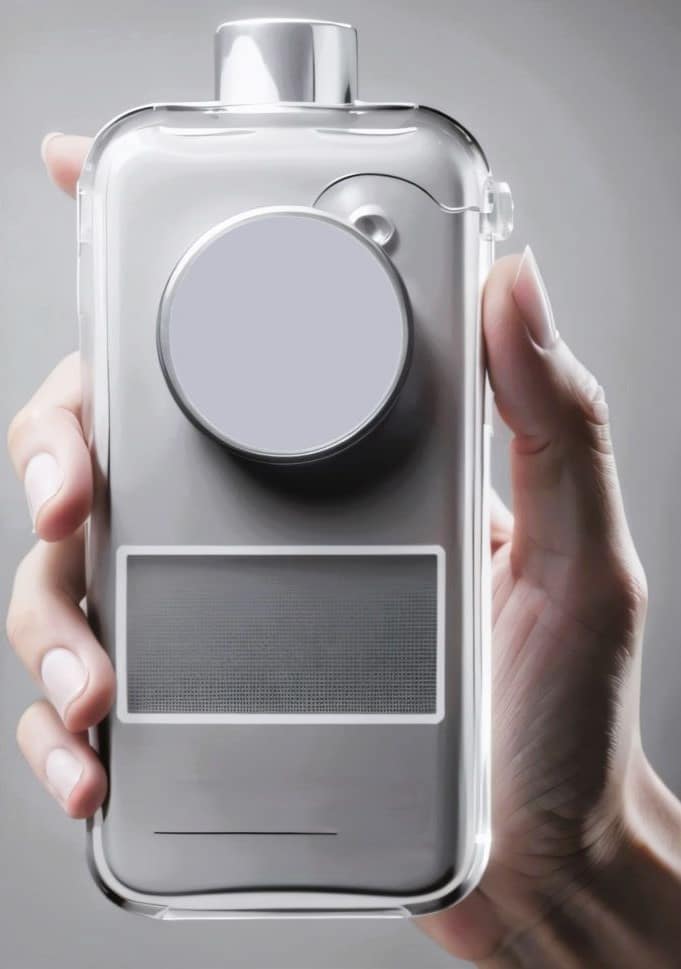
A functional prototype for investors is a physical part that proves a product works and shows what it will look like, so that whoever is going to fund it can see it in action. That is what a client needed who, until then, only had graphic material and patents to present their product in public.
The assignment was approached as a product development project within the prototyping and prototype manufacturing area, starting with a proof of concept of the most delicate mechanism: the device’s fluid dosing system.
PROOF OF CONCEPT
Do you have a patented mechanism that has never been tested beyond paper? Discover our proof of concept service

Functional prototype to present a product to investors
The client wanted to present their product to investors and at trade fairs, and renders or patent documentation were not enough for that. They needed an object that could be touched, switched on and shown in front of an audience.
A presentation prototype has a different role from a laboratory prototype. While the latter only needs to prove that a technical solution works, the presentation prototype has to communicate the product to people who have never seen it, so its appearance, size and handling matter as much as its operation.
The prototype had to fulfil two functions at once. On the one hand, prove that the product did what it promised. On the other, look polished, because it would be the first physical image of the product for anyone who saw it.
That dual requirement, functional and aesthetic, shaped the whole project: every design and manufacturing decision had to make the device work and, in addition, look good in a presentation.
Patented dosing system without technical validation
The core of the device was a patented fluid dosing system. The patent protected the idea, but the system had not been technically validated: there was no data confirming that it worked as expected.
A dosing system has to deliver the same amount of liquid every time, regardless of factors such as the viscosity of the fluid, the level in the reservoir or the way it is actuated. That is why it cannot be validated with a single test: the flow rate has to be measured under different conditions to check that the result is repeatable.
A patent protects an idea, but does not prove that it works: to show it in action, the mechanism must first be validated in the laboratory.
That is why, before designing the rest of the device, the system had to be implemented and tested on its own. Building the complete prototype on an unvalidated mechanism would have put the whole development at risk.
This order of work, first the critical mechanism and then the whole, makes it possible to detect problems while they are still easy to correct.
Technical validation and aesthetic finish in a single prototype
The challenge was not only technical. As well as validating the dosing system, the final prototype had to be attractive, because it would be used as a presentation tool.
In a prototype of this kind, aesthetic decisions affect the mechanics. The thickness of a housing, the position of a control or the way two parts are joined change both the appearance and the operation, and solving them separately often means remaking parts when they are put together.
Combining both in a single part requires thinking from the outset about how the components will be manufactured and assembled, so that the finish does not compromise operation or vice versa. With those constraints, the project was organised in phases: validation of the dosing system, design of the assembly, manufacturing, assembly and testing, and delivery with a live demonstration.

TELL US ABOUT YOUR CASE
Do you need a prototype that works and looks good to present to investors or at a trade fair? Send us what you have of your product and we will propose how to turn it into a prototype
How was it addressed or what was the solution?
The solution combined laboratory validation, 3D design and additive manufacturing, with a clear criterion: not to move forward with the design of the device until the operation of the dosing system had been confirmed.
Each phase built on the previous one, so that the geometries validated in the tests went straight into the design, and the design was conceived from the start to be manufactured through rapid prototyping.
Laboratory testing of the fluid dosing system
Work began with laboratory tests on the dosing technology proposed by the client. The aim was to obtain and validate the geometries needed for the system to work, which would later serve as the basis for the mechanical development.
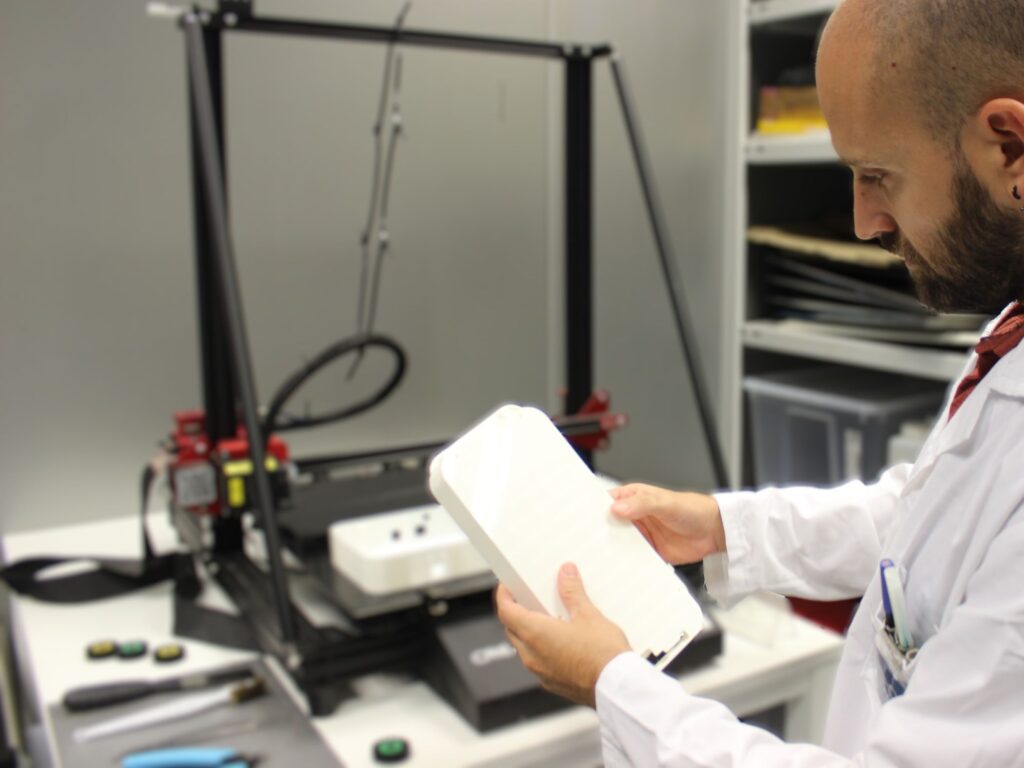
The test parts were made with 3D printers, which made it possible to try different variants quickly, and the performance of the system was measured with flow sensors to adjust it precisely.
3D printing is particularly useful at this stage because it makes it possible to produce several geometries quickly and at low cost, so that alternatives can be compared before the design is fixed. Flow sensors, in turn, turn the behaviour of the system into measurable data with which to decide which geometry works best.
With this approach, the dosing technology was validated before continuing with the rest of the device, which was exactly what was missing to move from a patent to a demonstrable product.
3D design of parts and assemblies for rapid prototyping
With the geometries validated, the parts and assemblies needed to integrate all the components of the prototype were designed. The final designs were modelled in 3D with professional software.
Validating the critical mechanism first and then designing the rest of the assembly avoids building a whole functional prototype on a technical unknown.
These models were optimised for manufacturing through rapid prototyping, so that all the parts fitted together and the subsequent assembly and testing were straightforward. Designing for rapid prototyping means taking into account, from the 3D model onwards, the tolerances of the manufacturing technology, the minimum wall thicknesses and how the parts will fit together. A design conceived only for series production, for example for injection moulding, cannot always be printed as it is.
The design took care of both the internal operation and the external appearance, since the same device had to serve to demonstrate the technology and to present the product.
Functional prototype made in resin and demonstrated live
The parts were made with a high-resolution resin 3D printer, a 3D printing technology suited to obtaining parts with a good level of detail.
Resin 3D printing solidifies a liquid resin layer by layer using light. Compared with other 3D printing technologies, it allows thinner layers and smoother surfaces, which reduces finishing work on parts that will be seen up close.
Each component was then assembled and tested to verify its operation. The tests made it possible to identify and apply the necessary modifications until the final prototype was fully functional.
A prototype that works in front of an audience turns a patent into a product that investors can see, touch and evaluate.
Finally, the prototype was delivered to the client with a live demonstration. The device, functional and carefully finished, allowed them to present their product clearly to their target audience, in line with other projects such as the functional physical prototype to attract investors or the scale prototype to present a product idea. To understand what a prototype of this kind can demonstrate, it is worth reviewing what a functional prototype does and does not validate.