
Natural fibre composites are materials in which plant fibres such as flax, hemp or jute replace glass fibre as the reinforcement of a polymer matrix, with less weight and a renewable origin.
They stopped being an experiment a long time ago. They are made in series for car interiors, sports equipment and furniture, and they come into a product improvement project when the aim is to make a part lighter, replace part of the fossil based material or improve its behaviour under vibration.
Within technological innovation in materials, their interest does not lie in being sustainable by definition, but in what they allow you to measure and demonstrate. A natural fibre that is badly chosen or badly treated gives a weaker part that is more sensitive to moisture, and a green label does not make up for a warranty return.
PRODUCT IMPROVEMENT
Do you want to make a part lighter or reduce its footprint without losing performance? Take a look at our product improvement

What natural fibre composites are and why they work as reinforcement
A natural fibre composite works like any composite material, the fibre provides stiffness and strength and the matrix holds the fibres together, shares the load between them and protects them from the environment. What changes is the nature of the fibre, which is plant tissue made mainly of cellulose, with an internal structure that makes it light and stiff along its axis.
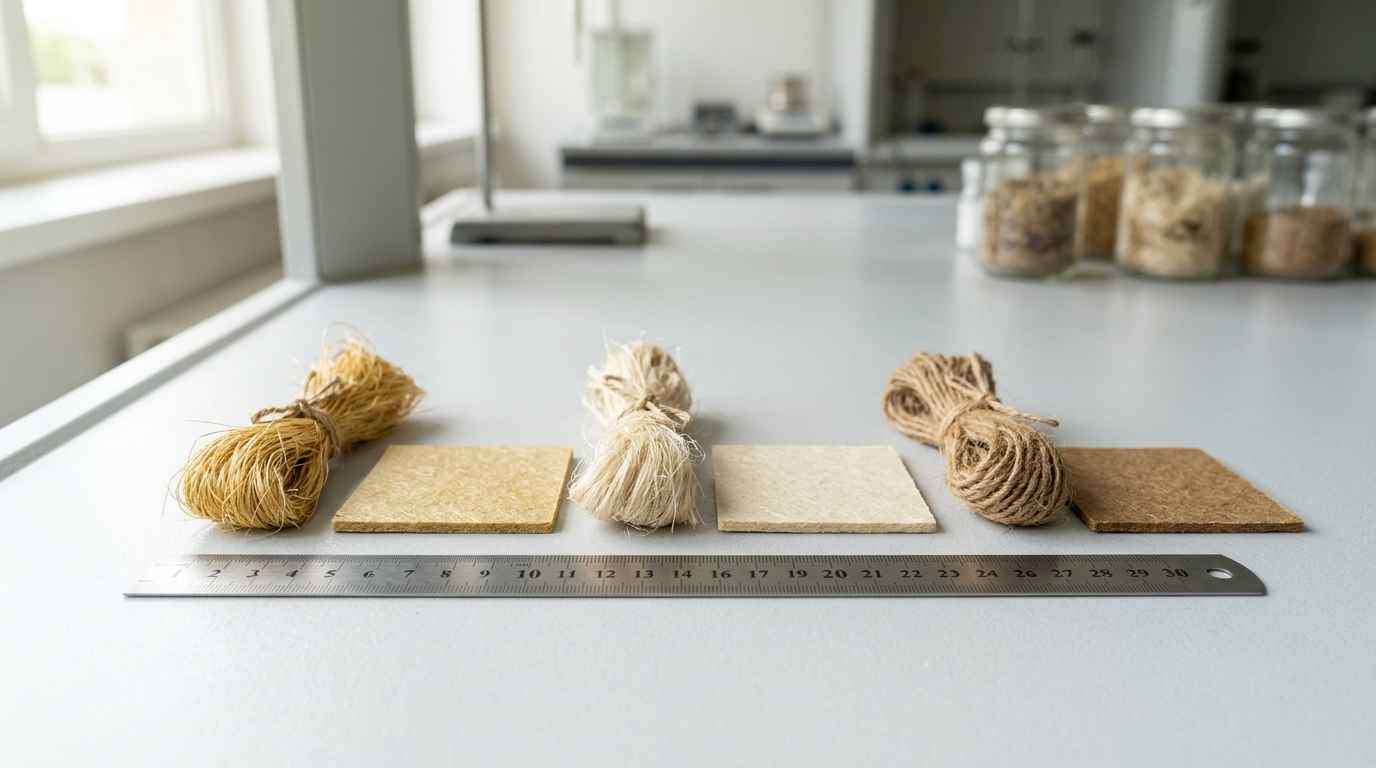
The fibres used as reinforcement come mainly from the stems of plants such as flax, hemp, jute or kenaf, and to a lesser extent from leaves such as sisal or from wood itself in the form of fibre or flour. Each has a different length, stiffness and water absorption, and they are not interchangeable without reviewing the design.
Plant fibres versus glass fibre, specific stiffness and density
The main advantage of plant fibres is density. A flax or hemp fibre weighs around 1.5 grams per cubic centimetre, compared with about 2.5 for glass fibre. Since their absolute stiffness is of the same order, the stiffness per unit weight of the best flax fibres comes close to that of glass, which allows parts that are just as stiff and lighter.
The drawback lies in strength. The tensile strength of plant fibres is clearly lower and, above all, more scattered, because it depends on the variety, the harvest and the extraction process. That is why natural fibre composites fit better in parts governed by stiffness than in parts that have to withstand high loads or heavy impacts.
Types of natural fibre composites by matrix and process
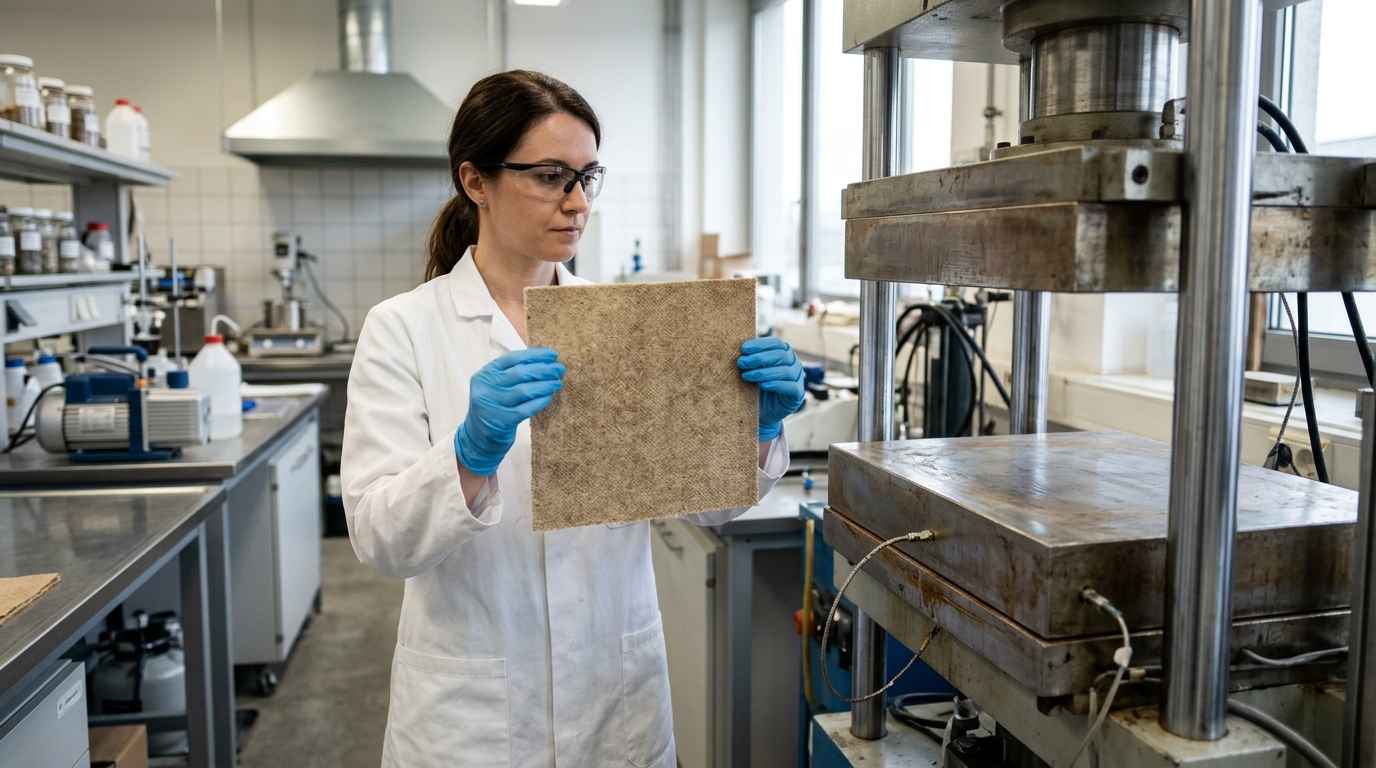
The matrix determines a large part of the behaviour and the end of life. With thermoplastics such as polypropylene, hot pressed mats and pellets for injection moulding are made, which is the high volume route. With thermosets such as epoxy, fabrics and unidirectional tapes are processed by infusion or resin transfer moulding, which is the route for parts with higher mechanical demands.
There are also bio based matrices, such as polylactic acid or epoxy resins with part of their carbon from renewable sources, which increase the renewable content of the whole. The underlying logic is the same as for any composite, described in what composite materials are and what they are for, with the difference that here the reinforcement grows in a field and does not come out of a furnace.
The fibre format matters as much as the matrix. Short fibre mixed into pellets gives injection moulded parts with modest properties that are almost the same in all directions. Nonwoven mats allow large, thin parts by pressing. Fabrics and unidirectional tapes orient the fibre where the loads are and are what brings the composite close to the performance of a glass fibre one.
A flax or hemp fibre weighs a little over half as much as a glass fibre and has a stiffness of the same order. That specific stiffness is the technical reason for using it, not its plant origin.
Where natural fibre composites already work
Natural fibre composites work today where the part needs stiffness with little weight, does not carry critical structural loads and operates in a controlled environment. That combination occurs in very different sectors, from cars to sports equipment.
Automotive, interiors and non-structural parts
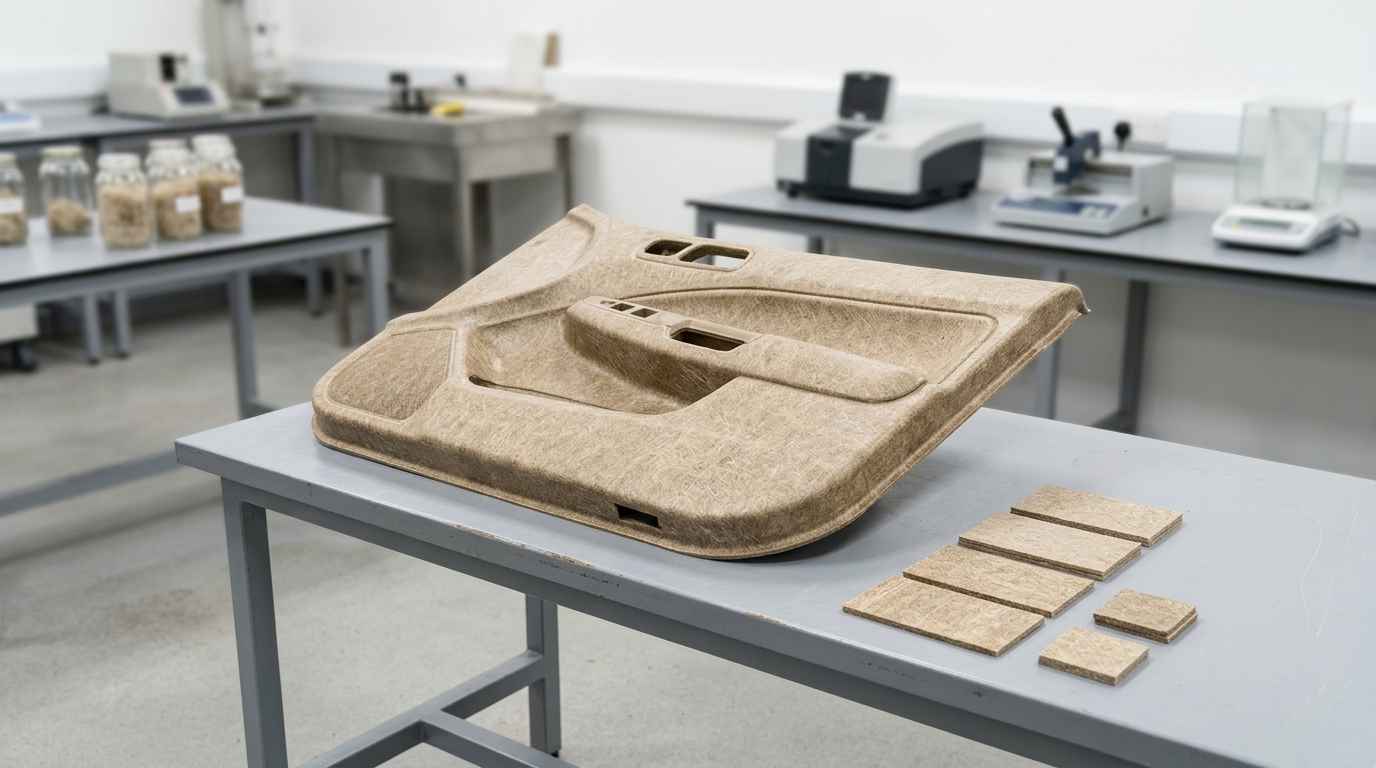
The car interior is the most established application. Door panels, parcel shelves, seat backs and boot linings have been made for years from natural fibre and polypropylene mats pressed under heat. They save weight compared with glass fibre or filled plastic solutions and, when they break, they do not produce sharp splinters.
In these parts the dominant requirement is stiffness and dimensional stability, not maximum strength, and the environment is indoors. Cabin emission and odour requirements do, however, make it necessary to control the volatile compounds the fibre releases when heated, a requirement that does not exist with glass fibre and that should be included in validation from the start.
Sports, marine and consumer goods
In sports equipment, flax is used in skis, boards, bicycles and rackets for its ability to damp vibrations, which the user perceives as a softer feel. In leisure marine, hulls and decks are made with flax fabrics and resin, alone or combined with carbon fibre in the most heavily loaded areas.
In consumer goods, furniture and light construction they appear as housings, boards and wood plastic profiles. Here the argument is usually twofold, reducing fossil based content and offering a finish with visible fibre, which the buyer associates with a more natural product. That finish requires controlling the colour variation between fibre lots, which is greater than that of a pigment.
Between pure natural fibre and synthetic fibre there is a growing middle way, hybrid composites. Combining layers of flax with layers of carbon or glass in the most loaded areas keeps the lightness and damping where they are enough and secures strength where it is needed, at the cost of a more careful laminate design and a more complicated end of life.
TELL US ABOUT YOUR CASE
Are you considering replacing the glass fibre in a part with a natural fibre? Send us the drawing, the current material and the conditions of use and we will tell you what has to be tested before the change
Technical limitations of natural fibres as reinforcement
The limitations of natural fibres come from their biological origin, they absorb water, they degrade at temperatures that an engineering thermoplastic easily exceeds and they vary from one lot to another. None of these prevents their use, but all of them shape the design and the validation.
Moisture, fibre matrix interface and durability
Cellulose is hydrophilic and most matrices are hydrophobic. That incompatibility has two consequences. The first is poor adhesion between fibre and matrix if the fibre is not treated or no coupling agent is added, which in polypropylene is usually maleic anhydride grafted polypropylene. The second is that the fibre absorbs water, swells and transmits stresses to the interface.
Fibre treatments tackle the first problem. An alkaline treatment cleans the surface and improves mechanical anchoring, and silanes create chemical bonds between fibre and matrix. They improve adhesion and reduce absorption somewhat, but they add a process step and a cost that have to be justified with comparative tests against untreated fibre.
Over time and with moisture cycles, that interface weakens and the part loses stiffness, distorts or separates into layers. It is the same mechanism behind delamination in composite materials, accelerated by water absorption, and an adhesion problem between layers can end up in a failure analysis of a multilayer composite material with adhesion problems. That is why water absorption is always measured, with a method such as ISO 62, and the mechanical tests are repeated on specimens aged in humidity.
| Property | Flax or hemp fibres | Glass fibre | What it means for design |
|---|---|---|---|
| Density | Around 1.5 g/cm³ | Around 2.5 g/cm³ | Lighter parts for the same fibre volume |
| Stiffness per unit weight | Of the same order in the best flax fibres | Reference | Suitable for parts governed by stiffness |
| Tensile strength | Lower and more scattered | High and consistent | Higher safety factors |
| Water absorption | Significant, the fibre swells | Practically none | Tests after humidity ageing |
| Processing temperature | Limited by fibre degradation | No practical limit | Restricts the choice of matrix |
| Vibration damping | High | Low | Advantage in sports and parts exposed to vibration |
Processing temperature, variability and fire behaviour
Plant fibres start to degrade at temperatures of around 200 °C, and above that point they yellow, give off odour and lose strength. That limits matrices to those processed below it, such as polypropylene, polyethylene or polylactic acid, and complicates the use of polyamides and other engineering thermoplastics that need higher temperatures.
Variability is the other side of natural origin. The length, diameter and strength of the fibre change with the variety, the weather of the season and the retting and separation process, so two lots from the same supplier can behave differently. The answer is a purchase specification with measured properties and incoming inspection, not trusting the name of the fibre.
On top of that technical variability comes supply variability. The availability and price of the fibre depend on the harvest, and the processing chain, from the field to the mat or fabric, has fewer suppliers than that of glass fibre. For a high volume part it is advisable to secure at least two approved sources before committing to the change.
Fire deserves separate attention. Cellulose is combustible, and a part that met a reaction to fire requirement with glass fibre may no longer meet it with natural fibre. If the sector requires it, as in transport or construction, flame retardant additives have to be added and the test set by the specification repeated.
A natural fibre is chosen for its measured properties, not for its name. Lot to lot variability means specifying the purchase with values and inspecting incoming material as with any other technical material.
How to validate a natural fibre composite before changing material
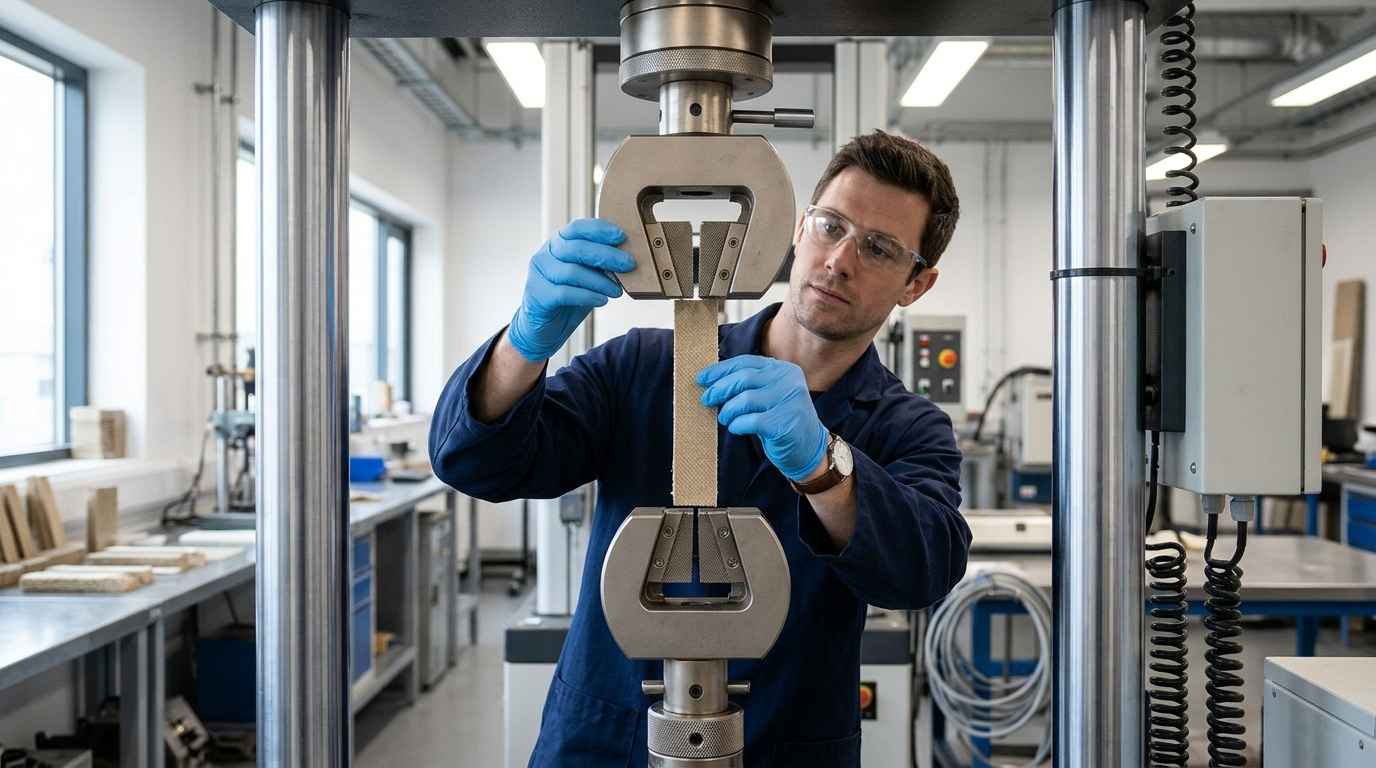
Validating a natural fibre composite means checking that the part meets the same requirements as with the current material, under real conditions of use and after ageing. A test under laboratory conditions with freshly made specimens is not enough, because it is precisely in humidity and over time that natural fibre behaves differently.
Mechanical and ageing tests on natural fibre composites
The basis is the usual composite materials testing, tensile, flexural, impact and fibre content, carried out on specimens cut from real parts when the fibre orientation depends on the process. ISO 527-4 sets the tensile test for isotropic and orthotropic fibre reinforced plastic composites, which is the case for natural fibre mats and fabrics.
Specimens have to come from the same process as the part. A plaque pressed in the laboratory and an injection moulded part in the same material can have different fibre contents and orientations, and therefore different properties. Measuring the actual fibre content in the part is the way to know whether the test result represents what is going to be made.
To that basis is added what natural fibre makes necessary, ageing in humidity and in temperature cycles, emission and odour measurement when the part goes into a cabin, and creep when it carries a sustained load. Characterisation also helps to understand how each component is distributed in the material, as in the characterisation of composite materials to optimise the deposition of microcapsules in the final product.
Demonstrable sustainability, life cycle assessment and end of life
A plant based reinforcement does not make the part sustainable on its own. Cultivation consumes water, fertilisers and energy, the matrix may still be fossil based and a thermoset composite is still hard to recycle. The way to demonstrate the improvement is a comparative life cycle assessment carried out to ISO 14044, with the same boundaries and the same functional unit for the current material and the new one.
The end of life should be decided at the design stage. A natural fibre and polypropylene composite can be shredded and moulded again, although with some loss of properties. One with a biodegradable matrix can be composted under industrial conditions, but that same property can be a durability problem if the part works in humidity. Each option has consequences that the validation has to capture.
When it makes sense to switch to a natural fibre composite
Natural fibre composites make sense when the part is governed by stiffness, works in an environment without permanent humidity or high temperatures, and weight or fossil based content matter in the purchase decision. Under those conditions they allow the product to be made lighter and differentiated with a technology that is already manufactured in series.
They stop making sense when they are chosen for the label without measuring. Water absorption, processing temperature, fibre variability and fire behaviour are the four points that decide whether a material change is an improvement or a source of claims, and all four can be tested before committing a mould.
Gather the part drawing, the current material with its data sheet, the conditions of use with temperature and humidity, and the requirements of your customer or your sector. With that, the candidate fibres and matrices are selected, the test plan including ageing is defined, and you receive a comparison with the current material and a recommendation on whether the change is worth it.
Frequently asked questions about natural fibre composites
Is a natural fibre composite biodegradable?
Only if the matrix is too. A natural fibre composite with polypropylene or epoxy is not biodegradable, even though the reinforcement is. With a matrix such as polylactic acid the whole can be composted, but normally under industrial temperature and humidity conditions and not in the environment. Before claiming it for a product, check what the compostability test says and what each term means, which also applies to bioplastics.
Can a natural fibre composite be injection moulded in an existing mould?
In many cases yes, especially with polypropylene pellets reinforced with natural fibre, but not without adjustments. The injection temperature has to come down so as not to degrade the fibre, the material is dried before processing to remove moisture and the shrinkage differs from that of the glass fibre material, which can shift dimensions. A trial in the existing mould with measurement of the resulting parts tells you whether adjusting the process is enough or the tooling has to be modified.
What factors determine the cost of switching a part to a natural fibre composite?
The cost depends on the price of the material, the process adjustments and the scope of the validation. Natural fibre is usually cheaper than glass, but coupling agents, drying and any flame retardant additives add up. The item that varies most is testing, because humidity ageing, emissions and creep may or may not be mandatory depending on the use of the part and the sector.
What risk do you take if you replace glass fibre without testing?
You risk the part losing stiffness or distorting with humidity, failing a fire or emissions requirement it used to meet, or breaking earlier on impact. These are failures that appear in service, with the product already sold, and that a substitute material validation with the right tests would have detected before changing the material in production.
How long does it take to validate a natural fibre composite for a part?
Typical lead times for the initial characterisation, with mechanical tests and water absorption on the candidate materials, range from one to four weeks depending on the number of candidates and tests. Humidity and temperature ageing add their own duration, set according to the use of the part, and the life cycle assessment is carried out in parallel with supplier data.