
Pre-production run is a short batch made with the final moulds, materials and process to check that the product can be manufactured in series with the expected quality and cost before production is launched.
It is the point at which the product stops depending on parts made in the workshop and starts depending on a process. That is why the earlier work on design for manufacturing is put to the test here for the first time, with parts injection moulded, stamped or machined under the same conditions in which thousands will be made.
Within product development, the pre-production run is the last stage at which a change is still relatively cheap. Once production has started, any correction affects moulds in use, stock already made and customers who have the product in their hands.
DESIGN FOR MANUFACTURING
Does your product work as a prototype but you are not sure it will survive the move to the series process? Take a look at our design for manufacturing

What a pre-production run is and how it differs from a prototype
A pre-production run differs from a prototype in where the parts come from, not in how they look. A prototype is made with workshop techniques, such as 3D printing, machining from solid or silicone casting, and it is used to check function, ergonomics and fits. A pre-production run is made with the series tooling and process, and it is used to check that the function holds when the parts come out of a machine at production rate.
That difference has physical consequences. An injection moulded part has weld lines where the melt fronts meet, uneven shrinkage that distorts it, residual stresses from cooling and, if the polymer is fibre filled, an orientation that changes its stiffness from one area to another. None of that exists in a machined or printed part with the same geometry, which is why a prototype that worked can cause problems in the first series batch.
Pre-production run and functional prototype, two different questions
The functional prototype answers whether the design does what it has to do. The pre-production run answers whether the process can repeat that design thousands of times within tolerance. They are complementary questions, and confusing them is one of the mistakes covered in the analysis of what a functional prototype does and does not validate, where material, process and approval fall outside the scope of the prototype.
There are usually intermediate steps between the two. Bridge moulds, normally in aluminium, produce parts in the final material with a process similar to the series one in weeks rather than months. They help bring tests and approvals forward, but they do not replace the pre-production run, because the thermal behaviour of the mould, the number of cavities and the cycle time are not those of the final tooling.
When the pre-production run takes place in development
The pre-production run is launched when the design is frozen, the series moulds and tooling are made and adjusted, and the suppliers of bought-in components have delivered parts from their own process. It is the hinge between development and product manufacturing, and running it earlier, with the design still changing, turns it into another, more expensive round of prototypes.
In regulated sectors or with an industrial customer, the pre-production run also coincides with the delivery of initial samples. In automotive, that package is formalised in the production part approval process (PPAP), which requires parts made with the real tooling, process, operators and production rate, not samples prepared for the occasion. Outside automotive the formal requirement is lighter, but the principle is the same, whatever is validated has to come off the line exactly as it will later.
A pre-production run does not validate the design, it validates the ability of the process to repeat it. That is why it only counts if the parts come off the series tooling, with the operators and at the rate of real production.
What a pre-production run validates before mass production
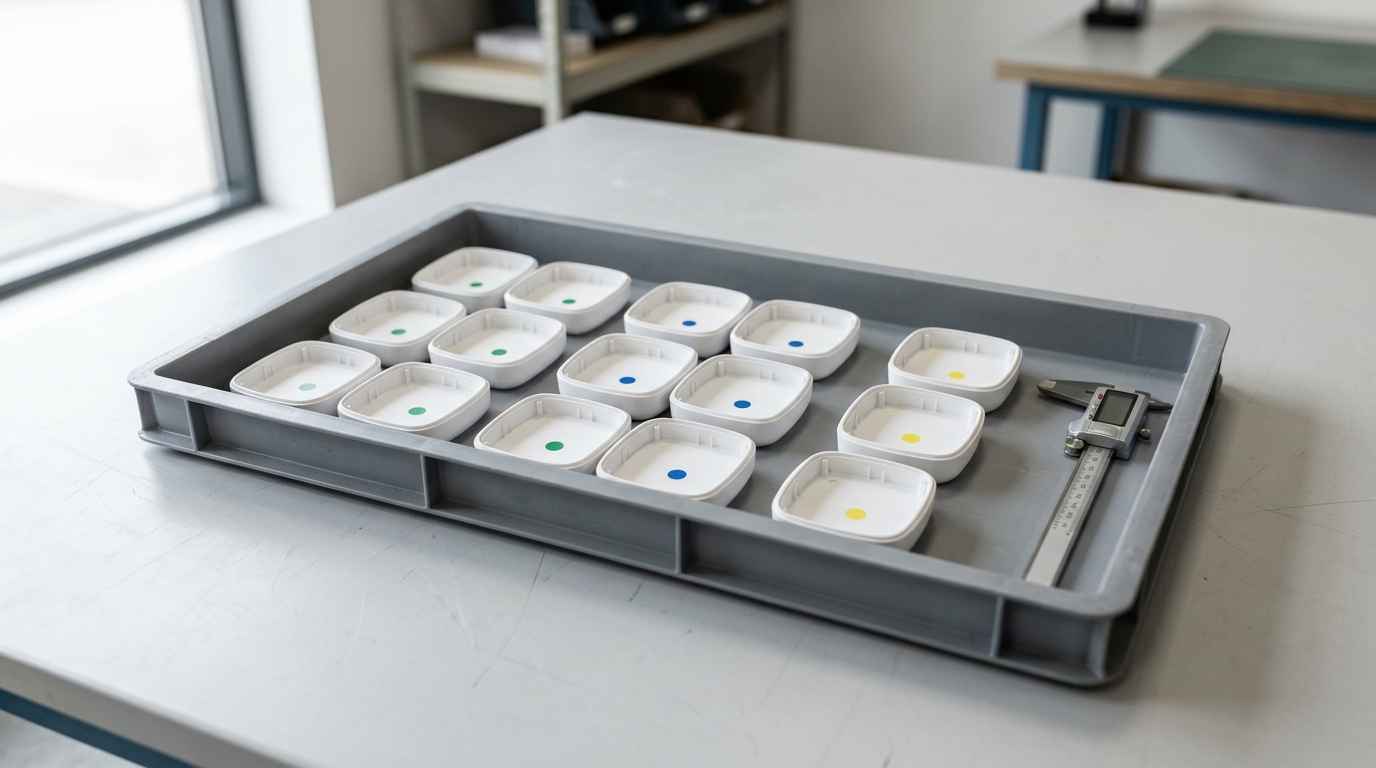
A pre-production run validates four things that no prototype can demonstrate, the ability of the process to hold the dimensions, the behaviour of series parts in assembly, the response of the supply chain and the compliance of the manufactured product with the tests its market requires.
Process capability and tolerances in the pre-production run
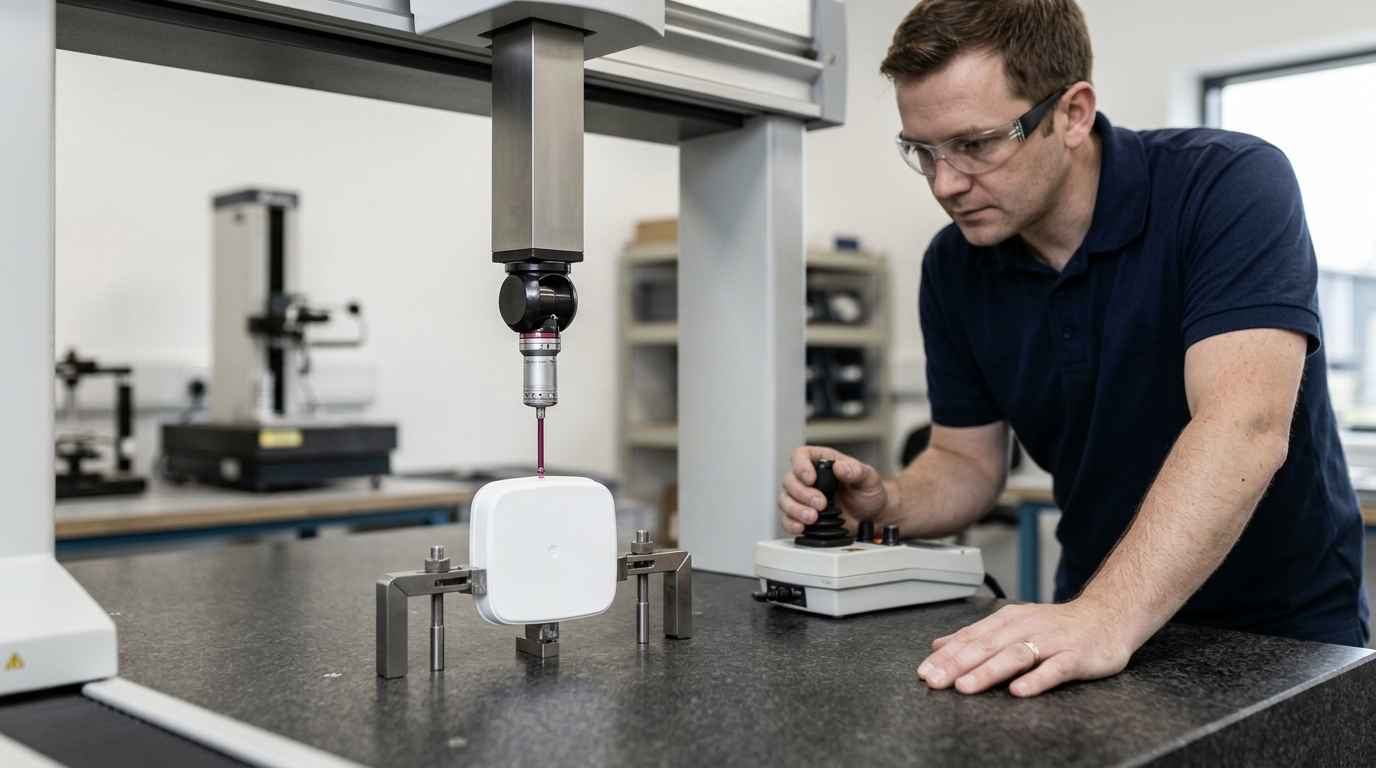
Process capability measures whether the natural spread of manufacturing fits within the drawing tolerance. It is calculated on consecutive parts from the pre-production run, per cavity when the mould has several, and expressed with the Cp and Cpk indices, which compare the width of the tolerance with the real variation and with how well centred the process is.
Before that study, a full first article inspection is worthwhile, with every drawing dimension measured on one unit from each cavity. It detects errors in the mould itself, such as a dimension the tooling has set wrongly, before time is spent studying the variation of a part that is off target from the start.
The figure cannot be obtained from five parts. In automotive, the PPAP manual requires an initial study with at least 100 readings in 25 subgroups and considers a Ppk above 1.67 acceptable. Outside that sector the criteria are set by the customer or by the quality plan itself, but the logic does not change, with few parts there is no way to tell a stable process from one that has been lucky.
The pre-production run is also the moment to measure what the drawing does not say. The flatness of a large lid, the warpage of a housing with uneven walls, flash at the parting line or sink marks on a visible face depend on the process, and the prototype, made with a different technique, could not show them.
Assembly, tooling and suppliers in the pre-production run
Accumulated tolerances show up in assembly. Each part can be within its dimension and the assembly still not close, because the deviations add up in the wrong direction. The pre-production run makes it possible to assemble dozens of units with series parts mixed at random and check whether fits, clips and screwed joints work with the real variation and not with the ideal part.
It also tests the assembly fixtures, the in-line checks and the times. A fixture that locates badly, a tightening torque that cannot be reached with the planned tool or a sequence that forces the operator to turn the assembly over three times only appear when assembling at rate. That kind of adjustment is part of accompaniment during production, which is where these issues are corrected before they turn into rejects.
Finally, the pre-production run is the first time all suppliers deliver at once and from their own process. A bought-in component that arrives with a dimension different from its samples, or with packaging that damages it in transit, is detected here with time to react, and not in launch week.
TELL US ABOUT YOUR CASE
Are your series moulds finished and your launch date committed? Send us the drawings with the critical dimensions and the status of the tooling and we will propose how to size the pre-production run
How to plan a pre-production run that supports a decision
A useful pre-production run is planned like a test, with a specific question, a batch size large enough to answer it and an acceptance criterion written before the first part is made. Without those three elements, the result is interpreted afterwards and almost always in favour of launching.
Pre-production run size and acceptance criteria
The size of the pre-production run is set by the most demanding question it has to answer. If a capability study is needed, the batch cannot fall below the readings that study requires. If samples also have to go to several customers, destructive tests have to be run and units reserved for a field trial, each destination adds its own quantity. That is why the pre-production run of a household appliance can be a few dozen units and that of an injection moulded component, thousands.
Acceptance criteria are written per variable and not as a block. Which critical dimensions have to reach which capability, what assembly reject rate is allowed, what cycle time counts as achieved and which product tests have to be passed on series parts. With that list, the decision to launch stops being an opinion.
| What is validated | How it is measured in the run | What it decides | What puts it at risk |
|---|---|---|---|
| Process capability | Capability study on consecutive parts, per cavity | Whether the process holds the critical dimensions | Batch too short or hand-picked parts |
| Assembly | Assembly at rate with mixed series parts | Whether accumulated tolerances close | Assembling only with the best parts |
| Cycle time | Recording of machine and station cycles | Real unit cost and line capacity | Measuring with a cold mould or without stoppages |
| Supply chain | Receipt of components from every supplier | Whether bought-in components arrive compliant | Supplier samples prepared by hand |
| Product compliance | Tests and approval on series units | Whether the manufactured product meets its claims | Testing prototypes instead of series parts |
Pre-production run test plan and data recording
The product tests that accompany the pre-production run have to be carried out on series units. An approval, an electromagnetic compatibility test or a packaging drop test passed with prototypes guarantees nothing, because the material, joints and tolerances of the real product are different. The pre-production run is what provides the representative samples those tests need.
Just as important is recording the parameters each batch was made with, temperatures, pressures, times and material lots. If a part causes problems later, that record shows whether the defect comes from a process window that is too narrow or from a one-off variation, and lets the working window be set with data and not with the settings that worked one afternoon.
A pre-production run without acceptance criteria written in advance validates nothing, it just produces parts. What turns it into a test is deciding before manufacturing which result forces a correction and which one allows the launch.
What happens when the pre-production run is cut short or skipped
Skipping the pre-production run, or reducing it to a handful of parts for the photo, moves its findings into production, which is the most expensive place to find them. Process defects do not disappear because nobody looks for them, they appear in the first week of manufacturing, when there is already stock, committed orders and moulds on which any change takes weeks.
The cost of correcting after the pre-production run
Modifying an injection mould to correct a dimension, remove a sink mark or move a gate is workshop work that can take weeks, and every modification means measuring again. If the change is found in the pre-production run, the schedule absorbs it. If it is found with production under way, the stoppage, the stock that has to be reinspected or scrapped and the product already on the market are added on top.
Redesigns aimed at better manufacturability show how much the design determines the series cost, as in the redesign of a product to reduce costs and take it to industrialisation or the redesign of plastic components for their manufacture and industrialisation. In both cases the adjustment was made before production, which is exactly the margin the pre-production run exists to protect.
A process defect found in the pre-production run costs a mould adjustment and a new measurement. The same defect found in production also costs the stoppage, the affected stock and the confidence of the customer who has already received the product.
Common mistakes when setting up a pre-production run
The most frequent mistake is treating the pre-production run as a commercial delivery and not as a test. It is made in a hurry to have units to show, the best ones are picked and the ones that fail are set aside without analysing why. The result is a set of flawless samples and a process nobody knows anything about.
The second is launching it with the process not yet frozen, changing machine parameters part by part until they come out right. That proves the machine can make a good part, not that it always does. The third is not involving whoever is going to produce. A pre-production run made with care by the development team, instead of by the operators at line rate, measures a capability the factory will not have.
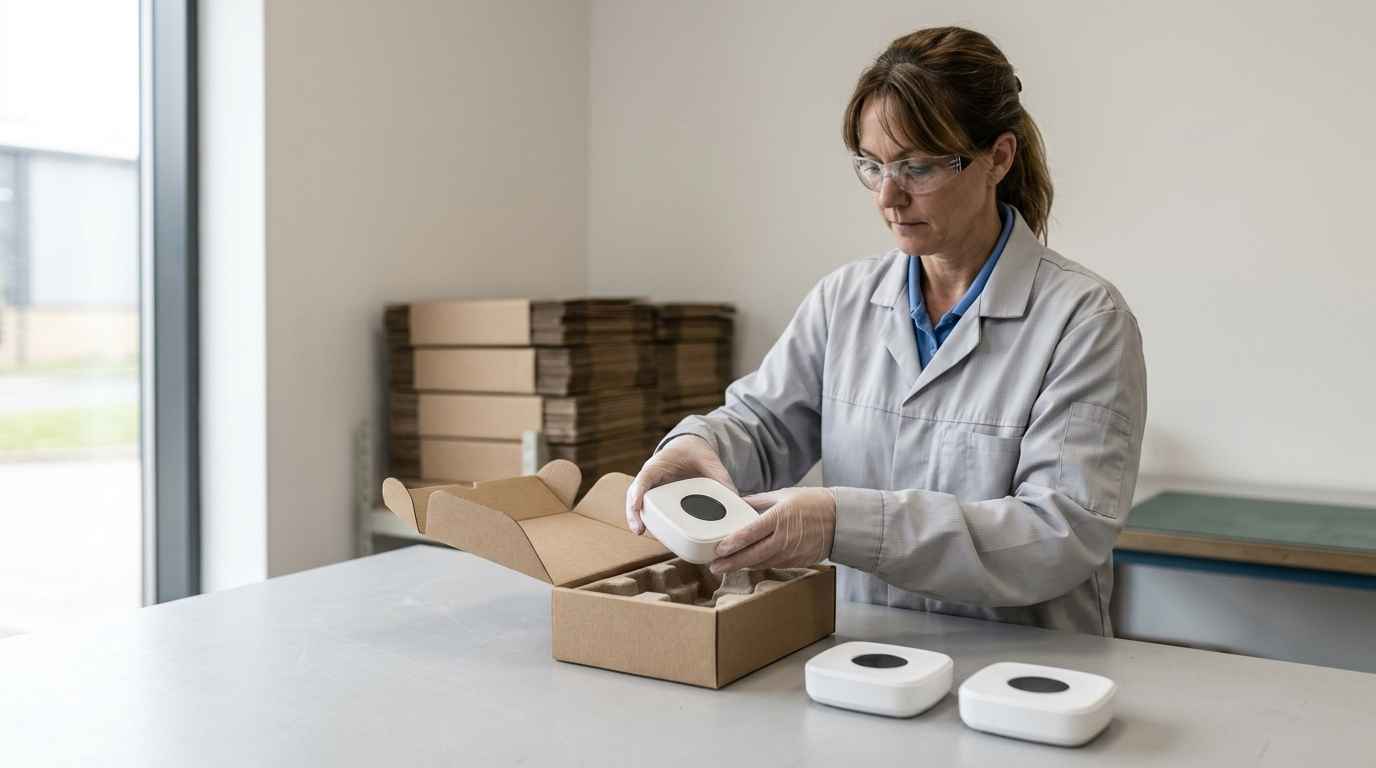
The fourth is leaving out packaging and logistics. A product that comes off the line perfect can arrive with marks, loose parts or crushed boxes if nobody has tested the packaging with series units and real transport. It is a cheap test that the pre-production run allows you to carry out with genuine product.
From the pre-production run to the decision to launch the series
A well executed pre-production run closes development with data. You know whether the process holds the critical dimensions with margin, whether the assembly goes together at rate with real parts, whether suppliers deliver compliant parts and whether the manufactured product passes the tests its market requires. With that information, the decision to launch is taken on measurements and not on confidence in the prototype.
What most affects its value happens before manufacturing, a clear question for each variable, a batch sized to answer it, written acceptance criteria and the commitment to analyse every reject instead of setting it aside. With that, the pre-production run stops being a formality before launch and becomes the last cheap opportunity to correct.
Gather the drawings with the critical dimensions, the status of the moulds and tooling, the list of suppliers and the launch date you have committed to. With that material the size of the pre-production run, the measurement and test plan and the acceptance criteria are defined, and you receive a pre-production plan with what has to be measured, how much and which result allows the launch.
Frequently asked questions about the pre-production run
What can a pre-production run not demonstrate?
A pre-production run does not demonstrate the long term durability of the product or how it behaves after years of use. It produces representative units and allows them to be tested, but when the risk lies in ageing, fatigue or wear, accelerated life tests or an extended field trial are still needed. Nor does it guarantee that the process will stay stable over time, which is what statistical process control monitors once production has started.
How many units should a pre-production run have?
There is no single figure, the size is set by the most demanding question it has to answer. A capability study needs enough consecutive parts for the index to be reliable, and to that are added the units for destructive tests, approval, customer samples and field trials. For low volume assembled products a few dozen units may be enough, while for high volume components the pre-production run is usually a full production run of several hours.
What factors determine the cost of a pre-production run?
The cost depends on the status of the tooling, the batch size and the scope of measurements and tests. If the series moulds and fixtures are finished, the main cost is machine time, material and measurement. It rises when the run reveals the need for specific tooling design for the series, when the plan includes approval tests on series units or when every part requires full three dimensional measurement instead of an attribute check.
What risk do you take if you launch production without a pre-production run?
You risk discovering in production the problems the pre-production run would have shown with time to spare. A dimension out of capability, a bought-in component that does not fit or a cycle time longer than planned turn into stoppages, stock that has to be reinspected and late deliveries. You also lose the chance to see each supplier deliver from their own process, which is the aim of supplier prospecting and validation before an external component conditions the launch.
How long does it take to prepare and analyse a pre-production run?
Typical lead times range from one to four weeks to plan the pre-production run, carry out the measurements and analyse the results, depending on the complexity of the product and the number of components. Manufacturing time is added to that, and it depends on the availability of the line and the moulds. If the results require a tooling modification, the time for the correction and the new measurement is added before the series is considered validated.