
Chemical substitution in a product consists of removing a component from its formulation or its process, such as a plasticiser, a flame retardant or a solvent, and replacing it with another that fulfils its function without degrading performance.
The reasons change from one case to another, a restriction on use, a supplier that stops making it, a customer that excludes it from its specifications or a cost that soars. The technical work is the same in all of them, and that is why it fits within process improvement, because the new substance almost always forces you to adjust the way you manufacture as well.
Within technological innovation, it is one of the most underestimated changes. On paper one ingredient is swapped for another, but in practice a substance rarely does only one thing, and whatever was not identified at the start appears later as a product defect.
PROCESS IMPROVEMENT
Do you have to remove a substance from your product or your process without losing performance? Take a look at our process improvement consulting

What chemical substitution in a product means
Substituting a substance is a change within the material, not a change of material. When a part moves from metal to polymer, the whole material changes and the part is redesigned. When a flexible PVC changes plasticiser, the material is still PVC, but its behaviour depends on a component that can account for a significant share of its weight and that interacts with all the others.
The substances that get substituted sit in two places. Some are part of the product, such as the additives in a plastic, the pigments in a coating or the preservatives in a formulation. Others only take part in its manufacture, such as cleaning solvents, the baths of a surface treatment or forming lubricants, and although they do not remain in the final product they determine its quality.
The real function of the substance to be replaced
The first step is to describe everything the substance does, not just its nominal function. A plasticiser gives flexibility, but it also lowers viscosity in extrusion and sets how the material behaves in the cold. A preservative protects against microorganisms, but it also affects the pH or the odour of a water-based formulation. Each secondary function is a property that the new substance has to maintain or that will have to be recovered by other means.
If the substance arrives inside a purchased component, sometimes you do not even know how much there is or which other additives it coexists with. In that case the starting point is an analysis of unknown substances in the current product, which identifies the substance, its approximate concentration and the other components it may be acting together with.
Why a drop-in substitute rarely works
A drop-in substitute, which goes in at the same proportion and changes nothing else, is the exception. Many substances work in pairs, such as halogenated flame retardants with the antimony trioxide that boosts their effect, and when one is removed the other loses its purpose. Others require very different doses, such as halogen-free metal hydroxide flame retardants, which need much higher loadings and change the stiffness and density of the compound.
Added to this are the effects that do not show up in the supplier’s data sheet. The new substance may migrate to the surface over time, react with a stabiliser, change colour after processing or give off an odour that did not exist before. None of these effects appears in a quick test, and all of them end in a complaint if nobody looks for them.
A substance almost never does just one thing in a product. Chemical substitution without first listing all its functions, including the secondary ones, is the surest way to discover them later, when they are missing.
How alternatives are chosen without losing performance
Choosing the alternative is a process of elimination, not a search for the perfect substitute. You start from measurable requirements, gather all the reasonable options and eliminate them with increasingly demanding tests until you are left with one or two worth taking into production.
Requirements the substitute substance has to meet
Requirements are written as values, not adjectives. What hardness, what flexibility at low temperature, what fire rating, what shelf life or what adhesion the product has to achieve with the new substance, and with what margin compared with the current one. The process window, the acceptable cost per unit and the security of supply are added to that list.
The suppliers’ starting information helps, but it has limits. The data sheet of an alternative describes its behaviour in a typical formulation, not in yours, and the declared composition does not always detail impurities or processing aids. It is worth asking for samples from more than one batch and treating catalogue data as hypotheses that the screening has to confirm.
There is one requirement that is often forgotten, that the alternative must not have the same problems as the original substance. Replacing a substance with another that is chemically very similar can reproduce the reason for the substitution a few years later, which is known as regrettable substitution. Bisphenol A being replaced by bisphenol S in some plastics is often cited as an example.
Laboratory screening of alternatives
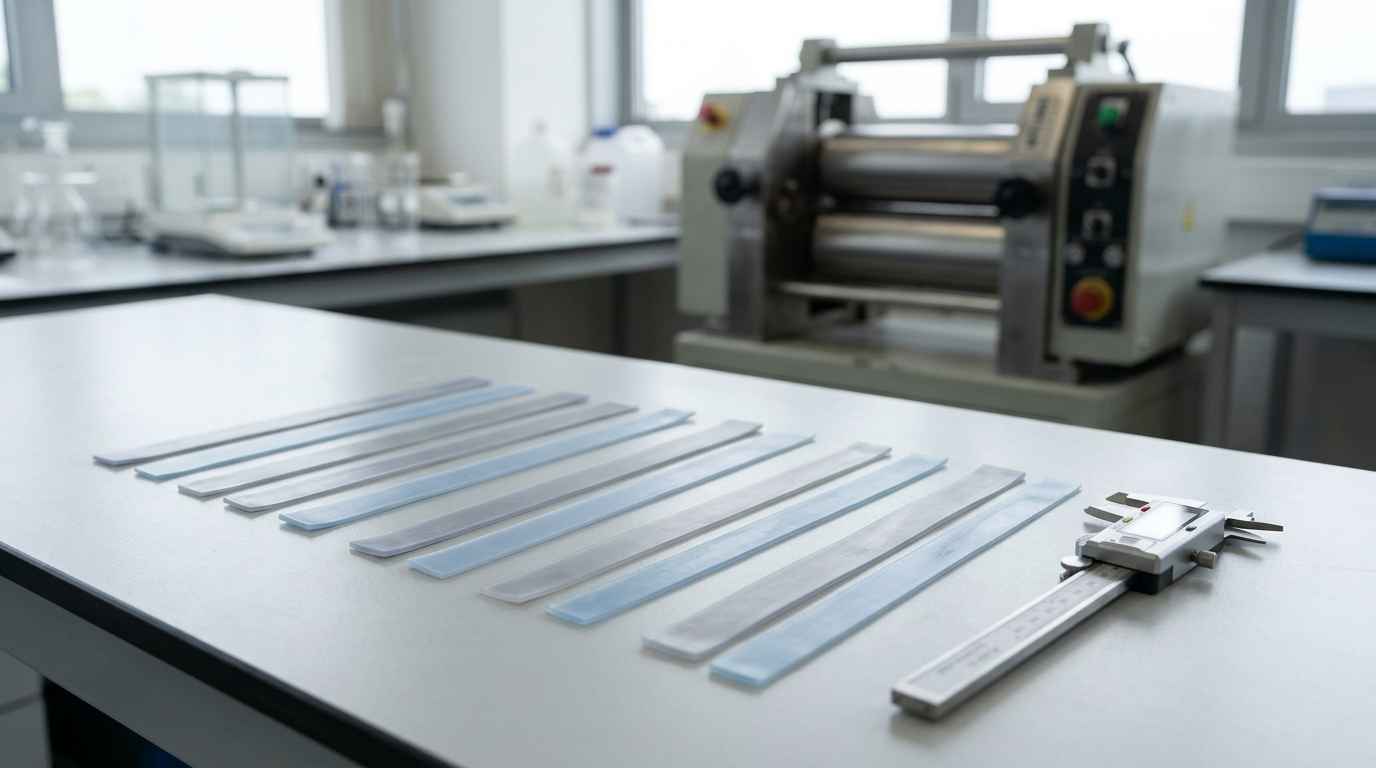
Screening reduces a long list of candidates to two or three with quick, inexpensive tests. Small-scale formulations are prepared with each alternative, at several concentrations, and the most discriminating properties are measured, usually the ones that depended on the main function of the substance being removed.
When several variables are in play at once, such as the concentration of the alternative, a supporting additive and a process temperature, a design of experiments saves a lot of formulations. Instead of moving one variable at a time, it combines the levels in a planned way and shows which factor weighs most and whether two of them interact.
At this stage it is always worth including a reference formulation with the original substance, prepared and tested at the same time as the others. Comparing against a catalogue figure or a test from years ago mixes the effect of the substitution with that of any other difference between batches, equipment or operators, and the result can no longer be interpreted.
Screening also rules out early what cannot be manufactured. An alternative that gives good properties but requires a process temperature the equipment cannot reach, or a curing time that doubles the cycle, leaves the list before money is spent on long tests.
TELL US ABOUT YOUR CASE
Do you need to change a component of your formulation and do not know which alternative will hold up? Send us the product data sheet, the substance you want to remove and the properties you cannot lose and we will propose a substitution plan
What has to be tested when you change a substance
What has to be tested when you change a substance is the properties that depended on it, the behaviour of the product throughout its life and the response of the manufacturing process. All three change at once, and a plan that looks at only one of them approves substitutions that fail in the other two.
Product performance with the new substance
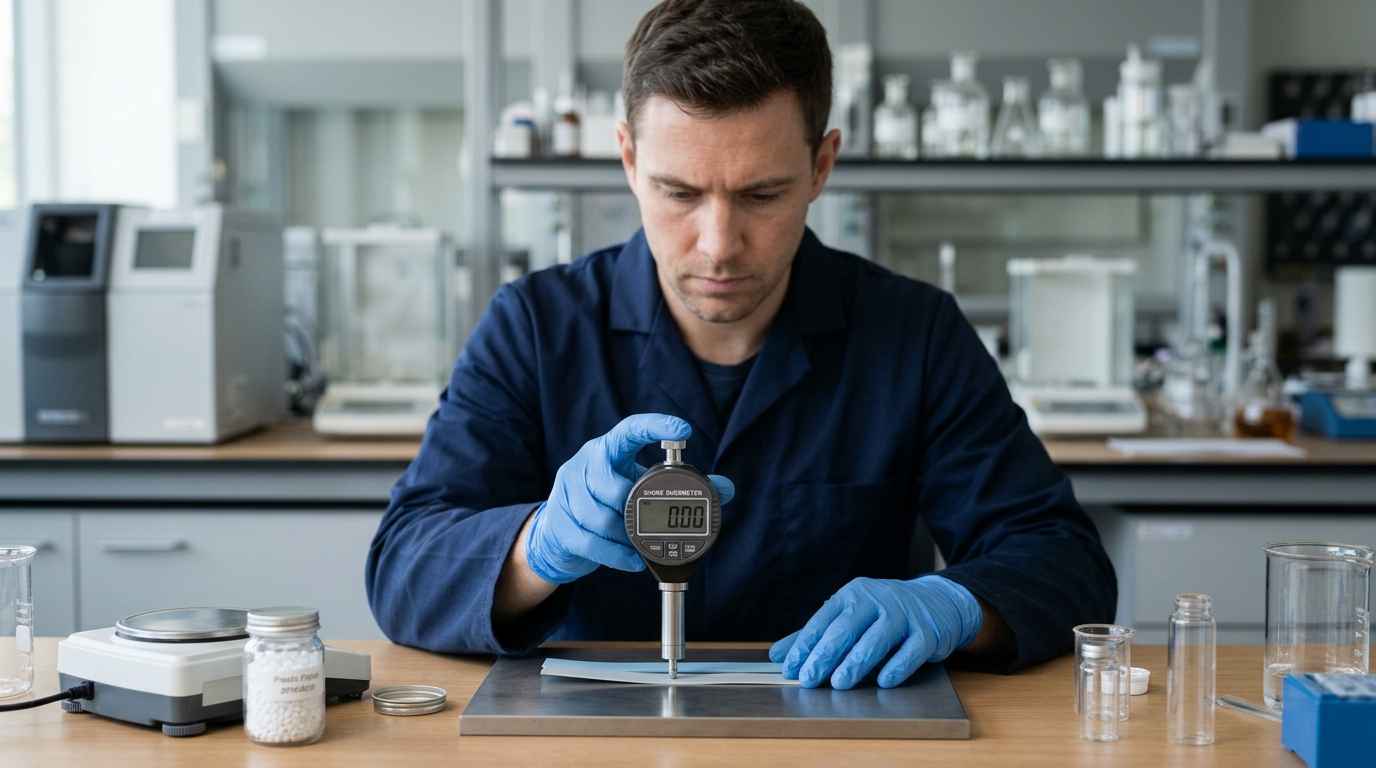
Performance is compared against the reference with the same tests and under the same conditions. The logic is the same as in validating a substitute material with the tests that confirm equivalence, with one difference, here the change is smaller and so its effects can be subtle, which means the tests have to be able to detect small differences.
Detecting small differences requires repetition. Each test is carried out on several specimens and, if possible, on more than one batch of the new formulation and of the reference, to separate the effect of the substance from the normal scatter of the process. A difference that fits within that scatter is not a difference, and one that repeats across all batches is.
| Function of the substance | Substitution example | What may change | Test that checks it |
|---|---|---|---|
| Plasticiser | Phthalates replaced by terephthalates in flexible PVC | Low temperature flexibility and migration | Hardness, low temperature bending and exudation |
| Flame retardant | Halogenated replaced by metal hydroxide | Fire behaviour and stiffness | Flammability and mechanical tests |
| Heat stabiliser | Lead replaced by calcium-zinc in PVC | Processing stability and colour | Thermal stability and colour after ageing |
| Metal passivation | Hexavalent chromium replaced by trivalent | Corrosion resistance | Salt spray and finish adhesion |
| Cleaning solvent | Chlorinated replaced by modified alcohol or water-based | Cleaning, drying and residue | Surface residue and subsequent adhesion |
| Preservative | Change of biocide in a water-based formulation | Shelf life and antimicrobial efficacy | Antimicrobial efficacy and ageing |
Compatibility with the manufacturing process
A new substance changes the viscosity, the melting temperature, the curing rate or the drying time, and with them the process window. A formulation that works in the laboratory can produce parts with sink marks, bubbles or poor adhesion on the line, simply because the machine is still set up for the previous substance. That is why validation ends with a production trial and not with specimens.
The move from laboratory to line is made in stages. First a laboratory-scale formulation, then a pilot batch that reproduces the mixing and processing conditions, and finally a run on the real line with the process parameters recorded. Each stage may require the dose or the window to be adjusted, and skipping one usually costs more than doing it.
Sometimes the substitution affects a process parameter that nobody associated with it. In the study of the influence of materials on the conductivity of a coolant, the aim was to check whether replacing a material with another of lower environmental impact altered the conductivity of the coolant, a key parameter that could cause production failures.
A substitution is not validated until it has gone through the production line. The laboratory tells you whether the substitute substance can work, the production trial tells you whether it works with the real machines, cycle times and operators.
How to prove that the substitution is complete
A substitution is complete when the old substance has disappeared from the product, the new one maintains performance throughout the service life and everything is documented for customers and suppliers. Each of the three conditions is demonstrated with different tests.
Checking that the original substance is no longer there
The removed substance may keep appearing in the final product through routes that have nothing to do with the formulation, residues in hoppers, tanks or mixers, raw materials from a supplier that still uses it or a purchased component that contains it without declaring it. It is checked by analysing the manufactured product, not the recipe.
Supplier declarations are the first filter, not the proof. A certificate stating that a substance is absent is valid for the batch it refers to and for the method used to measure it, so it is worth checking it against your own sampling analyses, especially in the first batches after the change and whenever a supplier changes.
The technique depends on the substance. For organic compounds such as plasticisers or solvents, a gas chromatograph coupled with mass spectrometry detects traces and identifies them, and for metals such as lead or chromium X-ray fluorescence or atomic spectrometry is used. What matters is to set in advance the detection limit that is considered acceptable.
Ageing tests and trials under real conditions
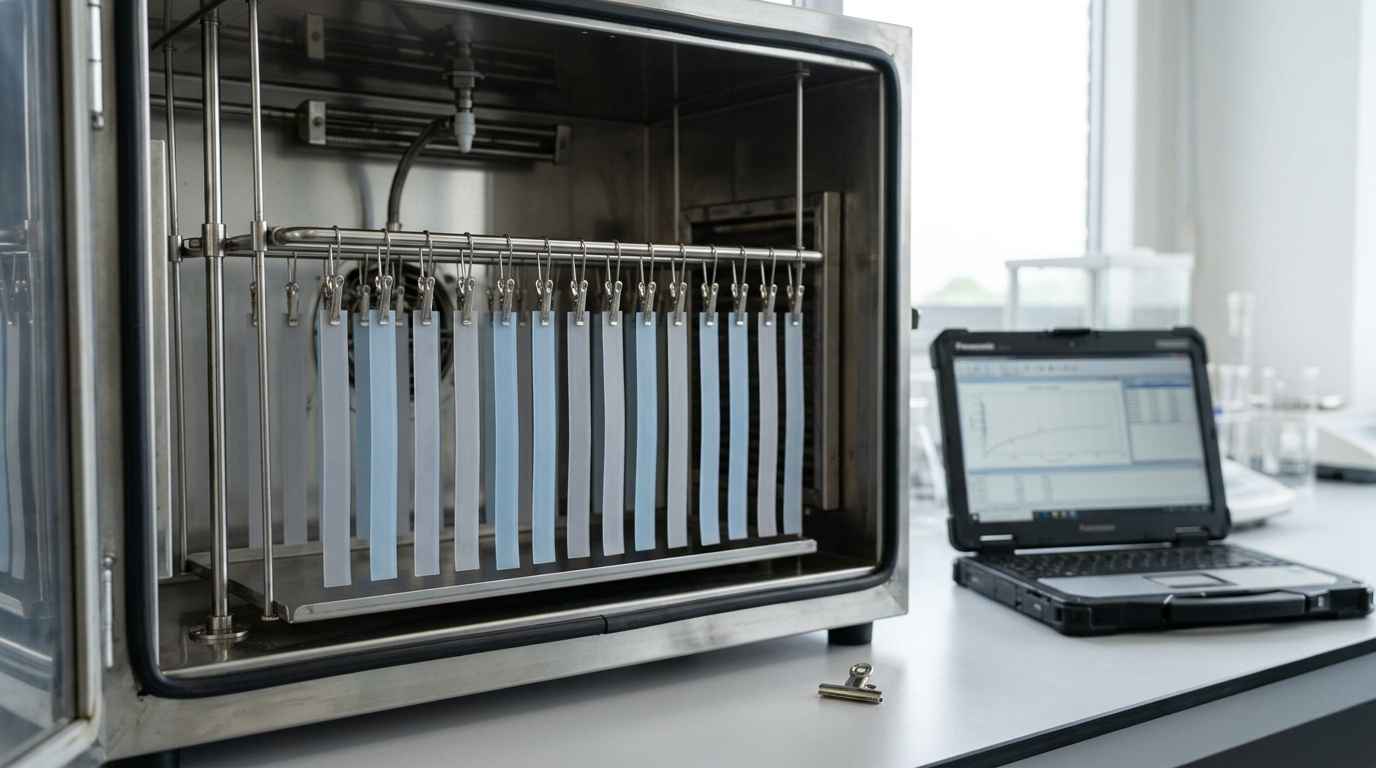
Many consequences of a substitution take time to appear, such as plasticiser migration, loss of efficacy of a preservative or yellowing of a part exposed to light. Accelerated ageing tests compress that time and allow the new formulation to be compared with the reference before the product reaches the customer.
Ageing conditions are chosen according to how the product is used. An outdoor part is exposed to ultraviolet radiation and humidity cycles, an under-bonnet component to sustained temperature and a seal in contact with oils or detergents to immersion in those fluids. Ageing that does not reproduce real use compares formulations, but it does not tell you which one will last.
One example is the accelerated testing and approval of materials to ensure their antimicrobial activity in demanding environments, where accelerated ageing made it possible to verify that the property was maintained over time and to identify possible formulation adjustments before the material was introduced.
Documenting the substitution for customers and suppliers
The substitution is closed by updating the product specification, the supplier data sheets and the documentation customers receive. It is worth keeping the comparative results against the reference, because they are the proof that the change was made with sound judgement if a customer asks years later why a property changed.
Removing a substance from the recipe is not the same as removing it from the product. Only the analysis of the manufactured product, with a detection limit set in advance, proves that the original substance has really disappeared.
Substituting with tests and not with data sheets
Chemical substitution in a product without losing performance depends on three things, listing all the functions of the substance before choosing the alternative, testing the product and the process against a reference prepared at the same time, and checking in the manufactured product that the original substance is no longer there. Supplier data sheets are useful for drawing up the list of candidates, not for deciding.
The effort is concentrated at the beginning. A well-made inventory of functions and requirements written as values save rounds of testing and avoid choosing an alternative that passes in the laboratory and fails on the line or after two years of use.
If you have to remove a substance from a product or a process, gather the product data sheet, the formulation if you know it, the reason for the change and the properties you cannot lose. With that, the alternatives worth evaluating, the tests that discriminate between them and how the change is validated in production are defined, and you receive a substitution plan with the acceptance criteria for each step.
Frequently asked questions about chemical substitution in a product
Is there a drop-in substitute for every substance?
No, a drop-in substitute that goes in at the same proportion without changing anything else is the exception. Usually the alternative requires another dose, another supporting additive or a process adjustment. When the change affects the whole material and not a component, the approach is closer to material substitution, with a redesign of the part.
How is chemical substitution in a product validated?
It is validated by comparing the product with the new substance against a reference with the original one, prepared and tested at the same time, in the properties that depended on it, in accelerated ageing and in a production trial. For reliable chemical substitution in a product you also need an analysis of the manufactured product, which confirms that the removed substance has disappeared.
What factors determine the cost of substituting a substance?
The cost is determined by the number of alternatives that have to be screened, the length of the ageing tests the product requires and the need for production trials. A substitution in a simple product with a known substitute costs much less than one that requires reformulation. If the change also affects the design, it moves into the area of product improvement.
What risk do you take if you change a substance without testing the product?
You risk the defect appearing at the customer and not in the laboratory. A loss of flexibility in the cold, migration of the additive, a change of colour or a drop in the efficacy of a preservative can take months to show. Added to this is the risk of the original substance still being present through contamination of equipment or raw materials.
How long does it take to substitute a substance in a product?
The study, screening and test plan phase usually takes between one and four weeks, depending on the complexity of the product and the number of alternatives. On top of that come the ageing tests and the production trial, whose duration depends on the service life that has to be demonstrated and on the availability of the production line.