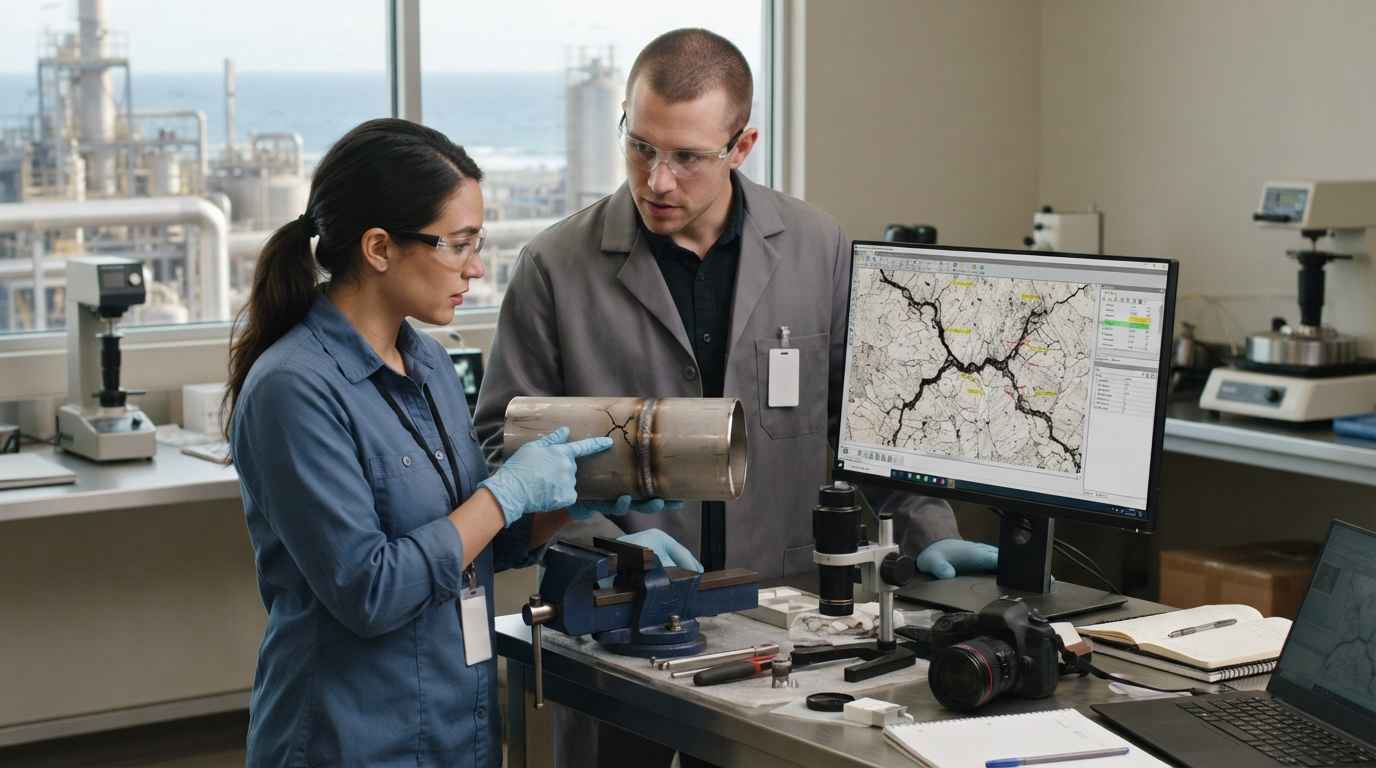

Stress corrosion cracking is a failure mechanism that appears when a susceptible material bears a mechanical stress and an aggressive environment at the same time, and which causes cracks to start and grow until fracture with barely any visible loss of material. It is one of the most dangerous failures in aggressive environments because it advances in silence and is usually discovered once the part has already broken.
Unlike general corrosion, which is visible and can be measured through thickness loss, stress corrosion cracking leaves the surface almost intact while the crack progresses inside. That is why a routine visual inspection rarely detects it in time, and when the failure comes it is sudden. Understanding why it happened is the task of forensic engineering, which reconstructs the combination of stress, environment and material that led to the fracture.
Anticipating this failure starts with a good initial fault diagnosis, which identifies whether the cause is stress corrosion cracking and not another similar mechanism. Confusing it with fatigue or general corrosion leads to solutions that do not fix the problem and to the failure repeating.
INITIAL FAULT DIAGNOSIS
Do you suspect a part has failed by stress corrosion cracking? Discover our initial fault diagnosis service

What stress corrosion cracking is
Stress corrosion cracking is the cracking of a material caused by the combined action of a sustained tensile stress and a specific corrosive environment, in a material sensitive to that pair. None of the three factors alone would cause the failure: it is their coincidence that opens and propagates the crack, often at stresses well below the material’s design limit.
Stress corrosion cracking needs neither an extreme stress nor a very aggressive medium: it only needs a susceptible material, a sustained stress and a specific environment to coincide long enough for the crack to start and grow.
How stress corrosion cracking acts
The mechanism starts at a point where the material’s protective layer breaks locally, for example due to chlorides in a stainless steel. A micro-crack is born there and, under the tensile stress, concentrates stress at its tip and keeps advancing while the medium keeps the attack active. The result is a crack that progresses steadily over weeks or months and ends in a sudden fracture when the remaining section can no longer hold.
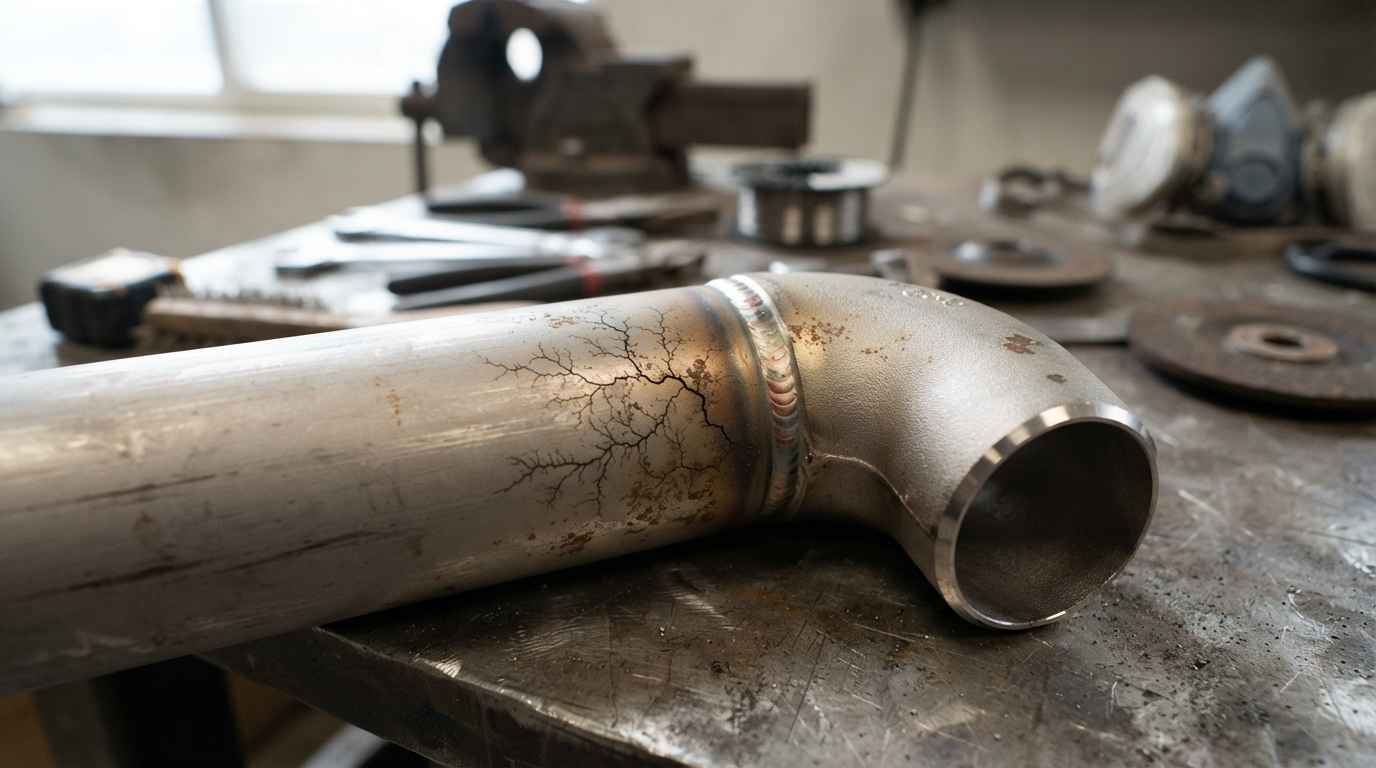
The cracks can be intergranular, following the grain boundaries, or transgranular, crossing them, and that detail is a valuable clue to the cause. Their branched appearance, with hardly any plastic deformation around them, is a characteristic signature that failure analysis uses to tell stress corrosion cracking apart from other mechanisms.
The time factor is part of the problem. The crack can take weeks, months or even years to reach the critical size, so a component can be damaged for a long time with nothing giving it away. That long incubation explains why the failure sometimes appears well after a change of process, material or supplier, when it is already hard to link the cause to its origin.
In practice, how fast stress corrosion cracking advances depends on how aggressive the medium is and how much stress the part bears: the higher the chloride concentration or the temperature, the sooner it starts and the faster the crack grows. That is why two identical components can behave very differently depending on where in the installation they work, something worth keeping in mind when deciding where to inspect first.
Why it is a silent failure
Stress corrosion cracking is a silent failure because the part keeps its appearance, its dimensions and its function until the moment of fracture. It does not leak, does not deform and does not lose material appreciably, so neither the operator nor a routine visual inspection notices that the crack is growing inside. That hidden nature is exactly what makes it so expensive: the failure comes with no warning and, often, at the worst moment.
On top of this, it usually affects components that are assumed to be reliable, such as pipes, tanks or structural stainless-steel elements, precisely those chosen for their corrosion resistance. Trusting that a stainless material does not fail by corrosion is one of the most common mistakes, because stress corrosion cracking attacks exactly those steels in the presence of chlorides and stress.
The most exposed sectors are those that combine aggressive media with components under load for years: chemical and petrochemical, water treatment, energy, food industry with chlorinated cleaning and any installation in a marine environment. In all of them, a single affected component (a pipe, a flange, a bolt) can compromise a whole line, which turns stress corrosion cracking into a business risk and not just a technical one.
This progressive nature also makes it harder to attribute the failure to a specific cause: by the time the part breaks, months may have passed since the change that triggered the mechanism, so the service history is as important as the fracture itself to reconstruct what happened. Keeping records of temperatures, cleaning cycles and modifications helps a lot when it is time to investigate a case of stress corrosion cracking.
When and where stress corrosion cracking appears
Stress corrosion cracking does not appear anywhere: it needs a specific combination of conditions that, when they occur, make it almost inevitable. Recognising those conditions is the first step to knowing whether a component is at risk and deserves a specific inspection or test.
The three factors that must coincide
For stress corrosion cracking to occur, three factors must coincide: a susceptible material, a sustained tensile stress (from service or residual from manufacturing) and a corrosive environment specific to that material. If any of the three is missing, the failure does not happen, and that is also the key to prevention: removing or reducing just one of them is enough to cut the mechanism.
The stress does not have to come from the service load. It is often a residual stress introduced in forming, machining or, above all, welding, which leaves the affected zone especially exposed. That is why stress corrosion cracking fractures frequently appear next to weld beads or in heavily cold-worked areas, even though the part appears to work unloaded.
Assembly adds its own share of stress. Excessive tightening, a forced fit or a press-fitted part introduce permanent tensile stresses that add to those of service. These stresses do not appear on the drawings or in the load calculations, and are therefore easily overlooked, until the crack reveals them right at the tightest point.
Materials and environments at risk
The best-known case is that of austenitic stainless steels in contact with chlorides, a common combination in marine settings, chemical plants or hot-water circuits. Material choice is decisive, as shown by the selection of an austenitic stainless steel alloy resistant to corrosion, where getting the alloy right avoids the problem at source. Other critical pairs are brasses with ammonia or high-strength steels with hydrogen.
The environment matters as much as the material: temperature, chloride concentration and the presence of stagnation or evaporation zones multiply the risk. Designing with that environment in mind, as explained in design for a corrosive environment, reduces the chance that stress corrosion cracking finds the conditions it needs.
It is worth remembering that susceptibility is not a fixed property of the material, but of the material-medium pair at a given temperature. A steel that behaves well in fresh water can crack by stress corrosion cracking as soon as chlorides and a few extra degrees appear, as happens in cooling circuits or heat exchangers. Mapping which components combine a susceptible material, stress and an aggressive medium is the quickest way to prioritise where to act.
TELL US ABOUT YOUR CASE
Do you have an unexpected fracture in an aggressive environment? Send us the part and its conditions and we will propose a root cause diagnosis
How stress corrosion cracking is diagnosed
Diagnosing stress corrosion cracking means confirming that the fracture is due to that mechanism and not another, and identifying which of the three factors was decisive. That diagnosis is what allows the real cause to be corrected instead of applying a patch that leaves the problem latent.
Signs and failure analysis
The analysis starts from observing the fracture: branched cracks, an origin at the surface exposed to the medium and the absence of plastic deformation point to stress corrosion cracking. Electron-microscope fractography confirms whether the fracture is intergranular or transgranular, and the analysis of the material and the medium closes the diagnosis. An illustrative case is the corrosion in chemical reactors assessed through materials testing, where reconstructing the real conditions was key to identifying the mechanism.
Telling stress corrosion cracking apart from fatigue or general corrosion is essential, because all three show up as cracks but demand different solutions. A rigorous diagnosis crosses the evidence from the part with the service conditions, and avoids the trap of assuming the most obvious cause without checking it.
When the part is still in service and cannot be removed, non-destructive techniques help to bound the damage: dye penetrants reveal cracks that surface, while ultrasonics or eddy currents detect cracks that are not yet visible. None of them replaces the analysis of the fracture, but they allow a data-backed decision on whether a pipe or a tank can keep operating or must be stopped.
A wrong diagnosis is costly because it misdirects the solution. If a stress corrosion cracking fracture is attributed to overload, the part is reinforced and the stress is increased, so the failure returns sooner and worse. Getting the mechanism right from the start avoids useless redesigns and repeat failures, and is the part of the analysis that saves the most in the medium term.
Tests that confirm and anticipate it
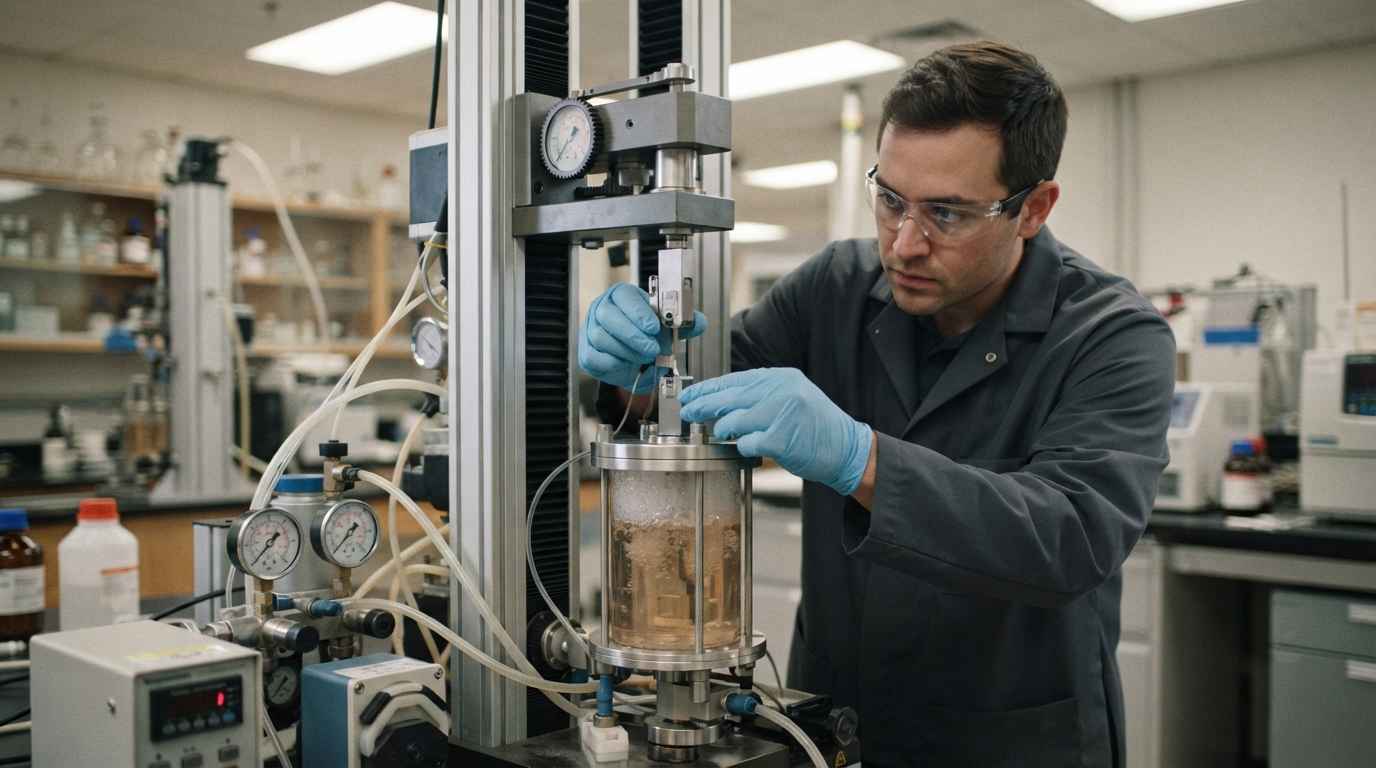
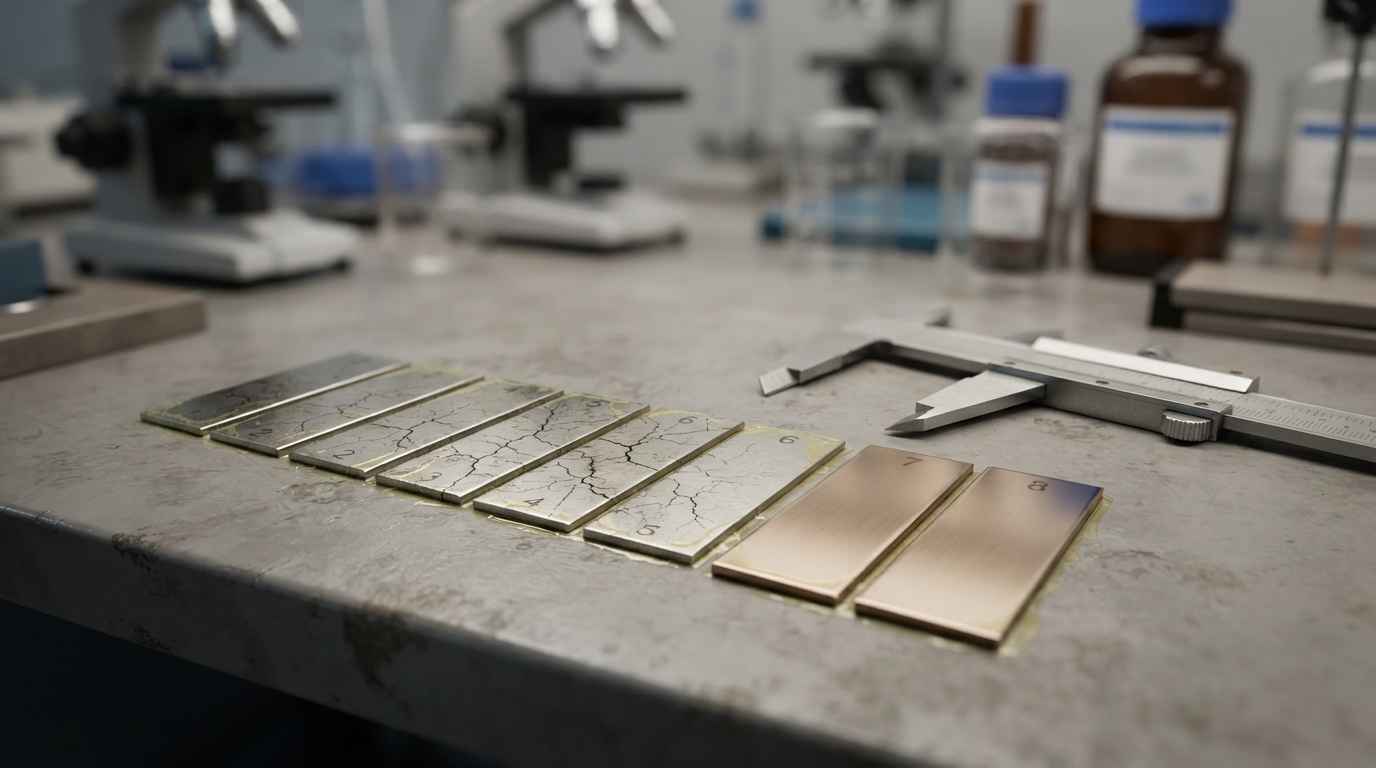
When the susceptibility of a material has to be confirmed or anticipated before putting it into service, specific stress corrosion cracking tests are used. These tests subject the material to stress and medium in a controlled way to see whether cracks appear and how soon, which allows materials to be compared or a choice validated before manufacturing.
| Test | What it evaluates | Reference | What it provides |
|---|---|---|---|
| Susceptibility test under load | Crack appearance under stress and medium | ISO 7539 | Confirms the material’s susceptibility |
| Boiling magnesium chloride test | SCC in austenitic stainless steels | ASTM G36 | Rapid susceptibility screening |
| Slow strain rate test | Sensitivity to the medium under rising load | ASTM G129 | Comparison between materials or media |
| Electron fractography | Intergranular or transgranular fracture mode | Representative analysis | Diagnosis of the failure cause |
From the test to the decision
The goal of these tests is not to accumulate data, but to make a decision: accept a material for an environment, discard it or change the design to remove the stress or isolate the medium. The correspondence between the standard and the real case must be verified, because a test that is too severe can discard a valid material and one that is too mild can give false confidence.
Documenting what was tested, with which method and against which criterion turns the result into a defensible decision before an audit, a customer or a claim. In stress corrosion cracking, where the failure is sudden and its consequences can be serious, that traceability is especially valuable.
How it is prevented and what not anticipating it costs
Preventing stress corrosion cracking consists of breaking the coincidence of the three factors before the crack starts, and doing so with criteria instead of oversizing blindly. It is an engineering decision that, well taken, costs little against the failure it avoids.
Prevention levers
The prevention levers act on one of the three factors: choosing a material not susceptible to the medium (for example a duplex stainless steel instead of an austenitic one in the presence of chlorides), reducing residual stress with a stress-relief heat treatment after welding, or isolating the medium through coatings, drainage and temperature control. Combining several is usually more robust than trusting everything to one.
Prevention starts in the design and in the material selection, not in maintenance. Anticipating where stress, medium and susceptible material may coincide allows it to be corrected on paper, when changing an alloy or adding a treatment costs little, instead of discovering it with the part already broken in service.
When the component is already in service and cannot be changed, prevention means monitoring it. Defining inspection points in the risk zones (welds, elbows, stagnation areas) and checking them with techniques able to detect fine cracks makes it possible to find the damage before it reaches the critical size. Knowing where and how to look, guided by an understanding of the mechanism, turns a generic inspection into useful monitoring.
On installed equipment, a simple monitoring plan usually pays off: recording the risk zones, setting an inspection frequency in line with how aggressive the medium is and noting any process change that raises the temperature or the chloride concentration. That follow-up turns stress corrosion cracking from a surprise into a controlled risk, and leaves room to act before the crack reaches the critical size.
The cost of the silent failure versus anticipating it
The cost of a stress corrosion cracking fracture rarely stays in the part: a pipe or a tank that fail by this mechanism can cause leaks, plant stoppages, damage to nearby equipment and safety risks. Added to this is the cost of investigating the failure, remaking the component and proving to the customer that it will not happen again.
On top of that direct cost there is a less visible one: the loss of customer trust and the engineering time spent proving that the problem has been solved at its root. A single well-documented case of stress corrosion cracking, with its diagnosis and its prevention plan, keeps that wear from repeating at every audit or every new order.
Against that scenario, anticipating the failure with a good diagnosis and a suitable selection is far cheaper, as captured in the approach to preventing failures in industrial products. Investing in understanding the mechanism before it acts is, almost always, the most profitable option.
Anticipating stress corrosion cracking is cheaper than suffering it
Stress corrosion cracking is a silent failure that combines a susceptible material, stress and an aggressive environment to crack a part without warning, even below its design limit. Recognising when it can appear, diagnosing it well when it happens and preventing it by acting on one of its three factors is what separates a plant that suffers unexpected fractures from one that avoids them. The difference is almost never in the budget, but in having anticipated the mechanism before it acts.
If you have an unexpected fracture in an aggressive environment or want to know whether a component is at risk of stress corrosion cracking, gather the part, the material and the service conditions and send them over: we return a root cause diagnosis and a data-backed testing and prevention plan so that the failure does not repeat.
Frequently asked questions
What is stress corrosion cracking?
It is a failure mechanism that cracks a material when three factors coincide: a susceptible material, a sustained tensile stress and a specific corrosive environment. The crack starts and grows with barely any visible material loss, often at stresses below the design limit, and ends in a sudden fracture. That is why it is considered one of the most dangerous failures in aggressive environments.
Why is it called a silent failure?
Because the part keeps its appearance, its dimensions and its function while the crack grows inside. It does not leak, deform or lose appreciable material, so a routine visual inspection does not detect it and the failure comes with no warning. It also tends to affect components assumed to be reliable, such as stainless steels, which increases the surprise when they break.
Which materials are most prone to stress corrosion cracking?
The best-known case is austenitic stainless steels with chlorides, typical of marine settings, chemical plants or hot water. Brasses with ammonia and high-strength steels with hydrogen are also susceptible. Susceptibility depends on the material-medium pair, so a material resistant in one environment may be vulnerable in another.
How is stress corrosion cracking diagnosed?
It starts from observing the fracture (branched cracks, no plastic deformation) and is confirmed with electron fractography to see whether it is intergranular or transgranular, together with the analysis of the material and the medium. Tests such as ISO 7539, ASTM G36 or ASTM G129 confirm susceptibility. The key is to tell it apart from fatigue or general corrosion, which require different solutions.
How is stress corrosion cracking prevented?
By breaking the coincidence of its three factors: choosing a material not susceptible to the medium, reducing residual stress with a stress-relief treatment after welding, or isolating the medium with coatings, drainage and temperature control. Prevention is decided above all in the design and material selection, where correcting costs little against the cost of a fracture in service.