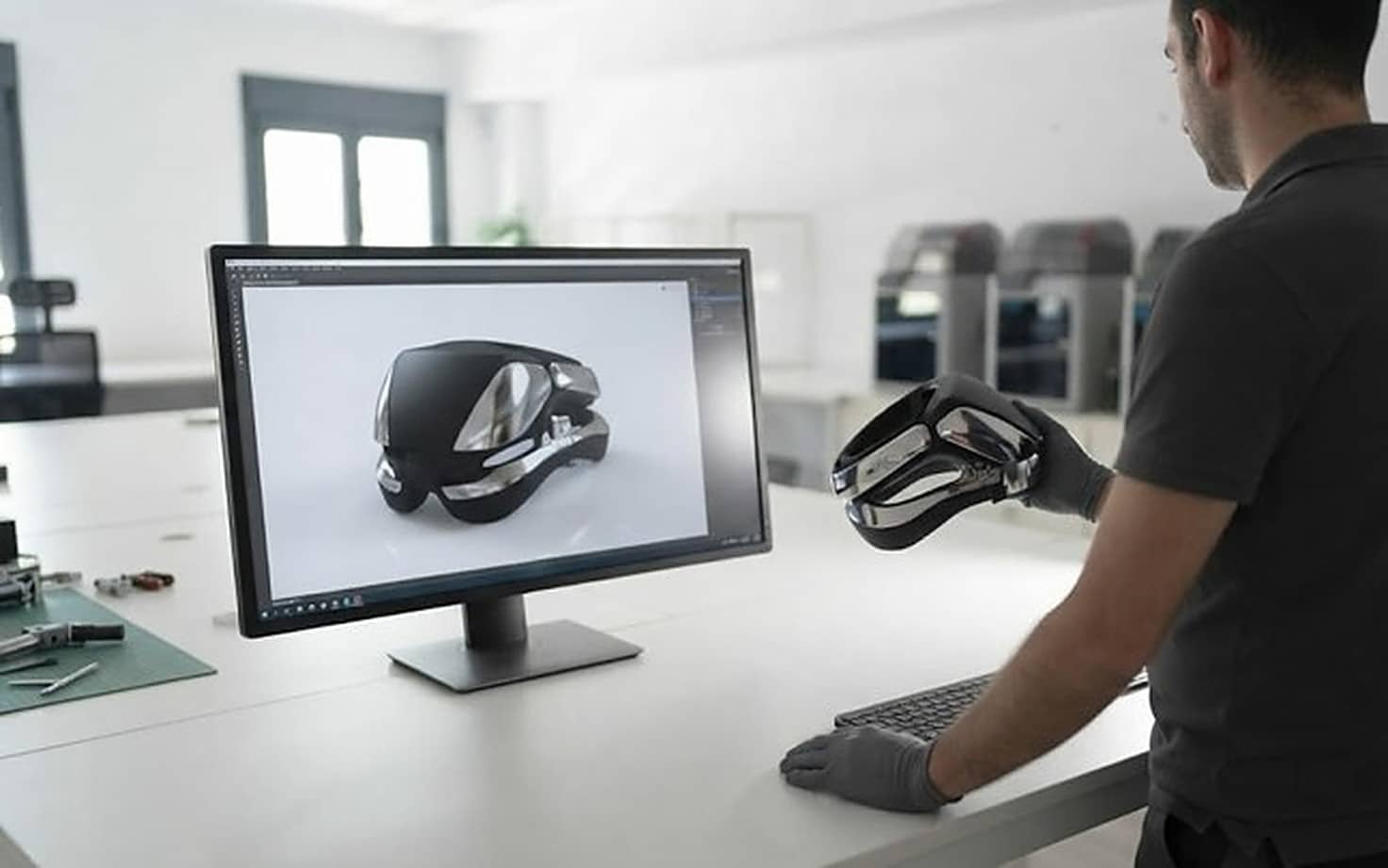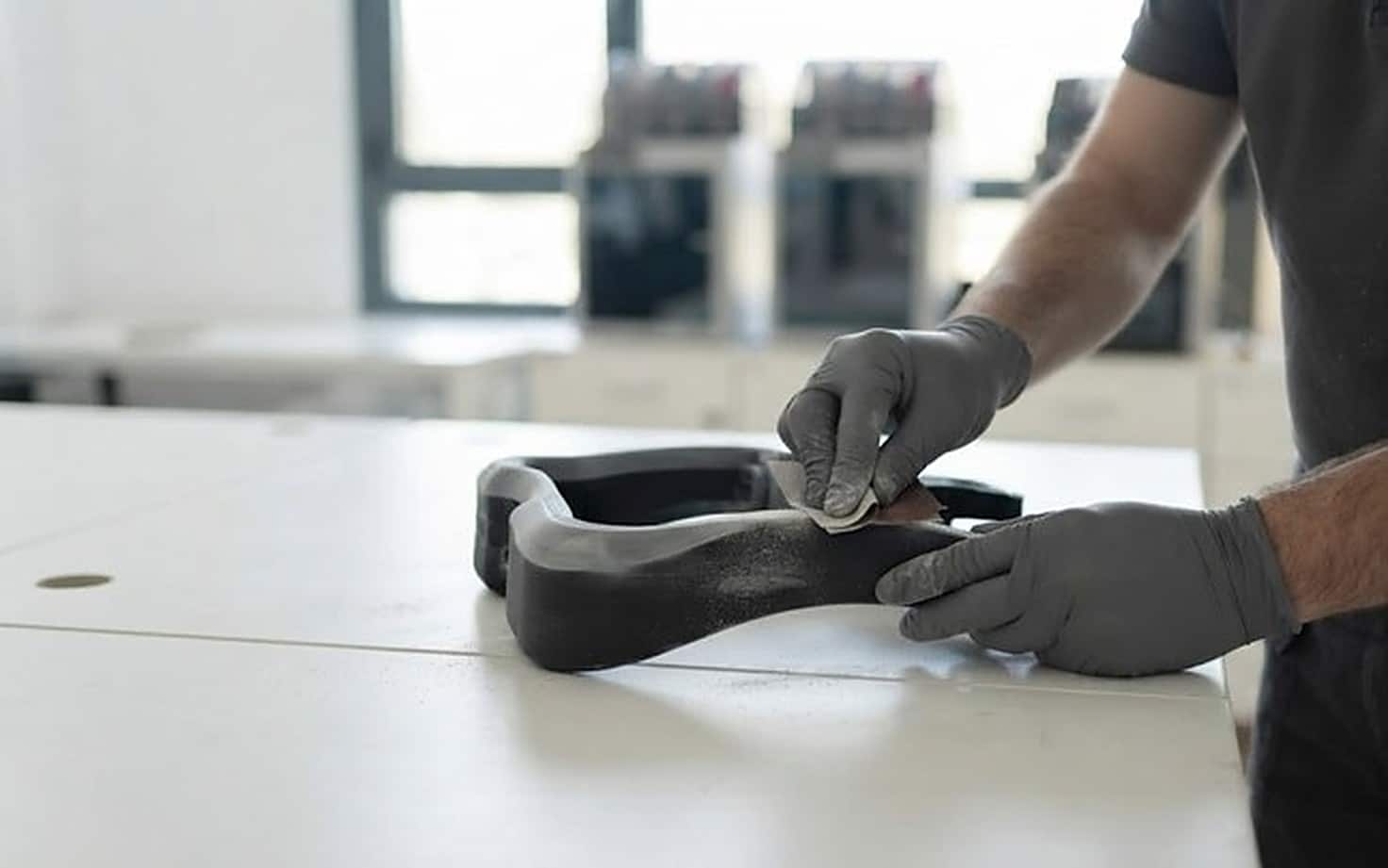

What was the challenge or problem to solve?
The redesign of a functional prototype consists of reviewing an already existing physical model to correct its technical limitations and raise its finish until it faithfully represents the aesthetics of the final part. In this project, the client already had a first prototype, but its resolution and physical appearance looked visually poor, to the point of not being valid either for user testing or for showing the product to potential investors or clients.
The need raised was not, therefore, to create a product from scratch, but to transform an internal working model into a part capable of supporting a presentation, and to do so without giving up an improvement in performance. The project was approached from the product development service, taking on the analysis of alternatives, the verification of the starting design and the generation of the supporting graphic material.
Low-resolution functional prototype: why it does not validate
A functional prototype is a physical model that reproduces the behaviour of a product to check whether it meets the defined requirements, even though it does not yet incorporate the appearance, finishes or materials of the production part. It is the usual tool for verifying mechanisms, ergonomics and fits before committing high investments in tooling or production lines.
The client’s starting point fulfilled that function only partially. The existing prototype made it possible to sense the concept, but its resolution and physical finish were far from what a model destined to leave the engineering environment demands. A low-resolution prototype usually shows visible process marks, surfaces that do not convey the intended material and joints with apparent clearances, all of which betray its provisional nature.
That distance between the model and the imagined product has direct consequences. When a user handles a rough prototype, their reaction is directed at the prototype and not at the product: they comment on the finish, the burr or the weight, and not on the value proposition being evaluated. The result is that user testing loses validity, because the feedback collected responds to a provisional artefact and not to the solution that is to be launched.
The second consequence is economic. A poor-looking model does not allow conversations to be opened with investors or potential clients, who need to see a credible representation of the product to make decisions. The project was thus blocked in an intermediate phase: there was a concept and there was functionality, but there was no object capable of communicating them.
User validation: what an aesthetic prototype requires
An aesthetic prototype is a model whose objective is not to validate full functionality, but to realistically represent the shape, proportions, finishes and visual perception of the final product. It is the type of prototype used in presentations, in user validation and in raising investment, when what is being tested is how the product is perceived.
What the client asked for combined both registers. It needed a model that worked, because the mechanism had to be operable during the demonstration, and that visually simulated the aesthetics of the final part, because it had to serve as a visual hook in the product presentation. This dual condition sets the level of demand of the project: an aesthetic prototype that does not move proves nothing, and a functional prototype that does not convince visually is not presented.
A prototype intended for user testing only provides reliable information when its finish stops being the star of the test.

The “what for” of the assignment conditions all the subsequent technical decisions. If the model’s destination is an internal test bench, resolving the mechanism is enough. If the destination is a room with users, clients or investors, one must also resolve the visible geometry, the parting lines, the fits and the set of details that determine whether an object reads as a product or as a mock-up.
Prototype redesign with injectable geometry and better finish
For INFINITIA, the main difficulty of the project was to reach an aesthetic result high enough for the client to be able to use the prototype in front of potential clients. That bar is not defined by a figure, but by a criterion of perception: the model must withstand close observation, direct handling and mental comparison with commercial products of the same segment.
Added to that demand was a technical condition detected in the starting design. The geometry of the original prototype presented aspects that generated failures when producing injected parts, which meant that the model was not only insufficient as a presentation part, but also carried design decisions incompatible with its future series manufacturing.
The project therefore had three simultaneous fronts: raise the finish, improve the product’s performance and correct the geometry so that the design would be industrialisable. Addressing them separately would have multiplied the iterations, and working on them at the same time requires a product design and innovation approach able to integrate functional, aesthetic and production-process criteria in a single review.
The last conditioning factor was the deadline. The client needed the result in a short time, which forced the selection of rapid manufacturing technologies and well-founded decisions from the first weeks, without resorting to long trial-and-error cycles.
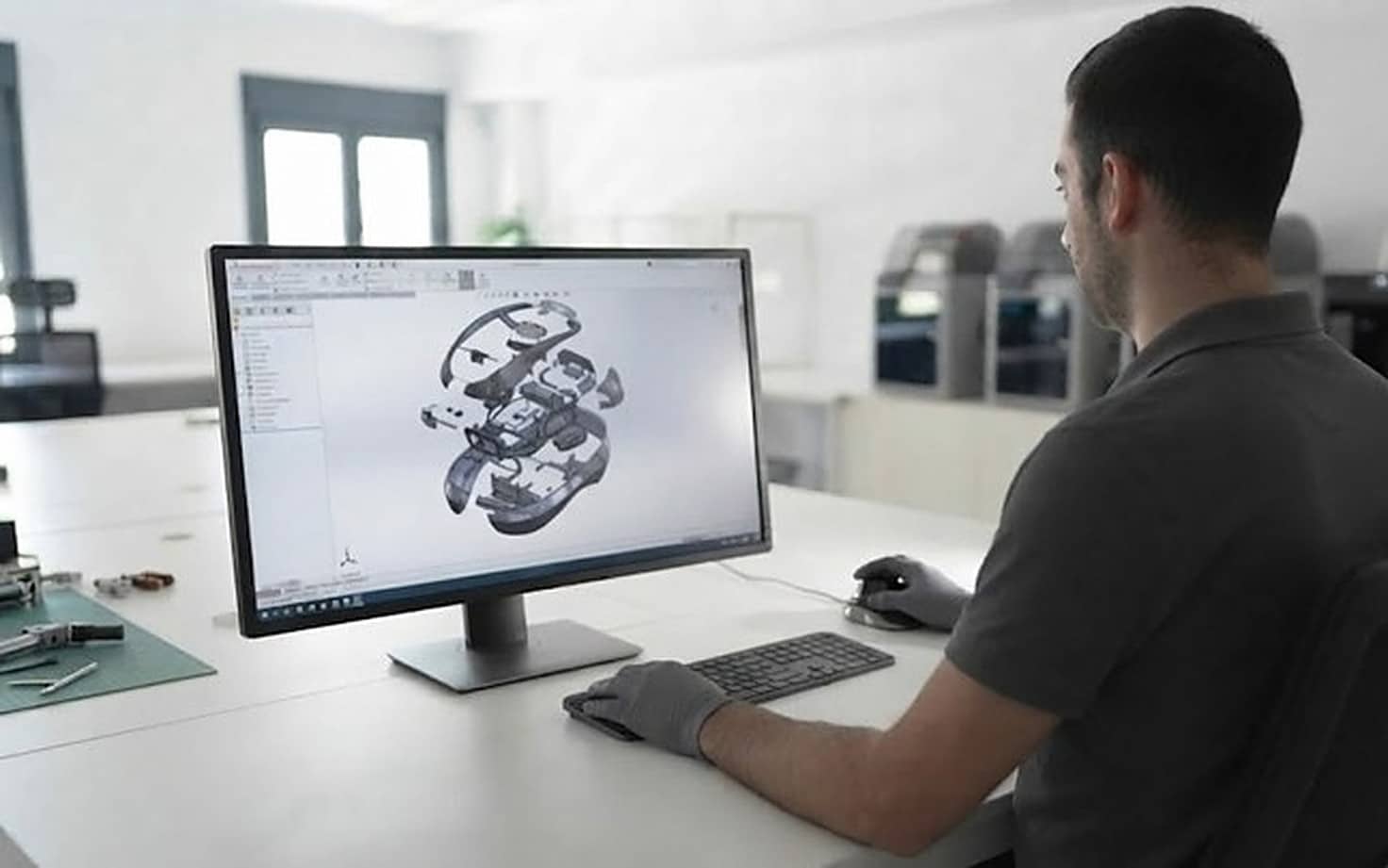 CAD design of the prototype with injectable geometry” class=”wp-image-37897″ style=”border-radius:16px”/>
How was it addressed or what was the solution?
The solution was structured in three chained tasks: an analysis of alternative mechanisms validated with prototypes, a verification of the starting design accompanied by an improvement proposal, and the generation of the supporting graphic material. Each task solved a specific question before moving on to the next, so that no aesthetic decision was made on an unverified mechanism.
INFINITIA’s Product Development team worked jointly with the client on defining the evaluation criteria and on selecting the alternatives. That collaboration is what allows the redesign to respond to the real intended use and not to an external interpretation of the product.
Analysis of alternative mechanisms with 3D printing
The analysis of alternative mechanisms started from a search for existing objects that had mechanisms similar to the one the product was to incorporate. This exercise, known in engineering as technical benchmarking, makes it possible to learn from solutions already proven in the market instead of reinventing a working principle from scratch.
The identified mechanisms were digitised and the best-rated ones were validated by manufacturing them through 3D printing. Digitisation, supported by 3D scanning and part digitisation techniques, turns a physical object into an editable three-dimensional model, which makes it possible to modify and adapt it before materialising it again.
Additive manufacturing makes it possible to join materials from a 3D model layer upon layer, which brought two decisive advantages here. It made it possible to have several alternatives in hand within a very short time and, above all, to detect on a real part the modifications that needed to be made, something that purely digital evaluation does not reveal. This use of industrial prototyping as a decision tool, and not as a final deliverable, is what turns a comparison into a well-founded selection.
The result of the analysis was twofold: a clear map of the advantages and disadvantages of each option and the selection of the mechanism that provided the most satisfactory result for the product, which answers the performance-improvement objective raised by the client.
Manufacturing several alternatives through 3D printing reduces the risk of choosing a mechanism on paper and discovering its limitations when there is no longer any margin.
3D CAD design to correct failures in injected parts
The second task consisted of verifying the starting design and proposing an improvement. The team reviewed the geometry of the original prototype and detected the aspects that generated failures when producing injected parts, that is, the points where the design conflicted with the injection moulding process with which the part was to be manufactured.
This review responds to the logic of design for manufacturing: checking that each geometry is producible under the real conditions of the intended process before approving it. In injection-moulded plastic parts, the relationship between shape and process conditions the quality of the visible finish, precisely the attribute the project needed to raise. Correcting those aspects in the redesign phase avoids carrying them through to the mould, when each modification comes to have a much higher cost and lead time.
The necessary changes were incorporated through professional 3D design and CAD modelling, obtaining the definitive 3D models. 3D CAD design is the digital modelling of parts and components in a virtual environment using specialised software, and its value in this project was direct: it provided complete control over the design and made it possible to carry out all the necessary changes quickly, which was exactly what the agreed deadline required.
Working on a parametric CAD model, moreover, leaves the project in a better position than it had at the start. The client receives not only an improved prototype, but a coherent digital definition on which to support the following industrialisation phases, with the geometry already cleared of the detected conflicts.
Photorealistic render: graphic material to present the product
The third task addressed a need that accompanied the physical prototype: the graphic support at the level of product marketing. The team analysed together with the client the different possible approaches to conveying the product information, jointly defining the form and content of what had to be shown.
From that agreement the necessary scenes were generated and the photorealistic images were produced with rendering software. A product render is a computer-generated image from the 3D model that precisely reproduces scale, colour, texture and lighting, showing clearly and realistically the final aesthetics of the product even before the production part exists.
A product render is not a decorative element: it makes it possible to verify shape, proportion and finish, and to communicate the design without ambiguity.
The product rendering and concept visualisation service fulfils a dual purpose in this kind of project, aesthetic and explanatory. On one hand, it presents the product in a visual and homogeneous way; on the other, it helps explain its mechanisms and operation, which is especially useful when the interlocutor is an investor or a client who needs to understand the proposal in a few minutes.
The project is considered a success for a specific reason: in a short time the client obtained the result it was looking for at the prototype level and, in addition, had the graphic material that served as support at the marketing level. It came out, therefore, with the two tools it needed to move from the development phase to the validation and presentation phase.
If an existing prototype has fallen short for testing it with users or for showing it outside the technical team, the usual route is to review it with function, aesthetics and process criteria at the same time.