

Pre-series manufacturing
Pre-series manufacturing is the production of a short run of the product with the final molds, materials and process to check, before launching series production, that it can be manufactured and assembled with the expected quality, pace and cost.
Within our product development service, the pre-series is the stage of product manufacturing in which the product starts to depend on a process: we plan the run, define what to measure and against which criteria, support its manufacture with the supplier and analyze the parts and the assembly to decide whether series production can be launched.
A product validated with prototypes can behave differently when its parts come out of a mold or off a line. Dimensions that vary with mold temperature, flash, parts that are hard to assemble or cycle times longer than expected, if they appear once series production is under way, affect stock already made and committed deliveries.
Talk to a specialist
Request a free initial consultation; contact a consultant from our team of specialists

What is pre-series manufacturing?
What is it?
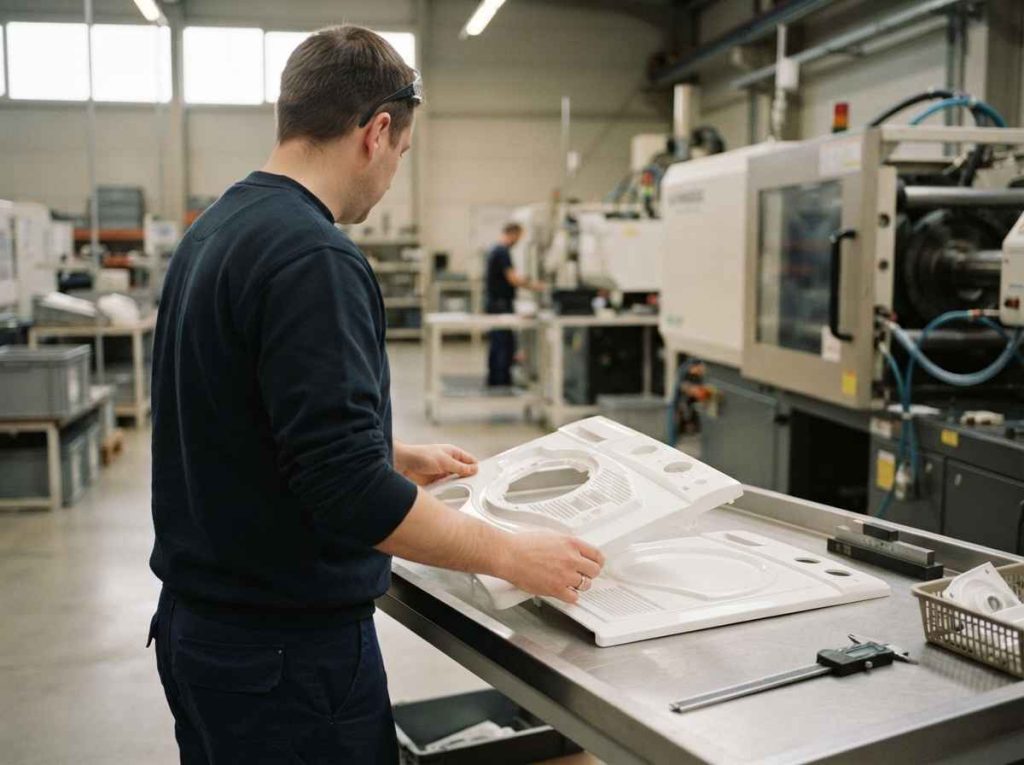
It is the manufacture of a limited number of units with the tooling, materials, suppliers and process that will be used for series production. It is used to check that the process reproduces what the design and prototypes already validated, that the parts stay within tolerance from one unit to the next and that assembly can be carried out at the planned pace. Its results are the basis for the decision to launch production.
It is carried out once the production molds and tooling have been made and adjusted, after the complete product has been validated and before production starts. It is the first time the product is made under the supplier’s real conditions, with its machines, operators and controls, which is why problems appear that no prototype can show: variation between cavities, warping on cooling, flash, initial tool wear or assembly difficulties on the line.
The pre-series studies the spread of critical dimensions between parts, compliance with acceptance criteria, the fit between parts from different suppliers, cycle and assembly times and the product’s behavior in functional tests. The size of the run is set according to what has to be demonstrated: a short run may be enough to review assembly and appearance, while estimating process capability requires more units.
Organizing the pre-series at INFINITIA
We start from the manufacturing documentation, the available molds and tooling and the validated prototype, and define with the customer what the pre-series has to demonstrate: which dimensions to measure, against which acceptance criteria, how many units to make and which tests to run with them before deciding.
The pre-series can include user tests on units made with the real process, as in the development of an air purifier through to user tests with a pre-series, where the design was optimized for industrial manufacturing before its commercial launch.
For injection-molded plastic parts, some of the pre-series problems can be anticipated in the design, as in the redesign of plastic components with injection process simulation, where wall thicknesses and draft angles were corrected and the most suitable gate location for the production process was identified.
The result is compiled in a report with the measurements, the manufacturing and assembly issues, their probable cause and the proposed actions, together with a recommendation on whether series production can be launched or what should be corrected first. That report also serves as the basis for production controls.
Benefits of validating the series process before launching production
Benefits
It makes it possible to correct the process while there is still no stock and no customers affected. A defect detected in the pre-series is solved by adjusting the mold, the process or the assembly on a few units; detected with series production under way, it affects parts already made, deliveries and, in the worst case, product already in the customer’s hands.
It provides data to set production controls. The pre-series measurements show which dimensions vary most and which remain stable, so the series control plan focuses on the characteristics that can go out of tolerance and on how often they should be checked.
It confirms manufacturing cost and pace. Real cycle time, rejection rate and assembly time make it possible to compare the unit cost with the forecast and adjust production planning before committing volumes and dates to customers.
It tests suppliers under real conditions. The pre-series shows whether each supplier meets tolerances, lead times and acceptance criteria with its own process, and whether parts from different suppliers fit together. Problems are solved with the supplier before the series orders are closed.
Types of pre-series by process and objective
Types
Each manufacturing process brings its own risks, so the pre-series for an injection-molded part is not planned the same way as one for an electronic board or for an assembly. In products with several processes, several are run in parallel.
The objective also changes the approach: reviewing assembly, measuring process capability or having units for testing require different runs, measurements and criteria. The table in the last section summarizes those differences.
Pre-series of injection-molded plastic parts
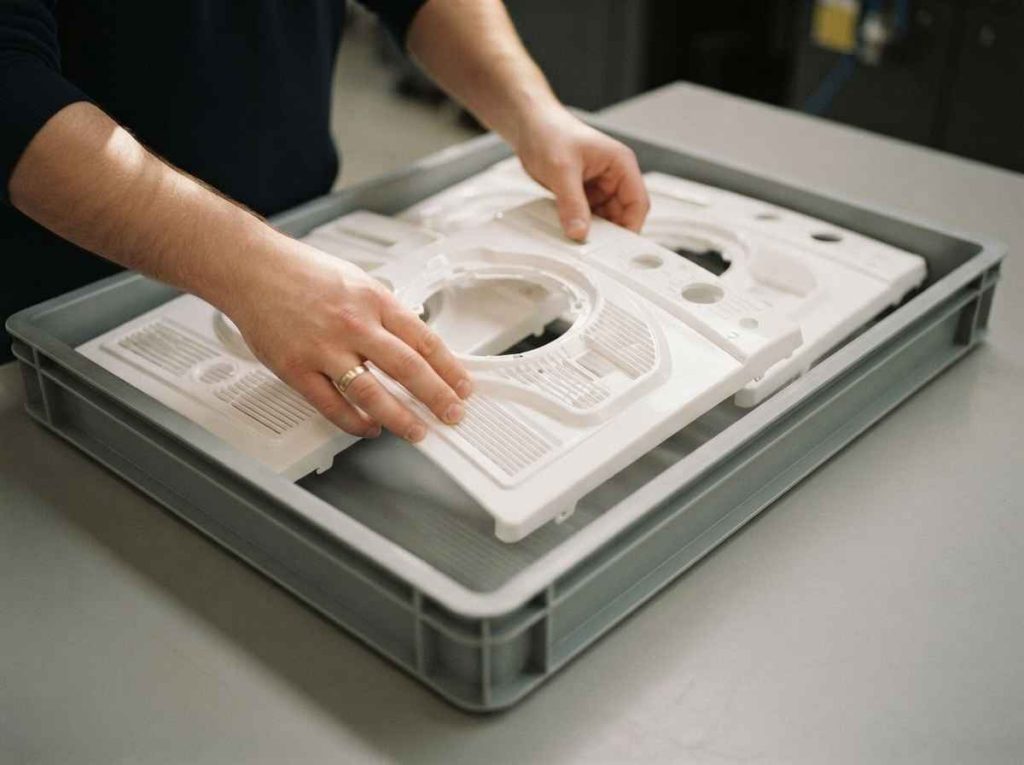
It is made with the final mold already adjusted and with the injection parameters planned for production. The dimensions of each cavity, filling, sink marks, warping, flash and weld lines are reviewed, and the parts are checked to fit with the others without forcing. The first parts are also measured after they stabilize, because some dimensions change in the hours following molding.
It makes it possible to decide whether the mold needs steel corrections or whether adjusting the process is enough, and to set the parameter window with which production keeps parts within tolerance. Parts from each cavity are identified separately, because a defect may affect only one of them.
Pre-series of machined and formed parts
For machined, bent or stamped parts, the pre-series is made with the final programs, workholding and fixtures. The spread of functional dimensions is measured between parts and throughout the run, to detect drift due to tool wear or machine heating. Finishes, cutting burrs and the distortion introduced by bending or welding are also checked.
The result shows whether the process holds tolerances without intervention and whether the workholding and inspection fixtures are adequate. When they are not, tooling design for clamping or inspection corrects the cause before series production is launched. Tolerances the process cannot hold are reviewed with engineering before being required from the supplier.
Pre-series of electronics and wiring
Boards are made on the supplier’s line with the series assembly and soldering process and undergo the functional tests planned for production. Solder defects, misplaced components, in-line test results and the fit of the board in its final housing are reviewed.
It is used to validate the production test bench itself, as well as the board, and to confirm that the selected components arrive with stable lead times and quality. Cables and harnesses are checked fitted in the product, with their final routing and fastenings, to verify that there is no strain or pinching when it is closed.
Assembly pre-series
The product is assembled at the final workstation or line, with the sequence, tools and operators planned for series production. The time for each operation, parts that are hard to fit, possible assembly errors and points where a fixture or guide is needed are recorded. It is also checked that parts from different suppliers arrive in the packaging planned for the line.
The reference for comparison is the unit validated in the zero prototype: any difference between the two points to an out-of-tolerance part or a process change. The results make it possible to adjust the sequence, balance the workstations and prepare the assembly instructions for the line.
Acceptance criteria and sampling
Before manufacturing, it is defined which characteristics are measured on each part, which are checked by sampling and which visual defects are acceptable. For inspection by attributes, sampling plans such as those in ISO 2859-1 can be applied, and for critical dimensions every unit in the run is measured.
Criteria defined in advance avoid later arguments about whether a part is good or not, and serve as the basis for incoming inspection of the series and for the limit samples given to the line. The same criteria are agreed with each supplier, so that their measurements and the customer’s are comparable.
Pre-series for testing and user trials
Some of the units are set aside for functional, durability or approval testing and for user trials, because they are the first ones that represent the product that will be sold. Their results hold for series production to the extent that the parts come from the final process, with their real materials and tolerances.
| Objective | Run | Main data |
|---|---|---|
| Assembly and appearance | Short | Assembly issues |
| Process capability | Longer | Dimensional spread |
| Testing | Per test | Test results |
| User trials | Short | User feedback |
These units should be reserved from the planning stage, because destructive tests consume parts and some approval lead times affect the launch. If a test fails, knowing the cavity, batch and time of manufacture of the unit helps to separate a process defect from a design problem. The table summarizes how the pre-series changes according to its main objective.
Sectors where validating the process before series production avoids start-up problems
Sectors
The pre-series adds the most where volumes are high, where a defect in series production forces product to be withdrawn or a customer’s line to stop, and where part approval requires data from the final process.
In all of them, the questions the run answers are the same ones covered in the article on what a pre-production run validates before series manufacturing; what changes is the weight of each one.
Pre-series manufacturing in automotive: part approval, capability and traceability
In automotive and mobility, suppliers have to show with parts from the series process that they meet the specifications before supplying, and deliveries feed into the customer’s lines with very little margin.
- Part approval: approval documentation is based on parts made with the final process, tooling and materials.
- Capability: spread of critical dimensions measured on a run large enough to estimate it reliably.
- Traceability: identification of batches, cavities and materials from the first parts produced.
The pre-series provides the parts and data required by PPAP and automotive testing, and makes it possible to correct the process before the first delivery.
Pre-series manufacturing in electronics: board assembly, in-line testing and housing
In electrical and electronic products, the board, the housing and the final assembly may come from different suppliers, each working with its own process, its own tests and its own component lead times.
- Board assembly: soldering and component placement defects reviewed on boards made on the final line.
- In-line testing: production test bench validated with real units before using it in series production.
- Integration: fit of the board, connectors and wiring in the final injection-molded housing.
A joint pre-series of board, housing and assembly confirms that the three parts fit when each one comes from its series process.
Pre-series manufacturing in consumer goods: volume, appearance and line assembly
In household appliances and consumer goods, runs are long, unit cost is decisive and an appearance or assembly defect is multiplied by thousands of units and reaches the user directly.
- Appearance: gloss, color, sink marks and injection marks assessed with agreed visual criteria and limit samples.
- Line assembly: times, sequence and possible assembly errors measured at the final workstation with line operators.
- Cost: real rejection rate and cycle time compared with the assumptions used to calculate the price.
The pre-series confirms that the product can be manufactured at the planned cost and pace before committing volumes to distribution.
Pre-series manufacturing in plastic and rubber parts: molds, cavities and parameters
In plastic and elastomer parts, the mold and the process parameters determine the final geometry, and small variations in temperature or pressure change the dimensions, the finish and the properties of the part.
- Molds: steel corrections decided with measurements from the first shots rather than by eye.
- Cavities: dimensions and defects measured separately in each mold cavity to detect differences between them.
- Parameters: window of temperatures, pressures and times set to keep parts within tolerance.
The pre-series completes the mold adjustment and sets the parameters that production will have to maintain on every shift.
Pre-series manufacturing in medical devices: process validation and documentation
In medical devices, the manufacturing process is part of what has to be demonstrated to authorities and customers, and changes after launch require additional justification and documentation.
- Process: process parameters and controls defined and recorded on units made under series conditions.
- Materials: raw material and component batches identified and traced from the first parts.
- Documentation: measurement and test records from the pre-series prepared for inclusion in the product documentation.
The pre-series provides the process data used to document that the device is manufactured repeatably before it is placed on the market and with every later change.
Pre-series manufacturing in machinery: first units, assembly and suppliers
In machinery and capital equipment, runs are short and each unit includes many parts from different suppliers, so the first machines in practice play the role of the pre-series.
- First units: complete assembly with parts from the series suppliers and a record of each issue with its cause.
- Assembly: times, adjustments and fixtures needed, documented so the following units can be assembled without improvising in the workshop.
- Suppliers: compliance with tolerances, finishes and lead times checked in each supplier’s first deliveries.
Treating the first units as a pre-series makes it possible to correct their issues in the rest of the batch, instead of repeating them machine after machine and customer after customer.
The pre-series as the last step before committing to production
Value
The pre-series is when the product shows that it can be manufactured repeatably with the real process. With its data, the decision to launch series production no longer rests on assumptions and is made with part measurements, assembly times and test results from the supplier itself.
Each department comes out of the pre-series with information for its decision. Engineering knows which dimensions and parameters to control, quality has tested acceptance criteria and purchasing knows which suppliers comply and which need corrections; if one cannot, supplier prospecting and validation looks for alternatives before start-up. Afterwards, support during production uses the same data as a reference for the first runs, so every deviation is compared with a known process state.
The cost of the pre-series is weighed against what it prevents: rework and rejected parts in the first deliveries, mold modifications with production under way and launch delays. In regulated sectors, it also provides the process records the product documentation needs, which can only be obtained with parts made under series conditions. It also gives sales and customers the first units that represent the product that will be sold.
If your series molds and tooling are ready or about to arrive, send us the manufacturing documentation, the validated prototype and your suppliers’ details, along with the planned volume and launch date. We will propose the pre-series plan, with run size, measurements, criteria and tests, and deliver the report with what needs to be corrected before production and a recommendation on the launch.
Frequently asked questions about pre-series manufacturing
FAQs
Does a pre-series without issues guarantee that series production will go well?
Not entirely. A limited pre-series shows how the process behaves under specific conditions, but it does not capture long-term tool wear, variation between material batches or the changes in shift, operator or season that appear over months of production.
That is why its results are complemented by a control plan during the first runs, which monitors the most sensitive characteristics detected in the pre-series. That monitoring confirms over time what the initial run can only indicate, and gives early warning if the process starts to change.
What is the difference between a pre-series and a zero prototype?
The zero prototype validates the design of the complete product with parts made by prototype processes; the pre-series validates the series process with parts from the final molds and tooling. The former is done before the molds are ordered and the latter once they have been made.
That is why they answer different questions. If the zero prototype detects a problem, the design is corrected; if the pre-series detects it, the correction is sought in the process, the mold or the supplier, and it costs more because the tooling has already been paid for.
Can a pre-series be made with prototype molds?
A short run can be made with prototype molds or rapid inserts, and it is useful for having units early, but it does not validate the series process. The final mold has different cooling, different materials and sometimes a different number of cavities, and its parts may differ from those of the prototype mold.
A run like this is useful for early testing, market trials or presentations, and it should be called by its name so as not to treat as validated a process that has not yet been tested. When the final mold arrives, the pre-series is still carried out with its parts.
Who manufactures the pre-series parts?
The supplier that will produce the series, with its machines, tooling and staff, because that is the process to be validated. If the parts are made elsewhere or by other means, the pre-series no longer represents what will happen in production.
What can be done outside the supplier is the planning, the definition of criteria, the follow-up of manufacturing and the measurement and analysis of the parts. Separating whoever manufactures from whoever evaluates provides an independent view of the results and makes it easier to agree on corrections based on data.
What is measured on the pre-series parts?
The functional dimensions and those that affect assembly, the visual defects defined in the acceptance criteria and, depending on the product, properties such as weight, hardness or sealing. Each measurement is recorded part by part, identifying cavity, batch and time of manufacture.
That identification makes it possible to distinguish an isolated defect from a process trend. A dimension that shifts over the run points to thermal drift or wear, while a constant difference between cavities points to the mold. Each case has a different correction.
What is done with parts that do not comply?
They are separated, analyzed to find the cause and a decision is made on whether the correction lies in the mold, the parameters, the material or the design. When the cause is a geometry that is hard to manufacture, the solution is reviewed with design for manufacturing criteria.
After correcting, a new short run is made to confirm that the problem has disappeared and that the correction has not created another one. Non-conforming parts are kept identified as a reference until the issue is closed, and are used to check that the correction works.
What is process capability and why is it studied in the pre-series?
It is the relationship between the real spread of a dimension and the tolerance allowed by the drawing, and it is expressed with indices such as Cp and Cpk. It shows whether the process can keep that dimension within tolerance consistently, and it is part of statistical process control.
It is studied in the pre-series because it is the first opportunity to measure it with the real process. If capability is low, action can be taken on the process or the tolerance can be reviewed before production; if it is not studied, the problem appears as rejects in series production.
How is a pre-series coordinated with several suppliers?
With a common plan that sets the dates of each run, the acceptance criteria for each part and the time of the joint assembly. Parts from all suppliers have to arrive in time to be assembled together, because the fit between them is one of the main results.
Each supplier receives the same measurement criteria and delivers its data in a comparable format. That way, when two parts do not fit, it is possible to tell which one is out of tolerance without disputes between suppliers. Issues are assigned with data and closed by an agreed date.
How much does pre-series manufacturing cost?
It depends on the number of units, the number of parts and suppliers involved, the planned measurements and tests and whether inspection fixtures have to be designed. The cost of making the parts is set by each supplier according to its process; the cost of planning and analyzing the pre-series, according to its scope.
To give you a firm figure, we need to know the product, its suppliers and what you want to demonstrate with the run. Send us that information and we will prepare a proposal with the pre-series plan, the measurements and the lead time, so you know what you will receive.
How much time should be set aside for the pre-series?
Typical lead times for preparing the plan and analyzing the results range from one to four weeks depending on the complexity of the product. Manufacturing the parts depends on the availability of the molds and on each supplier’s planning, which is agreed when preparing the plan.
If you have a committed launch date, let us know from the start. With it, we plan the run backwards, leaving room for a second confirmation run if the first one requires correcting the mold or the process. Without that margin, a single correction delays the launch directly.
What do I need to send to get started?
Send us the product drawings and models, the bill of materials, your suppliers’ details and the status of their molds and tooling, and the validated prototype if you have it. If there are already known issues in the first parts or in the prototypes, include them so the plan monitors them from the start.
Also tell us the planned series volume, the launch date and any part approval requirements from your customers or applicable regulations. With that information we will propose the scope and confirm the lead time and budget. If the project is confidential, let us know so we can agree on how information is handled with the suppliers.
What if I do not yet have a supplier for some parts?
Then the pre-series starts by finding one. For each part without a supplier, candidates with the right process are identified, their quotes are compared on the same documentation and their capability is validated before the mold or tooling is ordered.
In that case, the chosen supplier’s pre-series is also its approval test, and its results decide whether it is confirmed for the series order. Mention it when requesting the proposal, because the time to the run depends on how long the new tooling takes to make and on the supplier’s workload.