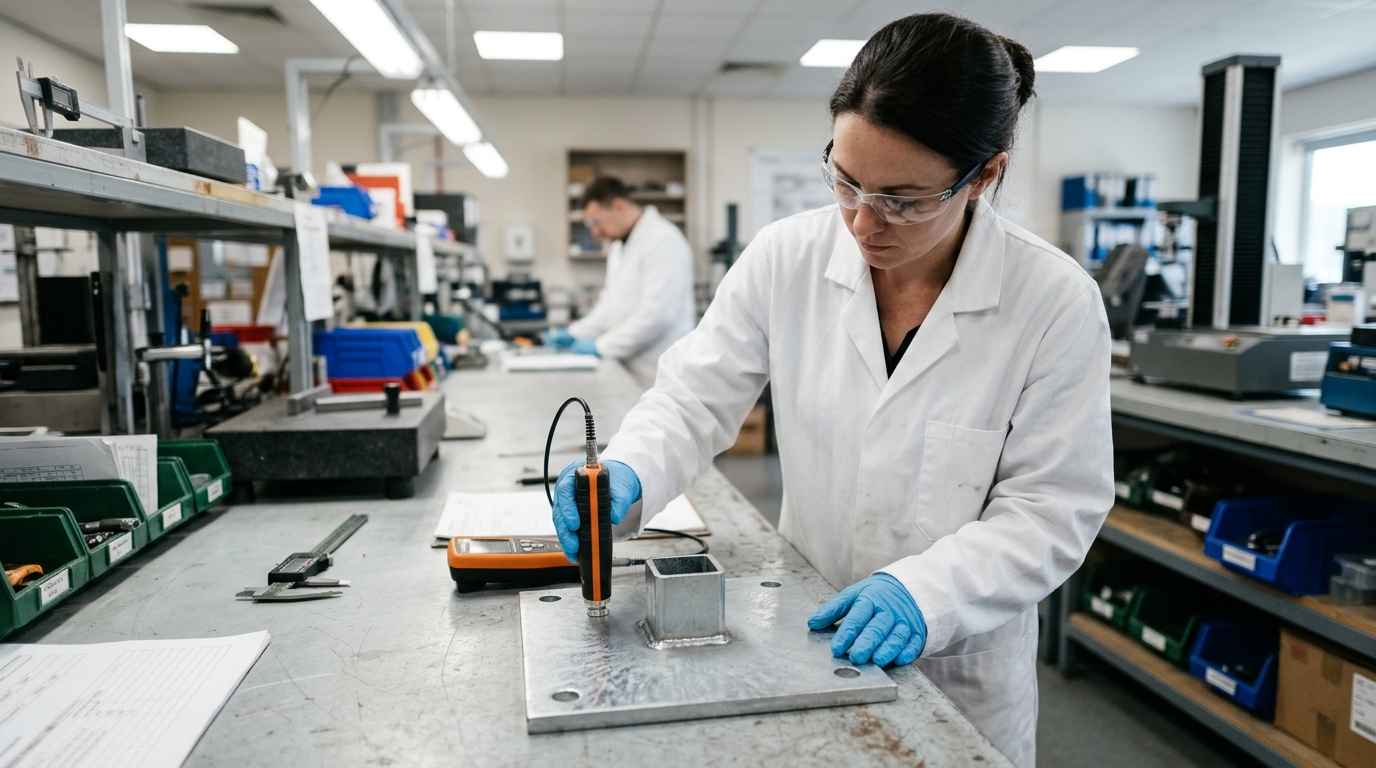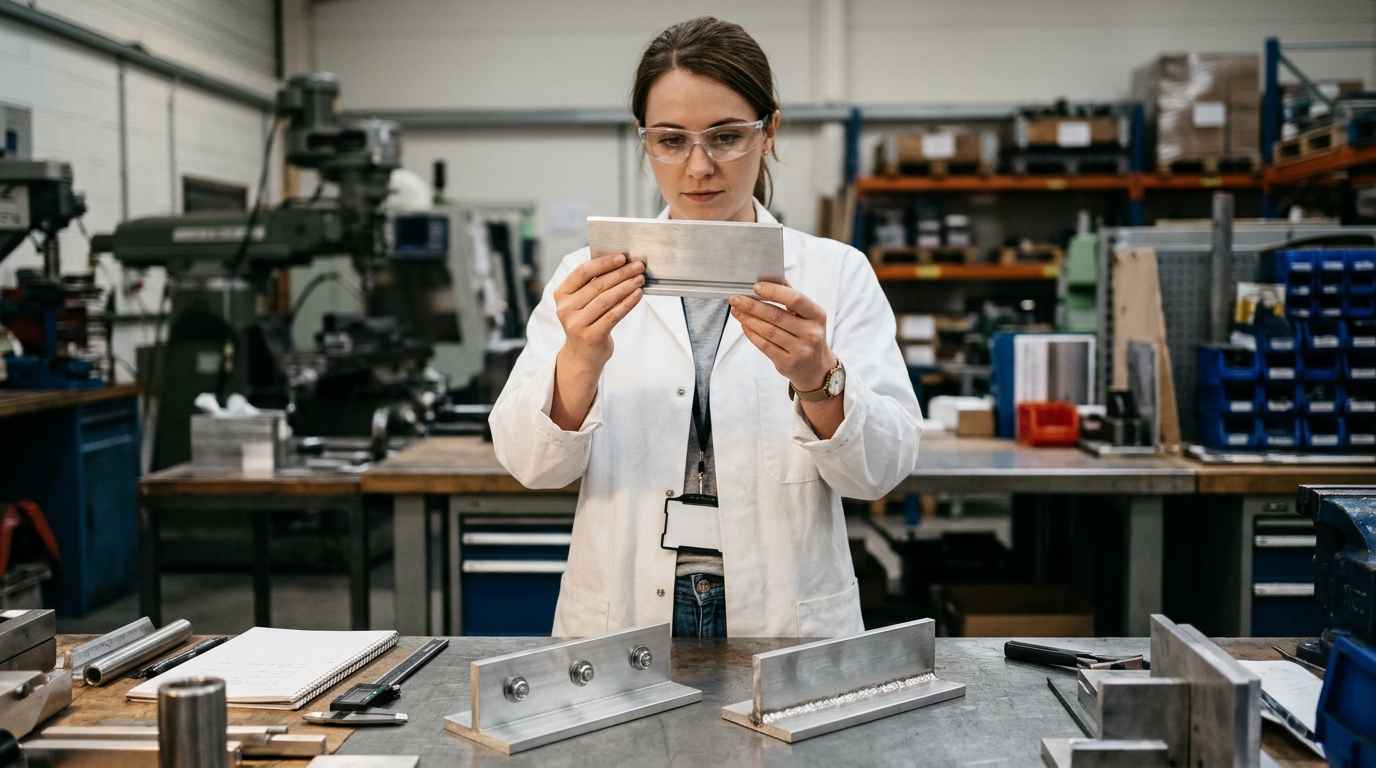

Joining methods in mechanical design fall into removable ones, such as bolting, and permanent ones, such as welding, riveting and adhesive bonding, and the choice between them determines the strength, cost and maintenance of the product.
The joint is often decided by habit, because the company has always welded or because the usual supplier works with bolts, and the problems appear later as bolts that work loose, fatigue cracks at the toe of a weld or adhesives that come unstuck in humid conditions. Choosing it with clear criteria is one of the first decisions in mechanical development, because it affects the geometry of the parts, the materials and the assembly process.
Within product development, changing the joint once the moulds and tooling are made costs far more than doing it on the drawing. That is why it pays to compare the options with the real load, the environment and the production volume in front of you, before the design closes around one of them.
MECHANICAL DEVELOPMENT
Designing a product and not sure how to join its parts so they hold up in service? Take a look at our mechanical development

What joining methods exist and how they are classified
Joining methods are classified according to whether or not they allow the parts to be separated without damage. Removable joints can be opened and closed again, and permanent joints can only be separated by breaking the joint or one of the parts.
Removable joints, bolts, pins and snap-fits
The bolted joint is the removable joint par excellence. A bolt or screw clamps the parts together with a force called preload, and the joint works well as long as that preload is maintained. It allows assembly and disassembly for maintenance, replacement of components and joining of materials that cannot be welded to each other, at the cost of drilling the parts and adding items that have to be bought, stored and tightened.
Pins and keys locate parts or transmit torque without clamping, and in plastic parts the snap-fits or elastic features moulded into the part itself replace screws without adding components. They are cheap in series production, but the snap-fit design has to account for the deformation during assembly and the creep of the plastic over time, because a snap-fit that loses tension leaves the joint loose.
Permanent joints, welding, rivets and adhesives
Welding joins the parts by melting the material of both, with or without filler, and gives a continuous, leak-tight joint that in many cases reaches the strength of the base material. The heat comes at a price, because it distorts the parts, leaves residual stresses and changes the properties of the material near the weld.
Rivets and clinching join sheets by deformation, without heat, and are widely used in car bodies and aluminium structures where welding is difficult. Adhesives join by adhering to the surfaces, spread the load over the whole bonded area and make it possible to join very different materials, such as metal to composite or glass to plastic. Hybrid joints, which combine adhesive with rivets or spot welds to add up the advantages of both, are becoming more and more common.
The principles of assembly design point in the same direction, fewer components, fewer fastener references and simpler assembly, and the choice of joint type is the most direct way to apply them.
Choosing between joining methods is not about finding the strongest joint, but the one that best fits the load, the material, the environment and the way the product is made and maintained.
How to choose between a bolted, welded or bonded joint
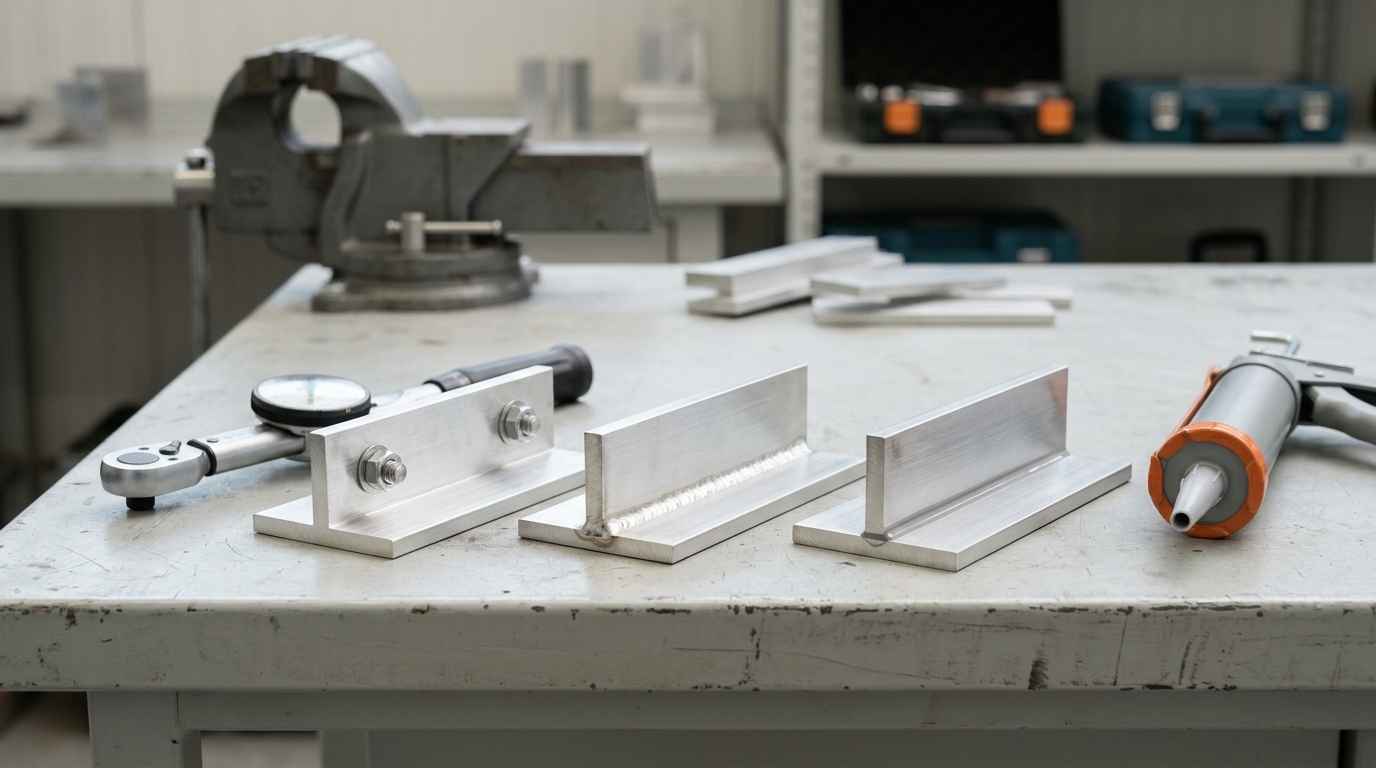
The choice between a bolted, welded or bonded joint is made by crossing four groups of criteria, how the load reaches the joint, which materials have to be joined and in what environment, whether disassembly is needed and how much it costs to make the joint at the expected volume.
The load and how it is transmitted
Each joint transmits load in a different way. The bolt concentrates it at the holes and, if the preload is sufficient, transmits it by friction between the parts, without the shank working in shear. Welding gives continuity to the material, but the weld toe is a stress raiser that limits fatigue strength. The adhesive spreads the load over the whole bonded surface and performs very well in shear, but very badly when the load tends to open the joint from one end, which is called peel.
If the part will be subjected to cyclic loads or vibration, fatigue matters more than static strength. A welded joint that easily withstands a static load can crack in service at a fraction of that load if it is repeated millions of times, and a bolt with too little preload works loose under vibration even if it is correctly sized.
Materials, environment and disassembly
Materials close off options. Steel and aluminium cannot be welded to each other by conventional fusion welding, because they form brittle compounds in the joint, and many plastics and composites accept neither welding nor drilling without losing strength. In those cases, adhesive or bolting with inserts are the usual alternatives.
The environment also decides. A stainless steel bolt in an aluminium part forms a galvanic couple that corrodes the aluminium in the presence of moisture, something that design for corrosive environments addresses with insulating washers, coatings or the choice of bolt material. Adhesives have a service temperature limit and age with humidity, and welding leaves areas with lower corrosion resistance if they are not treated afterwards.
Finally, if the product has to be opened for maintenance, repaired or separated for recycling, a permanent joint is ruled out in those areas, even if it were the cheapest to make.
Cost, volume and manufacturing process
The cost of a joint is not the price of the bolt or the adhesive, but the assembly time, the tooling, the inspection and the failures it causes. At low volumes, bolting is usually the simplest option, while in long runs automated welding, riveting or snap-fits moulded into the part cut the time per unit considerably. Design for manufacturing starts from that calculation to decide where and how parts are joined.
The number of references also counts. In the redesign of a product to reduce production and assembly costs, a device with more than nine parts joined by around forty screws of different references became a design with fewer parts and a more efficient fastening system, while keeping its function.
The table summarises how the three most common joint types behave against each criterion.
| Criterion | Bolted | Welded | Bonded |
|---|---|---|---|
| Disassembly | Yes, without damaging the parts | No | No |
| Dissimilar materials | Yes, with insulation if there is a galvanic couple | Only compatible combinations | Yes, and it also insulates |
| Load distribution | Concentrated at the holes | Continuous, with a concentration at the weld toe | Spread over the whole bonded surface |
| Fatigue | Good if the preload is correct | Limited by the weld toe and residual stresses | Good in shear, weak in peel |
| Sealing | Needs a gasket | Leak-tight if the weld is continuous | Leak-tight and damps vibration |
| Inspection | Simple, by torque or preload | Visual and non-destructive testing | Difficult without breaking the joint |
| Process | Fast and without heat | Heat, distortion and qualified welders | Surface preparation and curing time |
TELL US ABOUT YOUR CASE
Have a joint that loosens, cracks or comes unstuck, or a design where the joint is still undecided? Send us the drawings, the loads and the materials and we will propose which joint to choose and how to validate it
What fails in each type of joint and how to prevent it
Each type of joint has its own failure modes, and almost all of them can be prevented at the design stage if they are known in advance. What fails most is not the joining element itself, but what surrounds it, the preload, the weld or the surface.
Bolted joints, preload, loosening and fatigue
Most failures of bolted joints come from insufficient or poorly controlled preload. When tightening with a torque wrench, around 90% of the torque is lost to friction under the head and in the thread, so small variations in lubrication or finish change the actual preload a great deal. With too little preload, transverse vibration makes the bolt rotate and work loose, and the varying load passes into the bolt and breaks it by fatigue at the first loaded thread.
The VDI 2230 guideline is the usual reference for calculating loaded bolted joints, and it takes into account the preload, the loss due to embedding of the surfaces and the share of the external load that reaches the bolt. Design then adds measures against loosening, sufficient clamp lengths and a bolt property class, for example 8.8 or 10.9, that the parts can withstand under the head without being crushed.
Welded joints, distortion, residual stresses and fatigue
In welding, internal defects such as pores, lack of fusion or cracks reduce the load-bearing section and act as crack initiation sites. ISO 5817 defines quality levels for imperfections in fusion-welded joints in steel, and the design has to state which level is required for each weld according to how heavily it is loaded.
Even if the weld has no defects, the weld toe concentrates stresses and the heat-affected zone changes the properties of the material, especially in aluminium alloys and heat-treated steels. In the optimal weld design of metallic materials, the joint between two different stainless steels was solved with life tests in a climatic chamber and metallographic analysis before and after each adjustment of the welding parameters.
Distortion is also controlled from the design, with symmetrical welds, the smallest weld volume that meets the requirements, a defined welding sequence and clamping fixtures. It is worth specifying on the drawing which tolerances can be held after welding, because machining the part after welding to recover them makes it much more expensive.
Bonded joints, preparation, peel and ageing
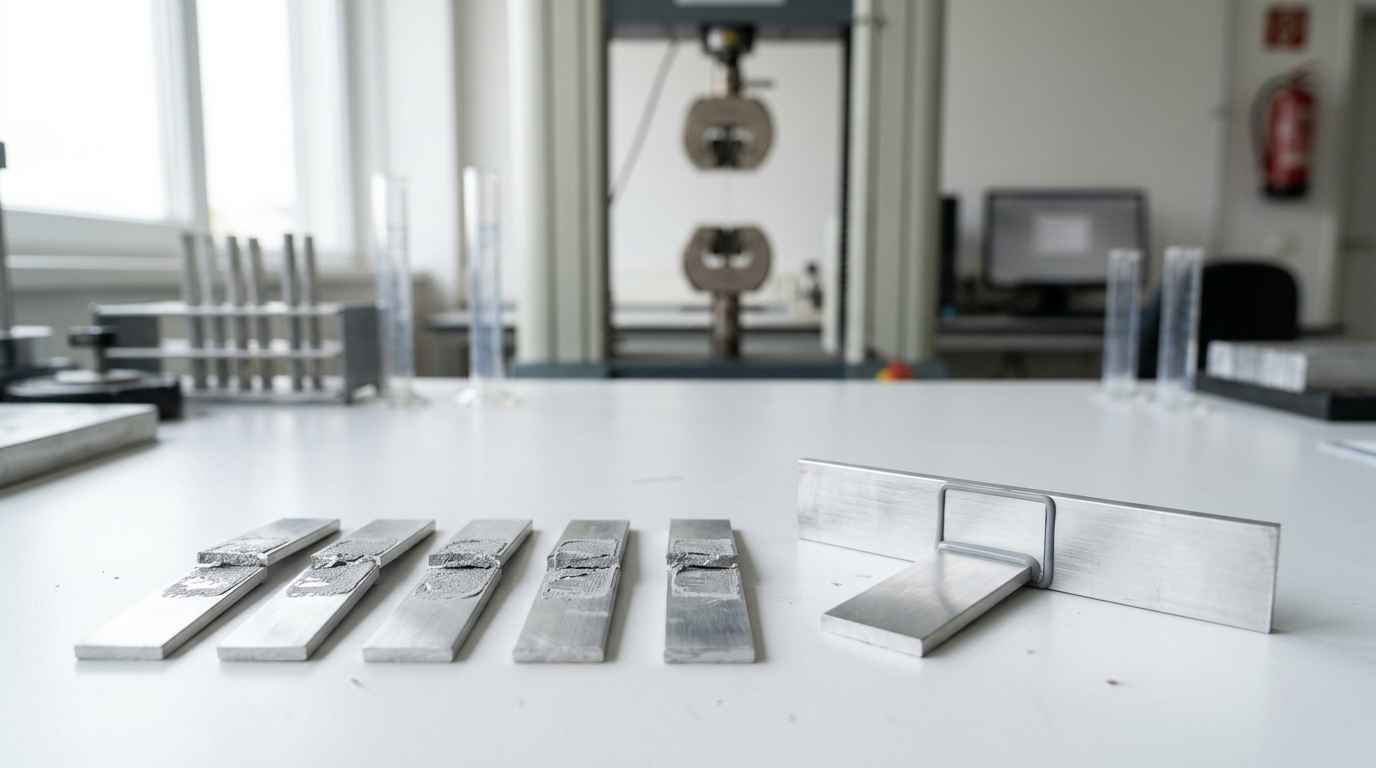
The strength of a bonded joint depends as much on the surface as on the adhesive. Traces of oil, release agents or oxides make the adhesive come away from the part, which shows in the fracture as a clean surface, while good preparation moves the fracture into the adhesive itself. ISO 4587 describes the tensile lap-shear test on overlap joints, the most widely used test for comparing adhesives and preparations.
In design, the rule is for the adhesive to work in shear and not in peel. Lengthening the overlap helps up to a point, because stresses concentrate at the ends of the overlap, and beyond that it gives more strength to widen the joint or stiffen the parts. Humidity and temperature degrade many adhesives over time, so the strength that matters is what remains after ageing, not on the first day.
A bonded joint that breaks leaving a clean surface has not failed because of the adhesive, but because of the surface preparation. Changing the adhesive in that case solves nothing.
How to validate the joint before series production
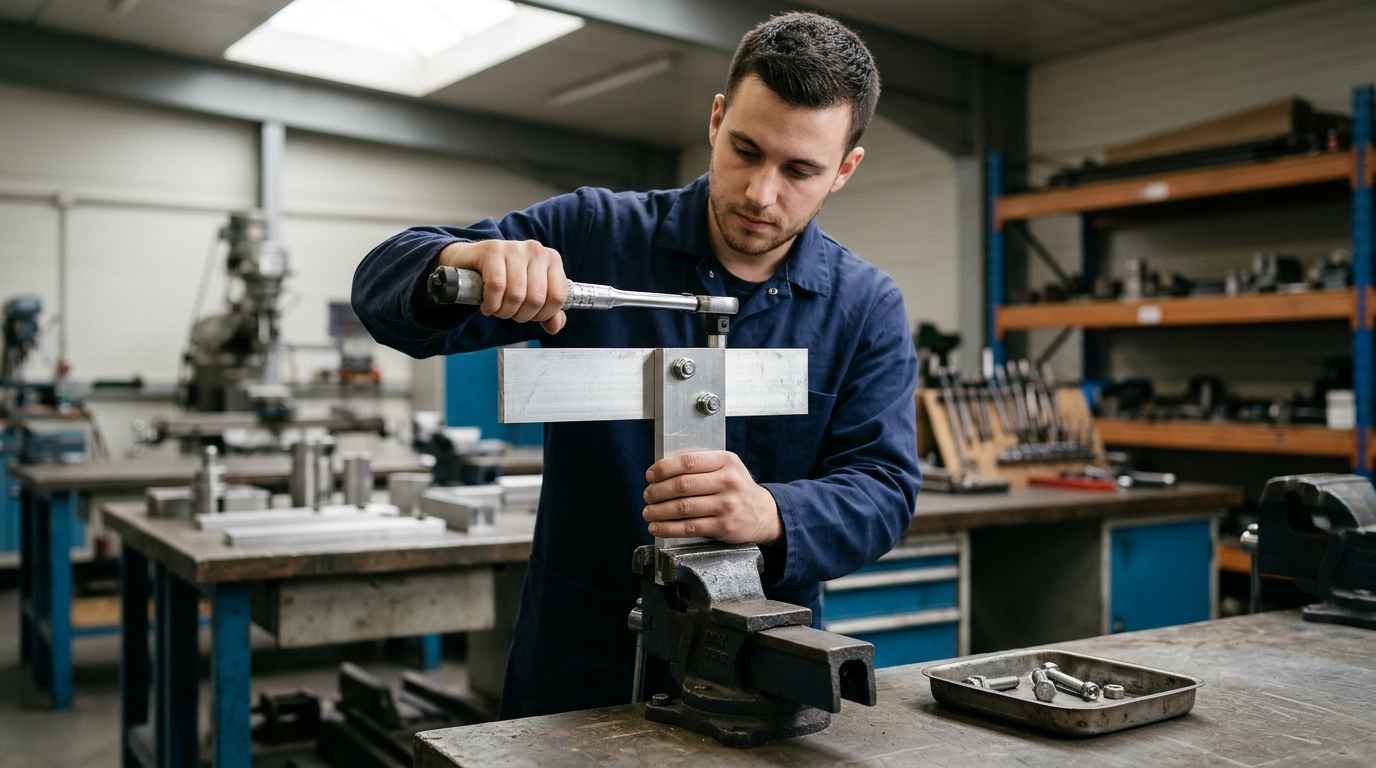
A joint is validated in two steps, first with calculation and simulation to rule out options and size it, and then with tests on specimens and prototypes that reproduce the real load and environment.
Calculation and simulation of the joint
Analytical calculation handles most bolted joints and standard welds. When the geometry is complex or the stiffness of the parts changes how the loads are shared, finite element simulation shows where stresses concentrate, which bolt takes the most load or where peel starts in a bonded joint.
Simulation has a clear limit in joints. Real behaviour depends on the preload achieved during assembly, the quality of the weld or the surface preparation, and the model does not provide that. That is why calculation is used to choose and size, and testing to confirm.
Tests on specimens and prototypes
Testing starts with specimens, with bonded lap joints, welds or bolts assembled in the same sheets and with the same torque as in series production, which are tested in tension, in shear or in fatigue. Then it moves on to the prototype, with vibration tests to check that the bolts do not work loose and temperature and humidity cycles to see how adhesives and welds age.
Before testing, the acceptance criterion has to be set, whether a minimum load, a number of cycles without loosening or the strength the joint must retain after ageing, so that the result serves to decide and not just to describe.
It is always worth testing the joint as it will be made, with the same process, the same operator or robot and the same tolerances. A joint bonded in the laboratory with perfect preparation says little about how the one bonded on the line at the end of a shift will behave.
The joint that is validated has to be the one that will go into series production, not an ideal version assembled by hand. The difference between the two is exactly where failures appear.
Choosing the joint while the design can still change
Joining methods are chosen by comparing how the load arrives, which materials are joined, what environment the product works in, whether it has to be disassembled and how much each joint costs at the expected volume. Bolting gives flexibility and disassembly, welding continuity and sealing, and bonding load distribution and freedom to join dissimilar materials.
Each one fails in a known way, through preload, the weld toe or the surface, and almost all of those failures are avoided on the drawing if they are taken into account from the start and validated with the joint as it will be made.
If you are designing a product and the joint for some of its parts is still undecided, or if an existing joint is causing problems in service, gather the drawings, the loads and the working environment, the materials and the expected production volume. With that, the options are compared, the chosen one is sized and the tests needed before series production are defined.
Frequently asked questions about joining methods
Which joint is strongest, bolted, welded or bonded?
None of them is in every case. A well-made weld can match the base material under static load, but its fatigue strength is much lower. A structural adhesive withstands a great deal in shear and little in peel, and a bolt depends on its preload. The strongest is the one that best suits how the load reaches that particular joint.
When is it worth replacing bolts or welding with adhesive?
When dissimilar materials have to be joined, the load spread over thin sheets, the joint sealed or weight reduced, and the design allows the adhesive to work in shear. First you have to check the service temperature and ageing, as in the search and evaluation of high-temperature adhesives, where the candidates were compared with accelerated life tests.
What factors determine the cost of designing and validating a joint?
The cost is determined by the number of critical joints, whether calculation is enough or simulation is needed and which tests the product requires. Validating a standard bolted joint is quick, while a new bonded joint exposed to temperature and humidity needs specimens, ageing and prototype tests. To narrow it down, send the drawings and the loads before the plan is defined.
What risk do you take if you choose the joint out of habit?
You risk failures that appear in service and not in the initial trials, such as bolts that work loose under vibration, cracks in the welds or adhesives that lose strength with humidity. In parts with varying loads, the fatigue design of the joint usually determines its life, and it is the first thing overlooked when the solution from another product is repeated.
How long does it take to choose and validate the joint type for a product?
Typical lead times range from one to four weeks to compare the options, size the chosen joint and define the test plan, depending on the number of joints and the complexity of the product. Fatigue and ageing tests add their own duration, which depends on the cycles and the life that has to be demonstrated.