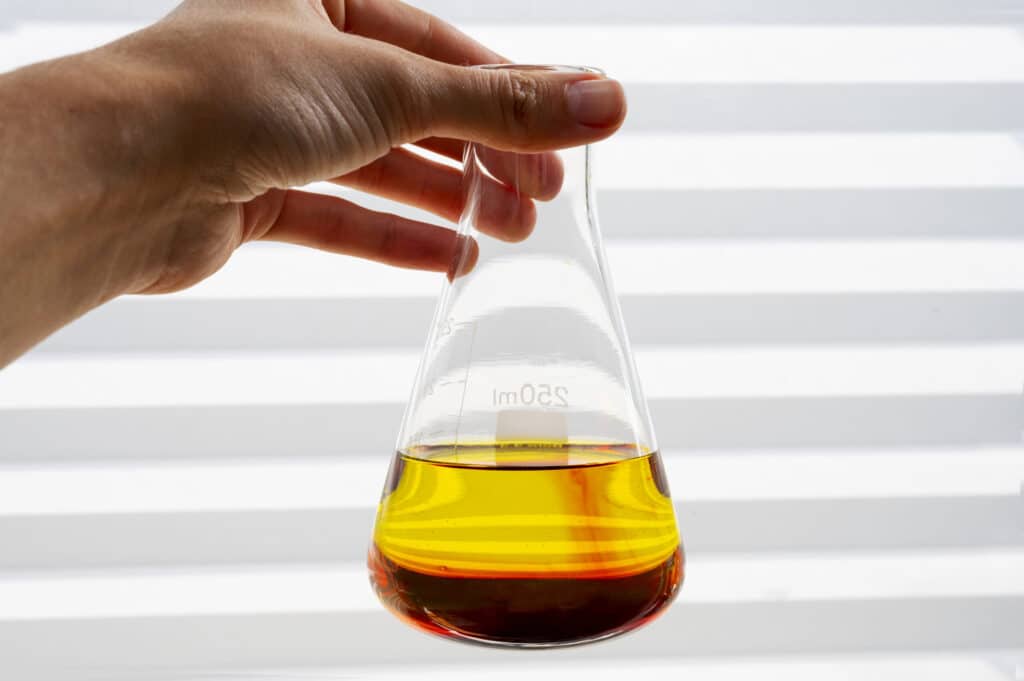

What was the challenge or problem to be solved?
Industrial oils play a critical role in the performance, reliability and operating costs of many production processes. In a context of increasing pressure to reduce operational expenses, the evaluation of alternatives to conventional oils becomes a relevant technical challenge.
In this case, the potential use of recycled oils required an objective and rigorous assessment to ensure that cost reduction objectives could be achieved without compromising process reliability or equipment integrity.
Industrial oil analysis in production environments
In industrial production environments, oils are essential for ensuring stable operation, controlling wear mechanisms and maintaining process continuity. Their behavior in service has a direct influence on equipment performance and long-term reliability. Even minor changes in oil properties can lead to deviations in operating conditions, particularly in continuous or high-demand processes.
The actual condition of the oil directly determines process reliability.
Industrial oil analysis provides a technical basis for understanding the actual condition of the oil under real operating conditions. This type of assessment makes it possible to evaluate whether the material remains suitable for its intended use and whether alternative solutions can be considered without introducing additional operational risks.
Production cost optimization through technical evaluation
Cost optimization in production cannot be approached solely from a purchasing perspective. In many cases, an apparent reduction in consumable cost may lead to indirect expenses associated with increased wear, higher maintenance requirements or reduced process stability. For this reason, any cost-driven decision must be supported by a technical evaluation of its overall impact.
In this project, the technical assessment made it possible to identify scenarios in which recycled oils could contribute to reduce significant costs, provided that their in-service behavior was compatible with process requirements. This approach ensured that economic benefits were evaluated alongside operational reliability.
Technical comparison between new and recycled industrial oils
One of the main challenges of the study was the comparison between new and recycled oils, as recycled materials inherently exhibit greater variability. Differences related to origin, previous service conditions or regeneration processes can affect key properties relevant to industrial use.
The variability of recycled oil requires case-specific technical evaluation.
The technical comparison was therefore conducted with a practical, application-oriented perspective. Particular attention was paid to the potential presence of contaminating substances, as well as to variability associated with previous service conditions or regeneration processes, which could influence the suitability of recycled oils for specific industrial applications.
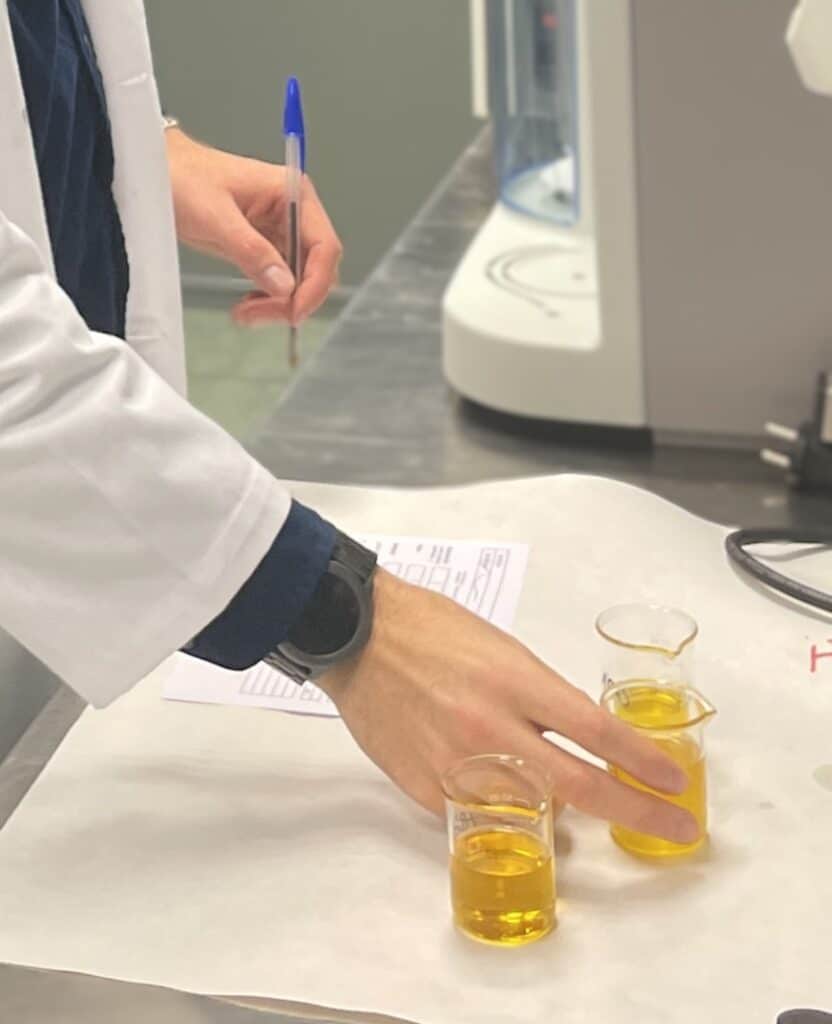
How was it addressed or what was the solution?
The solution was based on a comparative physicochemical characterisation of the oils involved. The analytical strategy was designed to generate technically relevant data that could support decision-making regarding the suitability of recycled oils for a specific production process.
Physicochemical analysis of industrial oils as a strategic approach
Physicochemical analysis represents a fundamental tool for understanding the behavior of industrial oils in service. In this context, the analysis also supports the identification of particles that may affect operational stability under real production conditions, providing additional insight for technical decision-making.
Beyond verifying compliance with nominal specifications, the analysis provided insight into how specific properties might affect process behavior. This made it possible to assess the potential implications of using recycled oils under real industrial conditions.
Physicochemical analysis enables decisions based on data, not assumptions.
Execution of the analysis and technical evaluation by INFINITIA
The project was carried out through laboratory testing focused on the characterization of industrial oils, with the scope of analysis defined according to the relevance of each parameter for the intended application. INFINITIA’s technical team contributed to defining the analytical approach, prioritizing parameters with the greatest potential impact on in-service behavior.
The comparative evaluation allowed differences and trends between samples to be identified and interpreted in the context of actual operating conditions. The results were analyzed with a practical and application-driven perspective, ensuring that conclusions remained technically sound and directly applicable.
Benefits obtained through comparative oil evaluation
The study provided a clear and objective understanding of the similarities and differences between new and recycled oils. This reduced uncertainty associated with the potential introduction of recycled oils into production processes and supported informed technical decision-making.
The main benefit was the ability to optimize production costs based on validated technical criteria, minimizing operational risks and maintaining process reliability. The project highlights the value of industrial oil analysis as a strategic tool for improving operational efficiency when applied within a rigorous and contextualized framework.