
What was the challenge or problem to be solved?
The client needed to determine whether heating a polymeric material under its real operating conditions could generate emissions of volatile gases with potential health risks.
The uncertainty did not lie in the mechanical performance of the plastic, but in the possible release of volatile compounds during thermal exposure under actual conditions, and in the need to assess their hazardousness objectively.
Controlled pyrolysis of plastics
Controlled pyrolysis of plastics describes the progressive thermal degradation that may occur when a polymer is subjected to elevated temperatures without reaching combustion. Although the material may appear stable externally, molecular bonds within the polymer chains can break, generating smaller fragments capable of volatilizing. This phenomenon is not always visible and does not necessarily imply an immediate loss of functionality, but it may represent a significant chemical transformation.
Thermal behavior depends on multiple factors, including the nature of the polymer, the presence of additives or plasticizers, and exposure time. Even within the recommended temperature range, thermal degradation processes may begin, producing substances not initially anticipated. Therefore, it was essential to analyze the material under conditions representative of its real application rather than under extreme scenarios unrelated to industrial use.
Thermal degradation can generate unexpected compounds even within the material’s operating range.

Within the context of the project, the objective was to verify whether reactions capable of releasing compounds with potential toxicological impact occurred within the defined temperature range. This approach replaced theoretical assumptions with experimental data and provided a clearer understanding of the polymer’s behavior under controlled heating.
Risk assessment of gaseous emissions in industrial environments
The risk assessment of gaseous emissions in industrial environments required integrating analytical results within a clear technical and regulatory framework. Detecting the presence of substances does not automatically imply a significant risk. Relevance depends on factors such as generated concentration, exposure frequency, and environmental ventilation conditions.
Each identified substance was analyzed considering its toxicological classification, potential irritant or toxic effects, and occupational exposure limits established by competent authorities. This assessment made it possible to distinguish between compounds with limited impact and those that might require specific preventive attention.
Hazard depends not only on the compound but also on its concentration and exposure conditions.
In addition, the specific operational scenario was evaluated, including potential accumulation in confined spaces or continuous use conditions. The objective was to provide a technically grounded assessment, avoiding alarmist conclusions and enabling evidence-based decision-making.
Identification of volatile organic compounds (VOCs) generated by heating
The identification of volatile organic compounds (VOCs) generated by heating constituted the technical core of the project. Thermal degradation of a polymer can produce a complex mixture of substances with diverse chemical structures and, in many cases, similar characteristics. This complexity requires analytical methodologies with high sensitivity and strong discrimination capability.
The objective was not merely to detect emissions but to assign a reliable chemical identity to each analytical signal. This required minimizing interferences, ruling out external contamination, and ensuring full traceability of results. Precision at this stage was critical, as any identification error could significantly affect the subsequent risk evaluation.
From the Forensic Engineering area, and through the Quality Control and Testing service, INFINITIA addressed this phase by applying strict validation criteria and cross-checking results against recognized databases. This ensured a robust chemical profile to support the subsequent safety assessment.
How was it addressed or what was the solution?
To respond to the identified need, an analytical strategy was defined that integrated controlled thermal simulation, efficient emission capture, and advanced instrumental identification. The approach was designed to faithfully reproduce real operating conditions and generate information directly applicable to safety evaluation.
TGA thermogravimetry of polymers to simulate real operating conditions
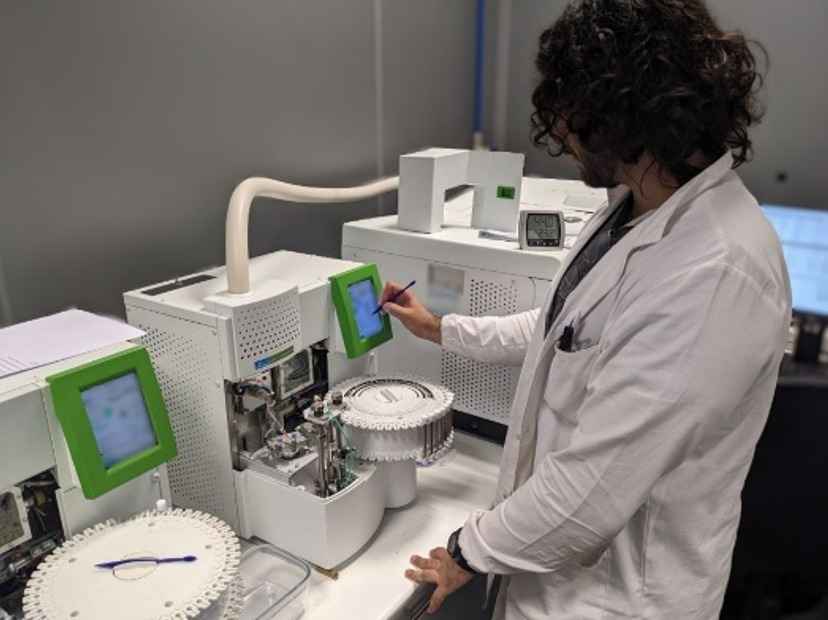
TGA thermogravimetry of polymers allowed the sample to be subjected to a progressive and controlled heating program while recording its behavior as a function of temperature. This technique provided information on potential mass losses associated with the release of volatile compounds and identified temperatures at which degradation intensified.
Its main advantage lies in the direct correlation between applied temperature and detected decomposition events. This made it possible to verify whether significant changes occurred within the defined temperature range or whether the material remained chemically stable.
During the test, the released gases were captured and subsequently analyzed using GC-MS.
GC-MS analysis for accurate identification of unknown volatiles
GC-MS analysis enabled the separation and individual identification of substances captured during the thermal phase. Gas chromatography discriminated compounds based on their physicochemical behavior, while mass spectrometry provided structural information derived from molecular fragmentation patterns.
Each chromatographic peak was evaluated to assign a chemical identity with a high degree of confidence. Spectral matches were compared against recognized libraries and reviewed when necessary to avoid misinterpretations.
Accurate chemical identification is essential for reliable risk assessment.
In addition, the relative abundance of detected compounds was estimated, allowing prioritization of those with greater potential relevance. This phase converted a complex emission into a structured and technically interpretable chemical profile.
Safety assessment of plastics at high temperature
The safety assessment of plastics at high temperature consisted of interpreting the obtained chemical profile within an industrial safety framework. Each identified substance was compared against toxicological databases to determine its hazard classification and potential health effects.
Occupational exposure limits and regulatory criteria applicable to the evaluated environment were reviewed. This analysis made it possible to determine whether the detected emissions could be considered compatible with safe use or whether specific mitigation measures were advisable.
The final report integrated testing conditions, analytical results, and technical interpretation into a structured document. Through this approach, it was possible to move from an initial hypothesis to a conclusion supported by experimental evidence and critical analysis.