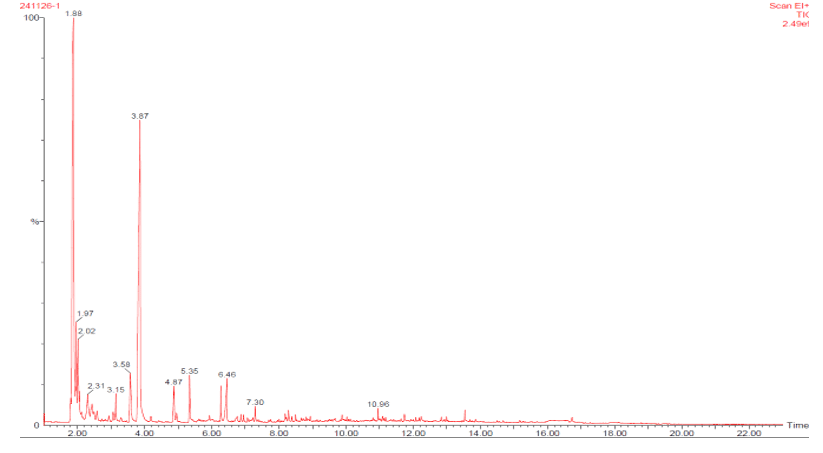

What was the challenge or problem to be solved?
In the electronic cigarette industry, the composition of refill liquids is a critical aspect from a technical, regulatory, and commercial perspective.
Proper declaration of nicotine concentration not only affects product perception by consumers, but also regulatory compliance and the trust relationship between manufacturers, distributors, and raw material suppliers.
Chemical analysis of electronic cigarettes as a guarantee of technical accuracy
An operator in the sector received a batch corresponding to a new product line and needed to verify that the nicotine concentration indicated by the supplier matched the actual content of the delivered product. In this context, chemical analysis of electronic cigarettes became an essential tool to confirm the accuracy of the declared technical information and reduce uncertainty associated with market launch.
The need did not arise from an evident non-conformity, but from a preventive approach aimed at minimizing risk. Before introducing the product to the market, the client required independent validation to support the technical documentation received. This type of action is becoming common practice in sectors where chemical formulation directly impacts safety and regulatory compliance.
Validating composition before launch reduces technical and regulatory risks.
Moreover, electronic cigarette liquids are not simple substances. They are formulations combining solvents, flavorings, and other additives, which requires approaching the analysis from a comprehensive matrix perspective. The initial challenge was therefore to ensure that the study considered this complexity and delivered technically robust results.
Nicotine analysis in liquids to validate supplier specifications
The main objective was to perform nicotine analysis in liquids to accurately determine the real concentration present in the supplied samples. This determination had to generate quantitative data comparable to the supplier’s technical data sheets and sufficiently robust to support internal decision-making.
From the client’s perspective, the purpose was clear: to obtain analytical evidence confirming whether the declared content was correct or whether deviations existed that could affect product commercialization. This validation was relevant both in terms of quality control and supplier evaluation.
Small nicotine deviations can impact both quality and compliance.
The task was not merely to detect the presence of nicotine, but to quantify it accurately. In formulated products, small concentration variations can have technical and regulatory implications. Therefore, the analysis needed to provide precision, repeatability, and traceability, avoiding ambiguous interpretations.
Analysis of complex mixtures as the project’s technical challenge
The main technical challenge of the project lay in addressing the analysis of complex mixtures, since nicotine had to be determined within a liquid matrix composed of multiple substances with different physicochemical behaviors. In this type of matrix, analytical interferences, signal overlap, or formulation-related effects are common.
The difficulty was not simply identifying nicotine, but isolating its signal and quantifying it reliably against the background of other components. This required selecting an instrumental technique with adequate separation capability and sufficient sensitivity to avoid misinterpretation.
In this context, INFINITIA defined an analytical strategy aimed at minimizing uncertainties and ensuring the metrological quality of the final result. The adopted approach transformed a potentially problematic mixture into an analytically manageable system, guaranteeing that the obtained data were technically defensible.
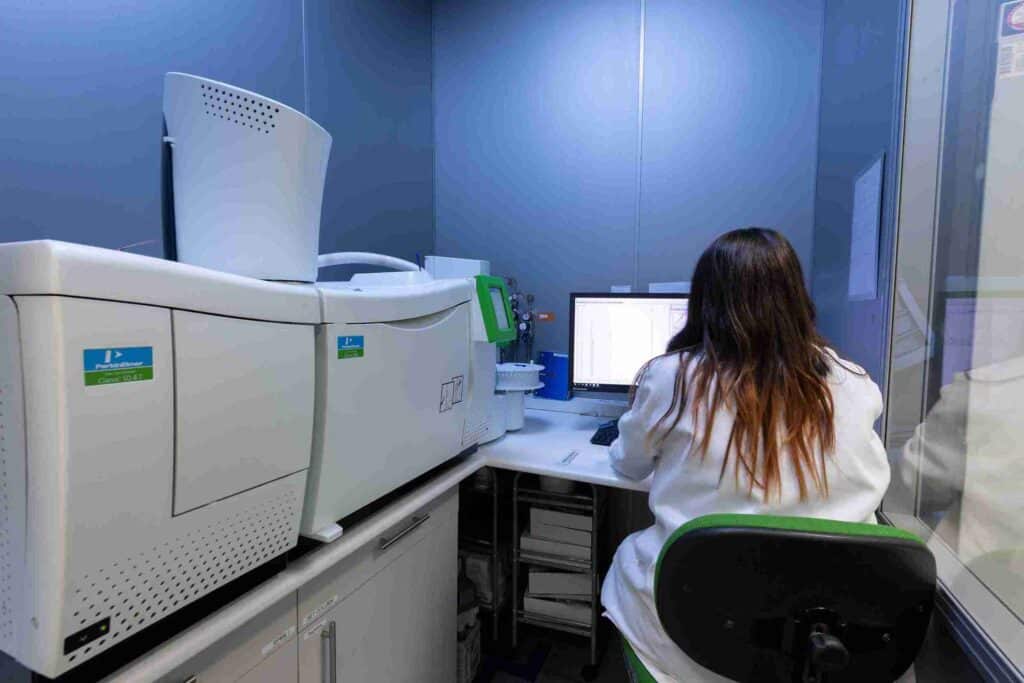
How was it addressed or what was the solution?
Once the objective of the study was defined, a work plan was structured to obtain reliable quantitative results, consistent with good laboratory practices and aligned with the client’s needs.
Nicotine quantification by GC-MS as the reference instrumental approach
To carry out the measurement, nicotine quantification by GC-MS was selected, a technique particularly suitable for analyzing organic compounds in liquid matrices. Gas chromatography enables separation of the different components present in the sample, while mass spectrometry allows their specific identification and quantification with high sensitivity.
The combination of both techniques provides selectivity, precision, and the ability to discriminate against potential interferences. In formulated liquids, where multiple volatile and semi-volatile compounds coexist, this approach is especially effective.
The analytical technique selected determines result reliability.
The choice of this method was based on objective technical criteria: efficient separation, unequivocal identification of the analyte, and reproducible results. This ensured that the measured signal corresponded exclusively to nicotine and not to other compounds with similar behavior.
Quality control in liquids through a structured analytical protocol
The study was conducted within the framework of a quality control in liquids service, applying a structured analytical protocol that ensured consistency throughout all phases of the process. The first stage involved sample preparation, obtaining appropriate dilutions to ensure homogeneity and representativeness.
Incorrect preparation can introduce systematic errors that compromise result validity. For this reason, this phase was handled with particular care, establishing controlled conditions to preserve analyte integrity and facilitate subsequent instrumental analysis.
Subsequently, the instrument’s working parameters were adjusted to optimize chromatographic separation and mass spectrometric detection. This optimization maximized compound resolution and improved signal quality. The technical team performed all tasks under strict methodological criteria, ensuring full traceability of each step.
Nicotine determination and objective validation of results
As a result of the study, nicotine determination was successfully achieved in the analyzed samples, obtaining quantitative values that were directly comparable with the technical specifications provided by the supplier. This comparison enabled an objective assessment of the agreement between declared and measured values.
The data provided the client with a solid technical basis for decision-making, whether regarding batch validation, supply continuity, or revision of internal approval processes. The generated information went beyond a numerical result, constituting verifiable analytical evidence.
The project was considered successful because it transformed a verification need into measurable, technically grounded results. It also demonstrated INFINITIA’s capability to perform composition analysis in complex liquid products using advanced instrumental techniques, adding value to industrial control and validation processes.