
What was the challenge or problem to be solved?
The chemical industry typically operates in environments where materials are exposed to extremely aggressive conditions. High temperatures, the presence of reactive chemical substances, and electrochemical processes can accelerate the degradation of metals used in industrial equipment, especially in contexts involving corrosion in chemical reactors. In this context, selecting suitable materials not only affects process efficiency but also the safety and service life of the equipment.
In this scenario, a company in the chemical sector needed to accurately evaluate the behavior of different metallic materials intended to be part of a reactor. The objective was to understand their performance against corrosion under severe operating conditions, including the effect of welded areas, which often represent critical points of degradation.
Corrosion in chemical reactor components
Chemical reactors operate with highly reactive substances and, in many cases, under conditions that promote electrochemical degradation processes. This can lead to progressive material loss, structural weakening, and contamination of the production process.
Corrosion in chemical reactors is particularly relevant when metals are in direct contact with aggressive media. Under these circumstances, even small variations in material composition or microstructure can lead to significant differences in corrosion behavior. For this reason, selecting the appropriate material requires rigorous experimental studies to evaluate its resistance under conditions representative of real operating environments.
Material selection in a chemical reactor not only affects equipment durability but also process safety and final product stability.

In the case analyzed, the client needed to select the most suitable material to manufacture an electrode designed to operate in an aggressive chemical environment. The goal was to ensure that the component maintained its integrity over long periods of operation, avoiding premature failures or degradation issues that could compromise reactor performance.
Corrosion resistance of metallic materials
The corrosion resistance of metallic materials depends on multiple factors, such as chemical composition, material microstructure, applied heat treatments, and environmental conditions. In demanding industrial applications, even small differences between materials can have a significant impact on durability.
For the client, the challenge was to compare the behavior of different materials under severe corrosion conditions in order to identify which offered the highest chemical stability. This type of evaluation is essential to minimize operational risks, reduce maintenance costs, and ensure the reliability of industrial equipment.
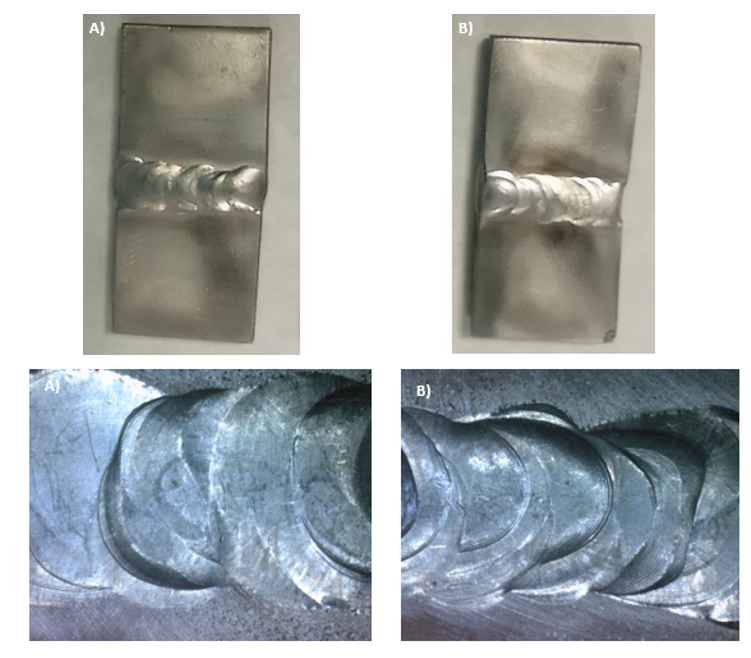
Additionally, the analysis had to consider not only the base material but also the areas where welded joints are present. These regions often exhibit different metallurgical characteristics from the original material and can act as preferential corrosion sites if not properly evaluated.
Therefore, the study needed to provide reliable information on the overall material behavior, including those areas that are typically more vulnerable in industrial environments.
Corrosion in heat-affected zones of welds
Welded areas represent one of the most sensitive regions to degradation in metallic components exposed to aggressive environments. During the welding process, microstructural changes, residual stresses, and local variations in composition are generated, which can alter the material’s corrosion behavior.
Corrosion in welds can manifest in different forms, such as localized corrosion, intergranular corrosion, or electrochemical phenomena associated with potential differences between different areas of the material. These situations can lead to accelerated degradation compared to the base material.
Welded joints are often critical degradation points due to their different microstructures and residual stresses compared to the base material.
The technical challenge of the project was to develop an experimental methodology capable of specifically evaluating the behavior of welded areas. To achieve this, it was necessary to design a testing system that could isolate only the region of interest, preventing the rest of the material from influencing the results.
Furthermore, the setup had to withstand the aggressive conditions of the test environment while maintaining the stability of the electrochemical system throughout the experiment. Ensuring this level of experimental precision was essential to obtain representative results that would support reliable material selection decisions.
How was it addressed or what was the solution?
To address the challenge, the INFINITIA team designed a specific experimental approach aimed at evaluating the corrosion behavior of the materials under study. The main objective was to reproduce laboratory conditions representative of real operating environments and to obtain comparable data across different material configurations.
The work was structured in several stages, combining the design of specific experimental devices, the fabrication of components through prototyping, and the execution of advanced electrochemical tests to accurately analyze the material’s response to the corrosive environment.
Electrochemical testing for corrosion evaluation
Electrochemical corrosion tests are among the most widely used tools to study the behavior of metals in aggressive environments. These techniques allow analysis of how a material interacts with its chemical surroundings by evaluating parameters such as corrosion potential, degradation rate, and stability of protective layers.
For this project, a detailed literature review was first conducted to identify the most appropriate experimental conditions. This analysis made it possible to define key parameters such as the composition of the reaction medium, temperature, and electrochemical conditions required to replicate the operating environment.
Based on this technical foundation, an experimental procedure was designed to ensure reliable and reproducible results. This approach guaranteed that the measurements obtained were comparable across different materials and sample configurations.
Evaluation of corrosion behavior in metallic materials
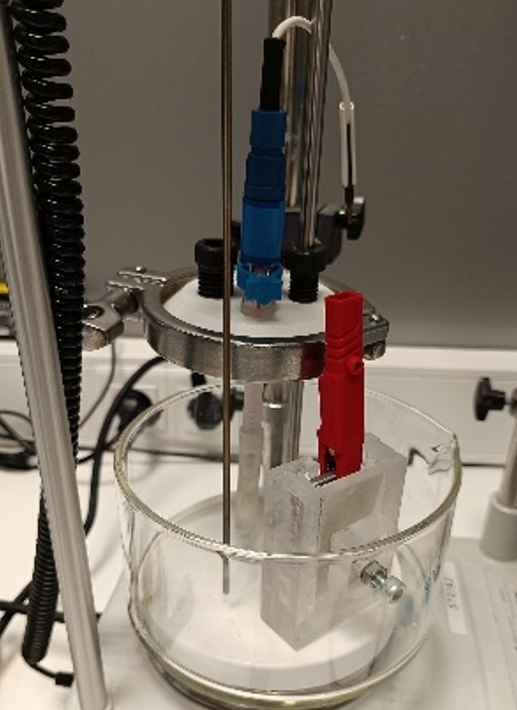
The evaluation of corrosion in materials was carried out through the design of a specific experimental system that enabled independent analysis of both the base material and welded areas. This required the development of a device capable of isolating only the region of interest during testing.
The team initially designed a prototype electrochemical cell made of methacrylate. This first version was manually manufactured to validate the concept and confirm that only the welded area could be exposed to the corrosive medium.
Designing specific experimental devices allows critical material areas to be evaluated beyond the capabilities of standard testing setups.
Once the prototype design was optimized, the final version was manufactured using 3D printing. This method enabled precise and reproducible geometry, ensuring that all tests were conducted under equivalent conditions.
The use of rapid prototyping facilitated iterative improvements until an optimal configuration was achieved, resulting in an experimental system specifically tailored to the project requirements.
Selection of corrosion-resistant materials
Selecting corrosion-resistant materials is a key step in the design of industrial equipment operating in aggressive chemical environments. Having reliable experimental data on material behavior allows informed decisions that improve system safety and durability.
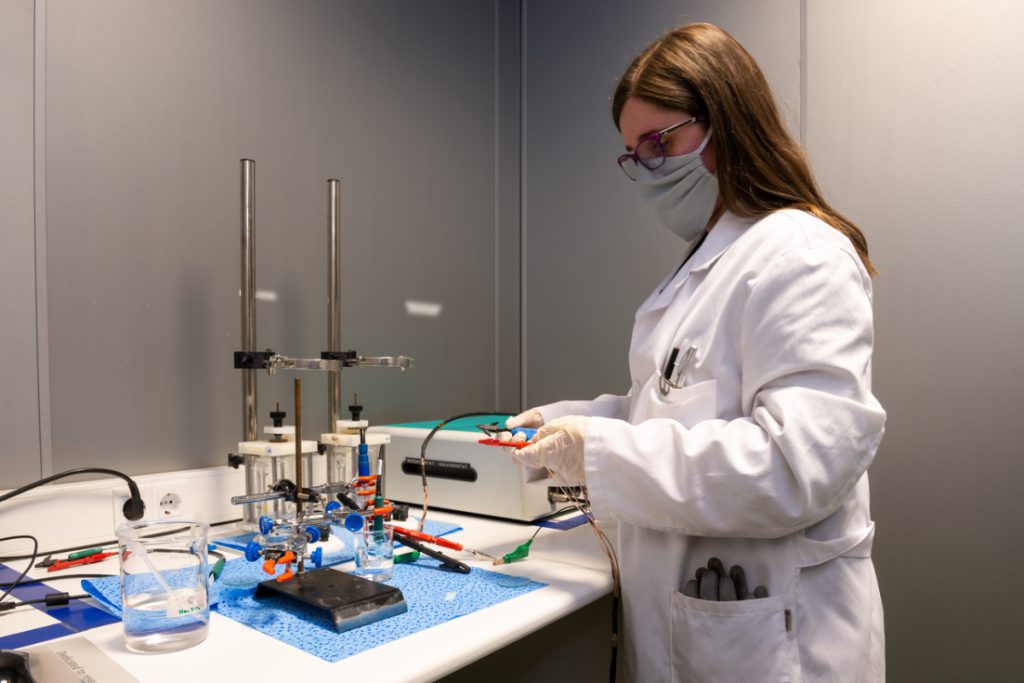
In the final phase of the project, electrochemical measurements were performed using a specialized potentiostat. This device controls the electrical potential applied to the system and measures the electrochemical response of the material, providing detailed information on its corrosion behavior.
These measurements made it possible to compare the performance of the different materials evaluated and to analyze the influence of welded areas on overall behavior. The results identified which configurations offered greater resistance to degradation under the studied conditions.
This study provided the client with a solid technical basis for selecting the most suitable material for application in chemical reactors. It also validated an experimental methodology capable of accurately evaluating material performance under aggressive conditions.
The experience gained during the project demonstrates INFINITIA’s ability to design experimental solutions tailored to complex industrial challenges, integrating scientific knowledge, technical development, and specialized material characterization testing.