What was the challenge or problem to be solved?
In certain industrial environments, the need to reliably separate and classify metallic materials is a key requirement to optimize production processes, improve operational efficiency, and reduce errors in subsequent stages. This need becomes critical when materials share similar physical properties, making their identification through conventional methods more difficult. As a result, a lack of classification accuracy can lead to cumulative inefficiencies that affect both product quality and overall system performance.
In this context, the need arose to address the problem through an approach based on metal detector development, enabling the identification and discrimination of different types of metals in real time without relying on complex or high-cost systems. The limitations of standard solutions available on the market made it necessary to adapt this solution to the specific needs of the process, ensuring greater technical control and better integration into the client’s industrial environment.
Detection of ferrous and non-ferrous metals through electromagnetic response
The client faced a challenge related to the correct identification of materials within their process, where both ferrous and non-ferrous metals needed to be distinguished. This need was not occasional but structural, as it directly affected the quality of the production flow. The absence of a reliable solution generated uncertainty and limited the system’s automation capabilities.
Detecting ferrous versus non-ferrous metals, such as aluminum, requires considering differences in electromagnetic properties that are not always evident. Many conventional sensors allow presence detection but do not provide sufficient information to discriminate between materials. This represents a significant technical limitation when the objective is classification rather than simple detection.
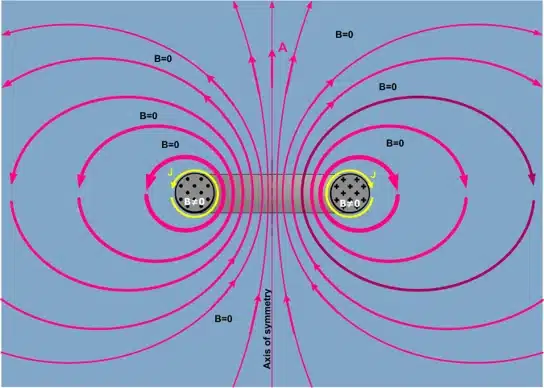
Material differentiation is based on their interaction with the electromagnetic field, enabling classification according to measurable physical properties.

Additionally, classification errors can propagate throughout the process, affecting both final quality and operational costs. In environments where repeatability is critical, this lack of control represents a relevant risk. Therefore, it was necessary to move toward a more precise and robust solution.
In this scenario, the objective was to evolve toward a system capable of classifying steel and aluminum based on measurable parameters. The goal was not only to detect but to reliably interpret the signal. This transition marked the starting point of the project.
Metal classification system based on differential electromagnetic properties
The objective of the project focused on developing a system capable of integrating into the existing process without introducing unnecessary complexity. To achieve this, it was necessary to design a metal classification system that could deliver consistent results under real operating conditions. The solution had to be robust, scalable, and compatible with the client’s environment.
One of the key aspects was ensuring that the system could operate continuously without requiring constant adjustments. This involved defining a stable and predictable architecture from a technical standpoint. System reliability was as important as its discrimination capability.
From an operational perspective, the system needed to reduce manual intervention in the process. Automating classification made it possible to improve efficiency and reduce human error. This represented a significant improvement in terms of productivity.
In this context, the development of a custom industrial metal detector was identified as the most appropriate solution. This approach allowed the system to be adapted to the actual needs of the process while facilitating integration with existing elements.
Technical challenge in the design of an inductive detector for metal material discrimination
The main technical challenge of the project lay in discriminating between materials with different electromagnetic behaviors. Although the use of inductive sensors for metals is a known solution, its application in classification requires higher precision. Differences between materials can be subtle and difficult to capture.
The system needed to detect small variations in the signal generated by the interaction with the material. This involves working with signals that are sensitive to external disturbances. Therefore, the design had to ensure stability and repeatability.
Small variations in the signal may reflect differences between materials, so system stability is essential to avoid interpretation errors.
The use of an oscillator circuit with an inductor provided an appropriate basis to address the problem. However, its implementation required fine tuning to avoid misinterpretation. The signal had to be sufficiently clear to allow proper analysis.
From INFINITIA’s perspective, this challenge was approached as an electronic product development problem. The key was to balance sensitivity, robustness, and simplicity. This balance was essential to ensure system viability.

How was it addressed or what was the solution?
The solution was developed with a functionality-oriented approach, prioritizing a design capable of capturing relevant differences between materials without relying on complex technologies. This approach made it possible to focus efforts on the key elements of the system, avoiding overengineered solutions. The goal was to ensure efficient implementation adapted to real operating conditions.
In this context, the project was approached as a custom electronic design exercise aligned with the client’s specific needs. The solution had to be technically viable while also being operationally integrable. This approach enabled the development of a system balanced between performance and simplicity.
Inductive metal sensor based on frequency variation in an oscillator circuit
The solution was based on the use of an inductive metal sensor, leveraging the interaction between an electromagnetic field and the material. This principle allows detecting variations depending on the physical properties of the metal. These variations form the basis for differentiation.
The system was designed to capture changes in electrical parameters resulting from the presence of the material. These changes are related to conductivity and magnetic permeability. Interpreting these variables enables classification.
In particular, an oscillator circuit with an inductor was implemented, whose frequency varies depending on the detected material. This variation constitutes the key signal of the system. Although the changes may be small, they are sufficient when properly interpreted.
Frequency variation enables identification of electromagnetic properties of metals without direct contact in industrial environments.
This approach was selected for its balance between simplicity and technical capability. It enables the development of a robust solution without relying on complex technologies and facilitates adaptation to different industrial environments.
Signal processing in metal detector using an embedded microcontroller
The system incorporated a microcontroller responsible for processing the signal generated in the oscillator circuit. This element allows transforming an analog signal into useful information. Its role is key in the classification logic.
The development of the metal detector included programming the microcontroller to analyze frequency variations. These variations are associated with different types of materials. Based on this information, the system can make decisions.
The implementation allowed the transition from basic detection to a classification system. This functional leap is key to the project’s value. It is not only about detecting, but about interpreting.
The INFINITIA team participated in the design, development, and validation of the system. This approach ensured the technical consistency of the solution and facilitated adaptation to real client conditions.
Improvement of steel and aluminum classification through advanced inductive detection
The developed system made it possible to differentiate between steel and aluminum through the analysis of electromagnetic signals. This industrial metal detector provided a concrete solution to the problem. Its implementation improved the process classification capability.
One of the main benefits was the reduction of errors in material identification. This translates into greater operational efficiency. It also improves the quality of the final result.
Process automation reduced the need for manual intervention. This improves system consistency and contributes to optimizing available resources.
Finally, the approach based on electronic product development enables system evolution. The solution is scalable and adaptable to new needs, reinforcing its medium- and long-term value.