
What was the challenge or problem to be solved?
The development and validation of catalysts require experimental infrastructures capable of reproducing controlled reaction conditions. When investigating new catalytic formulations or optimizing a chemical process, it is essential to generate reliable experimental data that allow analyzing the real behavior of the catalyst under different gas mixtures and operating conditions.
In this context, the need arose to design a specific experimental system that would enable reproducible testing, precise control of operating parameters, and comparison between different catalytic configurations.
Catalyst testing bench to analyze real behavior
The development of a catalyst testing bench is essential when studying the behavior of catalytic materials under representative operating conditions. In catalytic processes, variables such as temperature, gas flow rate, mixture composition, and residence time directly affect catalyst performance and must therefore be precisely controlled during experimental testing.
Without a suitable experimental platform, it is difficult to obtain consistent data that allow a rigorous evaluation of catalytic activity. Small variations in experimental conditions can lead to significant deviations in results, making data interpretation more complex and limiting comparisons between different formulations or reactor configurations.
Catalyst testing benches allow controlled reaction conditions to be reproduced and generate comparable experimental data across different materials or reactor configurations.

For this reason, having a testing bench specifically designed for this type of study enables controlled reaction conditions and ensures repeatability of the tests. These experimental tools facilitate the generation of reliable data and are a key element in advancing catalytic technologies.
Catalyst evaluation to validate new technological solutions
Catalyst evaluation is a key stage in research and development processes related to catalytic technologies. Before considering industrial application, it is necessary to analyze catalyst behavior under controlled experimental conditions to determine its performance and stability.
These studies allow the analysis of parameters such as reactant conversion, product selectivity, and the evolution of catalytic performance over time. Based on this data, it is possible to identify the most promising catalytic configurations and detect potential limitations related to the material or operating conditions.
In addition, experimental evaluation provides essential information to guide further process optimization. The results obtained make it possible to adjust reaction conditions, improve catalyst formulation, or adapt reactor design to maximize system efficiency.
Catalyst testing under controlled conditions as an experimental challenge
Designing a system for catalyst testing presents several experimental and technical challenges. To ensure reliable results, all relevant process variables must be properly controlled and monitored during testing.
This involves integrating different subsystems within a single experimental platform, such as gas dosing, flow control, temperature regulation, and instrumentation for recording operating parameters. The coordination of these elements is essential to ensure stable and reproducible testing conditions.
Another key aspect is providing the system with enough flexibility to adapt to different experimental scenarios. Catalytic studies often require variations in gas composition, temperature ranges, or operating conditions, so the system must allow these parameters to be adjusted without compromising result reliability.

How was it addressed or what was the solution?
To meet these requirements, INFINITIA developed an approach based on the design and manufacturing of a specific experimental system for evaluating catalysts in the gas phase. The project was structured in several stages, including defining system specifications, designing the testing bench architecture, and manufacturing the final equipment.
This approach enabled the development of an experimental platform tailored to the client’s needs while ensuring precise control of operating variables and reliable test results.
Gas testing bench as an experimental platform for catalytic testing
The core of the project was the development of a gas testing bench designed to reproduce representative reaction conditions and enable the study of catalyst behavior in the gas phase. These experimental systems are essential tools for analyzing catalytic processes in laboratory or applied research environments.
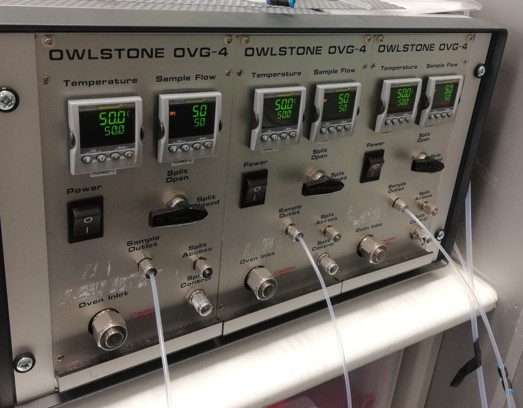
The testing bench was designed to precisely control critical variables such as gas flow rate, gas mixture composition, and reaction temperature. Controlling these parameters is essential to understand how operating conditions influence catalyst activity and performance.
This experimental platform makes it possible to reproduce different operating scenarios and analyze the response of the catalytic system to changes in reaction conditions. This type of analysis improves understanding of catalyst behavior and facilitates the generation of comparable data across different test campaigns.
Catalyst testing system designed and manufactured by INFINITIA
The project included the full development of the catalyst testing system, from conceptual design to manufacturing and commissioning of the experimental equipment. This approach ensured that the system was tailored to the specific requirements of the project and met all technical needs.
A custom-designed testing system allows experimental parameters to be adapted to the specific requirements of each catalytic study.
INFINITIA’s forensic engineering team participated in defining the system architecture, selecting the most appropriate components to ensure stable experimental conditions and precise control of operating parameters. This process included designing gas lines, integrating flow control systems, and implementing solutions for reactor temperature regulation.
Special attention was also given to integrating the instrumentation required to monitor key process variables. Proper data acquisition is essential for interpreting results and rigorously evaluating catalyst behavior during testing.
Catalyst validation through controlled experimental testing
Once the testing bench was developed, the system enabled experiments aimed at catalyst validation under controlled conditions. These studies allow the analysis of catalyst performance and behavior under different gas compositions and operating conditions.
Controlled testing facilitates the generation of reliable experimental data, enabling comparison between different catalytic formulations and evaluation of process parameters. This type of analysis is particularly valuable during the development and optimization phases of catalytic technologies.
Test reproducibility is a key factor for validating catalytic performance and objectively comparing different formulations.
In addition, having a dedicated experimental platform allows tests to be repeated under equivalent conditions, improving the robustness of the results. Reproducibility is essential for validating catalyst behavior and supporting decision-making during technological development.