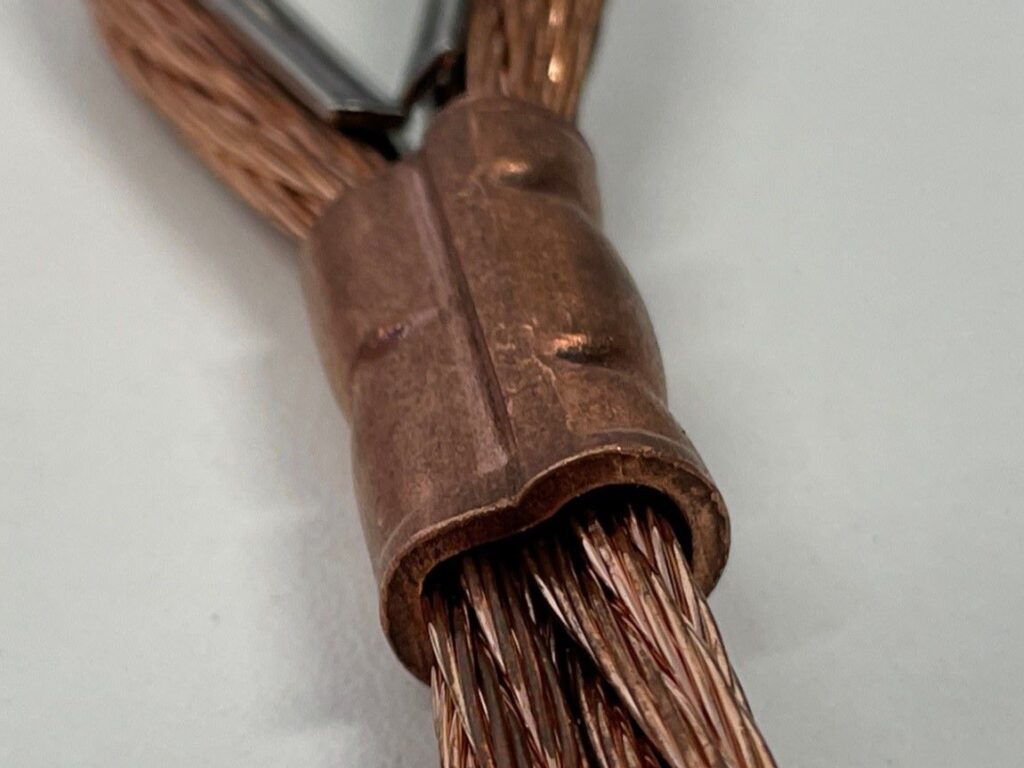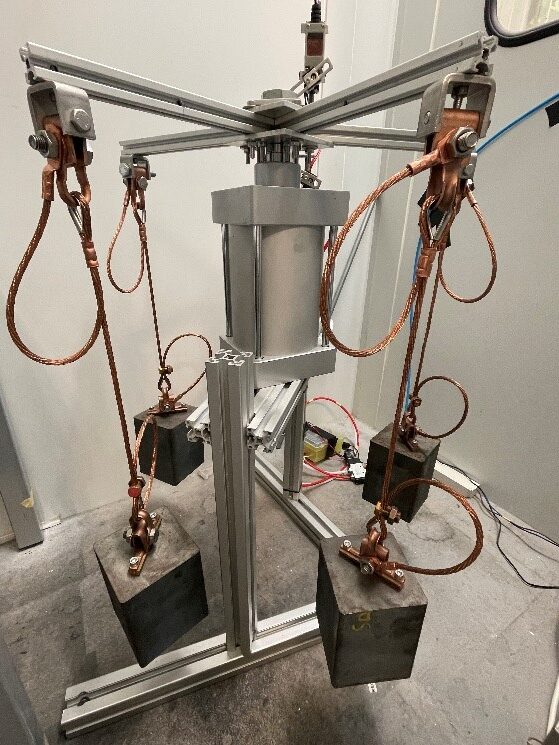

What was the challenge or problem to be solved?
Within the framework of the industrial development of electrical conductors, the need arose to accurately characterize their tensile behavior in order to validate their functional suitability.
The inability to directly apply standardized methods required the development of a specific solution capable of evaluating the elongation of electrical conductors under controlled and representative conditions.
Elongation of electrical conductors as a functional requirement
The starting point was the need to gain a deeper understanding of the mechanical behavior of electrical conductors subjected to tensile stresses throughout their service life. Generic base material values were insufficient, as the conductor’s structural design, cross-section, and final configuration directly influenced its response under load.
The elongation of electrical conductors plays a decisive role in their structural integrity during assembly and in their durability under repeated stresses. Insufficient elongation can lead to premature failure or internal microcracks, while excessive deformation may affect dimensional stability or compromise electrical connections at critical points.
Evaluating elongation helps anticipate mechanical failures before they occur under real operating conditions.

From the client’s perspective, this evaluation was part of the product development process, where it was essential to validate that the component met functional requirements before final implementation. The data obtained needed to be specific to the actual design, rather than extrapolated from non-representative standard tests.
The objective, therefore, was to obtain quantitative data correlating deformation and applied load, reducing technical uncertainty and enabling informed decision-making.
Elongation testing as a mechanical validation tool
The project focused on developing a system capable of performing an elongation test adapted to the conductor’s geometric and functional reality. The priority was not merely to apply tensile force, but to ensure that displacement measurement and load transmission were carried out under controlled conditions.
The aim was to precisely characterize mechanical properties, particularly longitudinal deformation under progressive loading, identifying behavior within the elastic range and deformation thresholds relevant to the intended application.
The expected benefit was twofold. On one hand, to obtain objective validation of the current design. On the other, to establish a solid technical basis for introducing adjustments if deviations from defined criteria were detected.
This approach avoided reliance solely on generic certifications and enabled results directly linked to the actual component, improving technical traceability throughout the project.
Technical complexity in test fixture design
The primary challenge was not only to apply axial load, but to do so homogeneously and reproducibly without altering the conductor’s nature. Conventional grips did not guarantee adequate clamping and could generate stress concentrations or slippage that would distort results.
Additionally, the component’s configuration complicated precise alignment within the testing system. Any deviation could introduce secondary stresses or unwanted bending, affecting data reliability.
For this reason, it was necessary to develop a specific test fixture design tailored to the conductor’s geometry and capable of ensuring proper load transmission. This approach required analysis of tolerances, fixation points, and compatibility with the available tensile testing equipment.
The technical challenge consisted of balancing structural robustness with measurement precision, ensuring that the system did not introduce external variables that could compromise interpretation of the component’s actual behavior.
How was it approached or what was the solution?
The solution consisted of designing and manufacturing a dedicated system capable of performing a custom test adapted to the specific characteristics of the electrical conductor. This approach enabled the analysis to focus on the component’s real behavior while avoiding limitations associated with standard configurations.
The work involved a comprehensive evaluation of the load application system, conductor clamping method, and displacement measurement, ensuring consistency among all elements of the assembly.
Approach based on custom testing and experimental adaptation
The project team defined a technical approach aimed at reproducing mechanical conditions relevant to the conductor’s final application. Expected load ranges and deformation levels of interest were analyzed, establishing clear criteria for test configuration.
The custom test allowed adjustment of parameters such as gauge length, fixation system, and displacement control, preventing external interferences that could affect result interpretation.
A custom test ensures that results reflect the actual behavior of the component, not non-representative standard conditions.
This approach ensured that the evaluation was not merely a forced adaptation of a standard, but a methodology aligned with the project’s technical objective. Repeatability and representativeness of applied conditions were prioritized.
Additionally, preliminary verifications were conducted to validate the system’s operating hypotheses, confirming assembly stability before the full testing campaign.
Implementation through the development of a dedicated experimental setup
The project included the complete development of a dedicated experimental setup, from conceptual phase to final device manufacturing. Initially, a prototype was created to verify design feasibility and adjust critical aspects related to clamping and alignment.
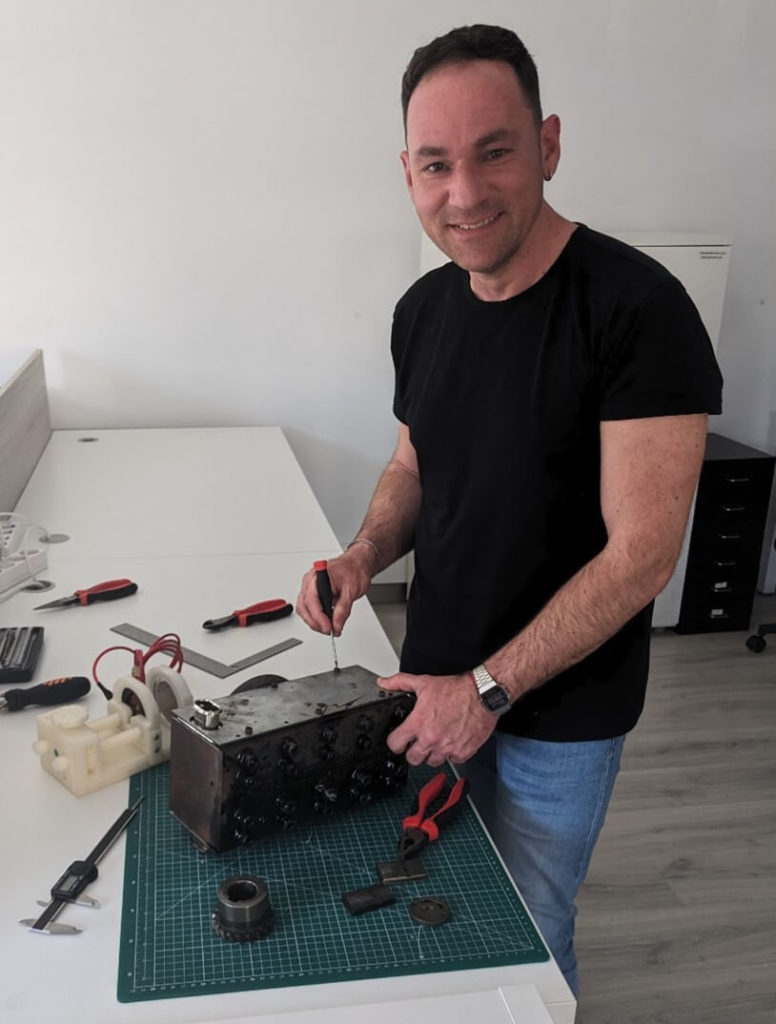
This iterative approach enabled identification of potential improvements before finalizing the definitive solution. The INFINITIA team participated in the design, manufacturing, and functional validation of the system, ensuring correct load transmission and dimensional stability of the assembly.
Developing a dedicated setup improves test repeatability and reduces measurement deviations.
Once optimized, the device was integrated into the available tensile testing system, ensuring mechanical compatibility and precision in force and displacement measurement.
Verification tests were performed to confirm result repeatability and rule out effects induced by the fixture itself, thereby consolidating the reliability of the developed method.
Objective validation of the mechanical properties of electrical conductors
The implemented solution made it possible to obtain quantifiable data on conductor deformation under progressive loading. This information proved decisive in validating the component’s mechanical properties under representative conditions.
The client gained access to an objective technical basis for decision-making, reducing uncertainty associated with the tensile behavior of the evaluated design. Furthermore, the developed system remained available as a reusable tool for future validation phases or comparative assessments between product versions.
The project was considered successful because it transformed an initial technical limitation into a specific and replicable methodology, providing a rigorous procedure to evaluate the elongation of electrical conductors with precision and experimental consistency.