
What was the challenge or problem to be solved?
Ozone-based disinfection systems have become an effective solution for eliminating microorganisms and disinfecting spaces and surfaces. However, their use presents a relevant technical challenge: once the disinfection process is completed, the residual ozone present in the air must be removed before people can re-enter the treated space, often requiring catalytic filters for ozone removal.
In industrial environments or portable disinfection equipment, this requirement can become a limiting factor. If ozone is not removed quickly and in a controlled manner, it can extend waiting times before the space can be reused or create risks associated with exposure to high concentrations of this oxidizing gas. In this context, there is a need to develop solutions capable of efficiently managing residual ozone treatment without compromising the effectiveness of the disinfection system.
Ozone removal in disinfection systems
Ozone is a widely used oxidizing agent in disinfection applications due to its high ability to destroy bacteria, viruses, and organic compounds. Its in situ generation allows it to be applied in multiple industrial contexts, from facility cleaning processes to environmental treatments.
However, this same chemical reactivity means that the presence of residual ozone in the air can become a problem if not properly controlled. After disinfection cycles, its concentration must be reduced to safe levels before allowing human access or resuming certain activities.
In many systems, ozone removal occurs naturally through spontaneous decomposition. However, this process may be too slow for certain applications, especially when aiming to optimize operating times or ensure stricter safety conditions.
Residual ozone treatment to improve operational safety
For manufacturers of disinfection equipment or environmental treatment systems, managing residual ozone is a key aspect of product design. It is not only about generating ozone efficiently, but also about controlling its removal once the process is completed.
In this context, having a technology capable of accelerating ozone neutralization allows for reduced ventilation times, improved safety, and easier system integration in environments where space availability is limited.
The client behind this project faced precisely this challenge: incorporating a technical solution capable of removing the residual ozone generated during system operation without significantly increasing system complexity or compromising industrial feasibility.
Catalytic ozone decomposition as a technological challenge
One of the most effective strategies to accelerate ozone removal is to promote its decomposition through catalytic processes. Catalytic filters for ozone removal enable the rapid transformation of ozone into molecular oxygen, without the need for consumables or additional energy input.
However, developing this type of solution involves several technical challenges. The catalyst must maintain its activity under real operating conditions, withstand continuous exposure to the oxidizing gas, and adapt to the design constraints of the equipment in which it will be integrated.
Ozone is a highly effective oxidant for disinfection, but its residual presence must be quickly reduced to avoid exposure risks in enclosed spaces.

Additionally, from an industrial perspective, the solution must be viable in terms of manufacturing, cost, and durability. For this reason, the selection of catalytic materials and the design of the filtration system require a technical and experimental evaluation process to identify the most suitable alternatives.
In this context, INFINITIA’s materials innovation team approached the project with the aim of exploring different technological options and developing a solution based on catalytic filters for ozone removal that could be effectively integrated into the client’s system.

How was it addressed or what was the solution?
To address the identified problem, the INFINITIA team defined a working strategy focused on identifying, evaluating, and validating different technological solutions capable of accelerating the removal of residual ozone generated during system operation.
The objective was not only to assess the effectiveness of certain catalytic materials, but also to analyze their viability from an industrial perspective. The final solution had to be integrated into the existing equipment, maintain stable performance over time, and be manufacturable without introducing unnecessary complexity into the design.
Development strategy for catalytic filters to remove ozone
The project began with a technological scouting phase aimed at identifying different materials and configurations that could promote catalytic ozone decomposition. At this stage, various alternatives used in similar applications were reviewed, along with different filter architectures capable of incorporating catalytic materials.
Catalysts accelerate ozone decomposition into oxygen without requiring consumables or additional energy input.
This initial analysis established a set of potential options that were subsequently evaluated experimentally. The goal was to determine which combinations offered an appropriate balance between catalytic activity, stability, and ease of integration into the system.
Based on this preliminary selection, different filter prototypes incorporating the identified catalytic materials were designed.
Experimental evaluation of the ozone catalyst
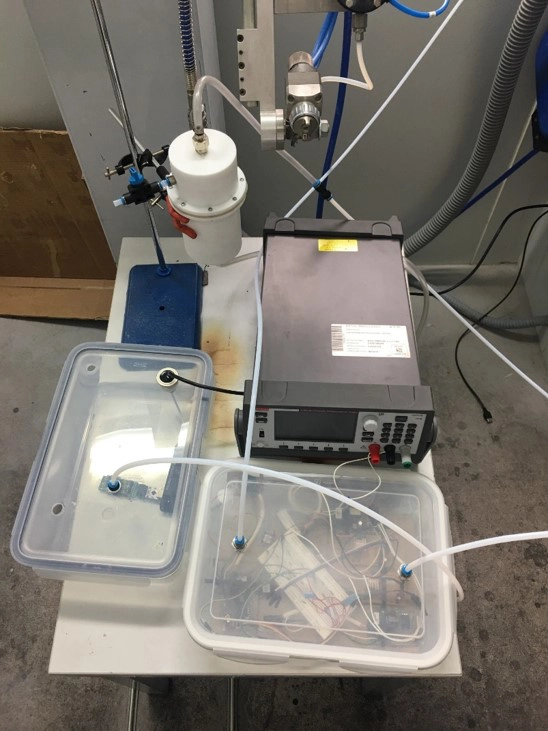
Once the prototypes were defined, the team carried out a series of tests aimed at evaluating the performance of the different solutions under controlled conditions. These experiments made it possible to analyze the ability of each alternative to promote rapid and stable ozone removal.
During this phase, different filter configurations were compared, with particular attention paid to factors such as gas removal efficiency, catalytic material stability, and behavior under prolonged ozone exposure.
This experimental approach provided comparative insights into the performance of the studied options and allowed those that did not meet the application requirements to be discarded.
Benefits of ozone neutralization through catalytic filtration
The evaluation process enabled the identification of a catalytic filtration solution capable of promoting the rapid decomposition of residual ozone into oxygen. This approach significantly reduces the time required to reach safe conditions after disinfection cycles.
From the client’s perspective, integrating a catalytic filter provides several advantages. On one hand, it enhances system safety by facilitating the removal of the oxidizing gas. On the other, it helps optimize equipment operating times, which is particularly relevant in applications with frequent usage cycles.
Fast removal of residual ozone reduces ventilation times and improves the operability of disinfection systems.
Additionally, as a catalytic process, the solution does not require consumables or complex regeneration processes, which supports its integration into compact industrial equipment.
Thanks to this development and evaluation work, the project identified a technically viable alternative to integrate catalytic filters for ozone removal into disinfection systems, improving both safety and functionality.