
What was the challenge or problem to be solved?
In many industrial and professional environments, detergents are routinely used to maintain proper cleaning conditions on surfaces, equipment, and work areas. However, repeated contact with these chemical products can lead to cumulative effects on the materials they interact with, causing progressive deterioration, loss of properties, or surface alterations that affect their durability.
In this context, the need arose to rigorously evaluate the effect of detergents on commonly used surfaces. The objective was to determine whether the continuous use of certain cleaning products could affect materials over time and, if so, identify which detergent-surface combinations could pose a higher risk of degradation.
Effect of detergents on surfaces: understanding their impact in everyday use
The first step was to analyze the context in which detergents were used and the surfaces they regularly interacted with. In many industrial and service sectors, cleaning products contain chemical agents designed to remove grease, organic residues, or contaminants. These agents may include surfactants, alkalis, oxidizers, or solvents, each with a specific behavior depending on the material.
The effect of detergents on surfaces is not always immediate or visible. In many cases, degradation processes occur progressively, accumulating after multiple cleaning cycles. This may result in microcracks, loss of gloss, discoloration, or reduced mechanical strength.
Compatibility between detergents and materials is not always evident small differences in chemical composition can lead to degradation with repeated use.

The difficulty lies in the fact that many of these chemical interactions depend on multiple variables, such as detergent composition, surface material type, operating temperature, or frequency of application. Therefore, a systematic study was required to evaluate these variables and understand how they influence material durability.
Understanding this phenomenon was key for the client, as it would enable anticipating potential deterioration issues and implementing preventive measures before failures occur in service.
Chemical compatibility between detergents and materials: study objective
Once the context was defined, the next step was to clearly establish the objective of the project. The study focused on analyzing the chemical compatibility between detergents and materials, meaning determining the extent to which detergent chemical components could interact with different types of surfaces. This analysis had a clear purpose to validate whether the cleaning products used could negatively affect the materials they come into contact with, especially under repeated or prolonged use.
Evaluating the interaction between detergents and materials makes it possible to anticipate durability issues before failures occur in service.
To achieve this, it was necessary to study both the chemical characteristics of detergents and the properties of the materials used in the surfaces. Each material presents a different resistance to chemical agents. While some metals or polymers may withstand exposure to certain compounds without issues, others may experience degradation or structural changes.
The goal of the study was not only to identify potential incompatibilities but also to understand the mechanisms behind these interactions. This knowledge would enable the development of preventive strategies, such as selecting less aggressive detergents or choosing more resistant materials for specific applications.
In this way, the project was conceived as a tool to improve technical decision-making regarding material and cleaning product selection.
Material degradation caused by detergents: a complex technical challenge
Analyzing material degradation caused by detergents involves several technical challenges. First, chemical interactions between detergents and materials can vary widely. Some compounds may cause oxidation in metals, while others may affect polymers through swelling, embrittlement, or additive loss.
Additionally, under real usage conditions, these interactions do not occur in isolation. Factors such as temperature, humidity, or mechanical action during cleaning can intensify the effects of detergents on surfaces.
For this reason, one of the main challenges of the project was to reproduce, in a controlled way, the conditions that could lead to material degradation. It was necessary to identify which detergent-material combinations could pose a higher risk and design tests capable of evaluating these scenarios within a reasonable timeframe.
INFINITIA addressed this challenge through a methodology combining theoretical analysis and experimental validation. This approach reduced initial uncertainty and focused experimental efforts on the most critical combinations.
How was it addressed or what was the solution?
To answer the client’s questions, the INFINITIA team developed a structured strategy combining documentary analysis, scientific review, and experimental testing. The objective was to build a solid knowledge base to correctly interpret the interactions between detergents and materials.
The project was carried out in several phases, each aimed at better understanding the variables involved in the interaction between cleaning products and surfaces.
Accelerated aging tests: reproducing years of use in the laboratory
One of the key elements of the study was the design of accelerated aging tests, a widely used methodology to evaluate material durability under demanding conditions.
These tests allow simulating in the laboratory the effects that would occur after long periods of real use. To achieve this, materials are exposed to more severe conditions than usual, such as elevated temperatures, prolonged exposure to chemical agents, or repeated cycles of contact with detergents.
Accelerated aging tests allow reproducing in the laboratory the effects that years of use can have on materials.
In this case, the tests were designed to analyze how surfaces evolved when exposed to detergents under elevated temperature conditions and prolonged exposure over time. This approach made it possible to observe changes in material properties more quickly.
The use of previously developed testing models facilitated the definition of experimental conditions, allowing adaptation to the specific context of the project.
Failure analysis in materials: integration of INFINITIA services
During the experimental phase, the project incorporated methodologies from the failure analysis in materials service, one of INFINITIA’s areas of expertise.
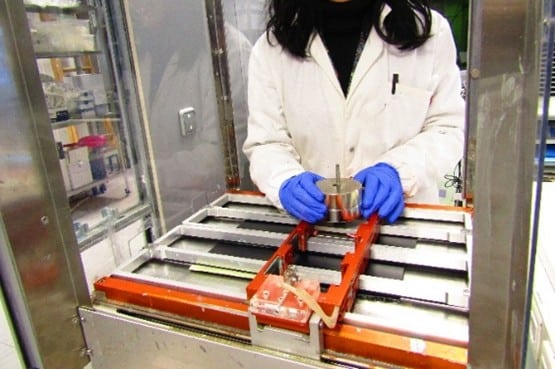
The technical team conducted different tests to evaluate whether the detergent-surface interaction caused changes in the physical or mechanical properties of the materials. These included mechanical tests designed to detect alterations in strength or structural behavior after exposure to detergents.
In addition to mechanical testing, signs of deterioration such as surface wear, loss of integrity, or the appearance of structural defects were also analyzed.
The team combined these observations with the theoretical analysis results. This integration allowed interpreting experimental findings within a broader context, linking observed changes to possible chemical interaction mechanisms between detergents and materials.
This multidisciplinary approach enabled a comprehensive understanding of the problem, combining chemistry, materials science, and engineering.
Chemical resistance of materials: optimal detergent-surface combinations
The project made it possible to identify which detergent-surface combinations presented a higher degradation potential, providing a clearer understanding of the chemical resistance of materials against different detergent ingredients. The results helped determine how factors such as temperature, exposure time, or cleaning frequency influence material deterioration.
Thanks to this study, the client obtained technical information to better assess compatibility between detergents and surfaces, enabling more informed selection of cleaning products and materials to ensure durability under real operating conditions.
Additionally, the analysis identified which materials were more sensitive to specific chemical compounds present in detergents. This was particularly useful to detect situations where prolonged use of certain cleaning products could accelerate degradation processes or loss of properties.
Overall, the study provided a solid technical basis to improve decision-making regarding material and cleaning product selection. Understanding how surfaces behave when exposed to chemical agents helps anticipate potential issues and contributes to improved reliability and service life of materials.