
What was the challenge or problem to be solved?
The durability of coatings applied to plastic surfaces is a key factor in ensuring the reliability and performance of many industrial products. These coatings can provide properties such as wear resistance, chemical stability, or surface protection, but it is essential to verify that these characteristics are maintained over time.
In this context, an industrial company needed to assess whether new coatings applied to its plastic surfaces offered better performance than the original ones. The challenge was to design a testing methodology capable of simulating, within a reduced period of time, the degradation processes that coatings could experience during the real use of the product.
Coating durability in industrial applications
In many products manufactured from plastic materials, surface coatings play an important role in improving performance against wear, chemical interaction, or repeated use. These functional layers help protect the base material and preserve specific product properties, whether mechanical, chemical, or aesthetic. However, for these benefits to be meaningful, it is necessary to verify that the coating maintains its performance over time.
Coating durability therefore becomes a critical factor when introducing new solutions into industrial products. A coating that initially exhibits good properties may undergo premature degradation if it has not been properly validated under realistic service conditions. This degradation may appear as loss of adhesion, color changes, surface deterioration, or reduced resistance to wear.
Coating durability defines the real service life of the product.

In the case analyzed, the client had introduced new coatings on certain plastic surfaces with the expectation of improving the final product’s performance. Before definitively adopting this solution in their production process, they needed to verify whether the new material actually offered advantages over the original coating and whether it could maintain its properties during use.
Evaluation of coatings on plastics to validate new solutions
The objective of the project was to carry out an evaluation of coatings on plastics that would allow an objective comparison between the original materials and the new proposed coatings. This comparison needed to be conducted under controlled conditions capable of revealing potential differences in their resistance to various degradation mechanisms.
Waiting for the products to age naturally over several years was not feasible for the client. For this reason, it was necessary to use testing methodologies capable of accelerating deterioration processes and providing results within a significantly shorter timeframe. This approach makes it possible to anticipate the behaviour of materials and identify potential issues before products reach the market.
Furthermore, the evaluation needed to include analytical techniques capable of detecting both visible and subtle changes in the coatings. This was particularly important for identifying surface alterations that, although initially minor, could evolve into more significant problems during prolonged product use.
Accelerated ageing tests to simulate real use
One of the main challenges of the project was defining accelerated ageing tests capable of realistically reproducing the degradation processes that affect coatings during their service life. These tests subject materials to controlled stress conditions that accelerate deterioration mechanisms that would normally occur gradually over time.
Accelerated testing enables failure prediction before market release.
Material ageing can be influenced by multiple factors, including exposure to chemicals, mechanical wear caused by friction, or interaction with different environmental agents. In many cases, these processes develop slowly and may take years to become noticeable. Therefore, accelerated simulation of these conditions becomes a key tool for evaluating coating stability.
The technical challenge of the project was to design a set of tests that could accelerate these phenomena without introducing unrealistic conditions that might distort the results. The testing strategy had to provide reliable conclusions about coating behaviour and its ability to maintain performance during real product use.
How was it addressed or what was the solution?
To respond to the client’s needs, INFINITIA designed a testing strategy that allowed the behaviour of the coatings to be analysed from different perspectives. The approach combined initial material characterization with various accelerated ageing tests capable of reproducing both chemical degradation processes and physical wear.
This methodology enabled a comparative evaluation of coating performance and provided reliable information about their resistance under different usage conditions. Based on these results, the client could make informed decisions regarding the suitability of the evaluated coatings for their industrial application.
Accelerated ageing testing strategy to evaluate materials
The work began with an initial characterization phase aimed at documenting the condition of the coatings before they were subjected to ageing tests. This involved a detailed visual assessment using photography and optical microscopy. These techniques allowed the initial appearance of the surfaces to be recorded and established a reference point for later comparisons.
Having this baseline information was essential to identify any changes produced during the testing phase. Photographic and microscopic documentation made it possible to observe alterations in the coating surfaces with precision, including texture changes, defect formation, or variations in the uniformity of the coating layer.
Based on this initial characterization, the experimental conditions were defined to expose the samples to different deterioration mechanisms. The goal was to reproduce, in a controlled manner, the conditions that coatings could experience during real use, enabling evaluation of their stability and long-term performance.
Abrasion testing of coatings and chemical exposure
A fundamental part of the study consisted of analysing the resistance of the coatings to both chemical interaction and mechanical wear. To evaluate their chemical behaviour, the samples were exposed to different substances that could be encountered during real use, including water with detergent and various types of acids.
These tests allowed the chemical resistance of coatings to be analysed and provided insight into how surfaces reacted to prolonged exposure to potentially aggressive agents. Varying exposure times and chemical concentrations provided a broader understanding of material performance under different scenarios.
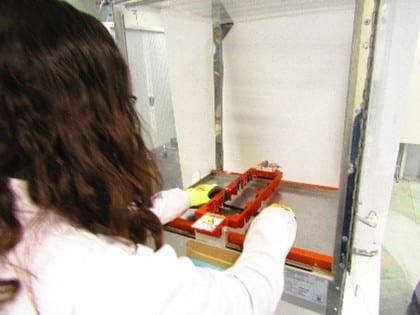
Complementary abrasion tests were also carried out using an abrasimeter in accordance with specific surface testing standards. This equipment reproduces controlled friction cycles that simulate the wear coatings may experience during repeated product use. These tests made it possible to evaluate the coatings’ resistance to mechanical deterioration.
Coating durability results after testing
Once the different tests were completed, a final evaluation of the samples was performed to analyse the effects of accelerated ageing. The same characterization techniques used during the initial phase were repeated, including visual inspection through photography, optical microscopy analysis, and colour measurements using colorimetry.
These tools made it possible to identify changes in coating appearance, colour variations, and potential surface defects associated with material degradation. Comparative analysis of the samples before and after testing revealed differences in the behaviour of the evaluated coatings.
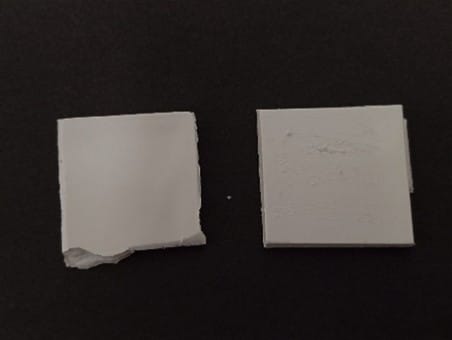
Comparing OK vs NOK samples reduces technical uncertainty.
The results showed that the original coating exhibited greater resistance to the simulated ageing processes. In particular, it maintained its surface properties more effectively both under chemical exposure and abrasion wear. Thanks to this experimental evaluation, the client was able to make informed decisions regarding the use of coatings and select the most suitable solution to ensure the durability of their products.