What was the challenge or problem to be solved?
In many industrial sectors, the durability of metallic materials directly impacts product reliability and associated maintenance costs. Components exposed to aggressive environments, such as marine atmospheres or saline conditions, may undergo progressive degradation processes that reduce their service life.
One of the key factors in preventing these issues is the proper selection of materials and protective coatings. When corrosion resistance is insufficient, oxidation, surface degradation, or loss of functional properties may occur, ultimately affecting product performance.
In this context, experimental studies allow different available solutions to be compared and the most suitable option to be selected before implementation. This type of analysis is particularly useful when alternatives appear similar and it is necessary to determine which performs best under corrosive conditions.
Evaluation of steel coatings in corrosive environments
The use of steel coatings is a widely adopted strategy to improve the resistance of metallic components to corrosion processes. These coatings act as a protective barrier between the base material and the aggressive environment, delaying or preventing degradation.
However, not all coatings perform equally under corrosive conditions. Factors such as coating type, thickness, manufacturing process, and surface finish can significantly influence their protective capability. For this reason, when several similar options exist, experimental evaluation becomes essential before making a technical decision.
Experimental comparison of coatings enables the selection of the most suitable material before product implementation.
In the case analyzed, the objective was to compare two steel coating alternatives intended for the same industrial application. Although both materials showed similar technical characteristics, the client needed to determine which one performed better in a saline environment. This information was critical to selecting the most appropriate material for the final product.
Material selection through coating corrosion resistance
The corrosion resistance of coatings is one of the most relevant criteria when selecting materials for industrial applications exposed to aggressive environments. Understanding how a material behaves under corrosive conditions allows its service life to be predicted and the risk of premature failure to be reduced.
In many cases, choosing between different coatings cannot rely solely on technical specifications or supplier data. Real operating conditions, the interaction between base material and coating, and exposure to specific chemical or environmental agents can significantly alter material performance.
For this reason, experimental testing provides objective and comparable information across different solutions. Based on these results, it is possible to identify performance differences between seemingly similar materials and establish technical criteria for decision-making.
In this project, the study aimed to analyze the corrosion resistance of coatings applied to steel by comparing their behavior under controlled corrosive conditions. The results enabled the selection of the most suitable option for the intended application.
Complexity in corrosion analysis of metals with similar coatings
One of the main challenges in this type of study arises when the compared solutions have very similar characteristics. In such cases, performance differences may be subtle and require rigorous analysis of the results.
Corrosion analysis in metals involves studying parameters related to electrochemical processes driving material degradation. Variables such as corrosion potential, corrosion rate, and polarization resistance help characterize material behavior in aggressive environments.
When coatings show similar properties, detailed analysis of electrochemical data is essential to identify real performance differences.
When materials exhibit similar properties, interpreting the results becomes particularly critical. It is not only about obtaining experimental data but also about integrating all available information to identify relevant trends and differences.
In this context, INFINITIA carried out an independent technical evaluation based on experimental testing and critical analysis of results. The goal was to provide reliable information that would allow the client to select the most suitable material while reducing technical and economic risks.
How was it addressed or what was the solution?
To address the study, INFINITIA’s forensic engineering team specialized in materials characterization designed an analysis strategy aimed at objectively comparing the behavior of the two coatings. The approach combined characterization techniques and electrochemical testing to obtain quantitative data on corrosion resistance.
Such studies require reproducing controlled laboratory conditions that allow materials to be evaluated under corrosive processes. At the same time, it is essential to ensure that the samples have comparable initial conditions to avoid misinterpretation of results.
For this reason, the study followed a structured workflow to ensure reliable and comparable data between both solutions.
Initial characterization of steel coatings
The first step involved an initial inspection of the samples to assess their condition before corrosion testing. This phase ensured that the specimens did not present visible defects or pre-existing degradation that could affect the results.
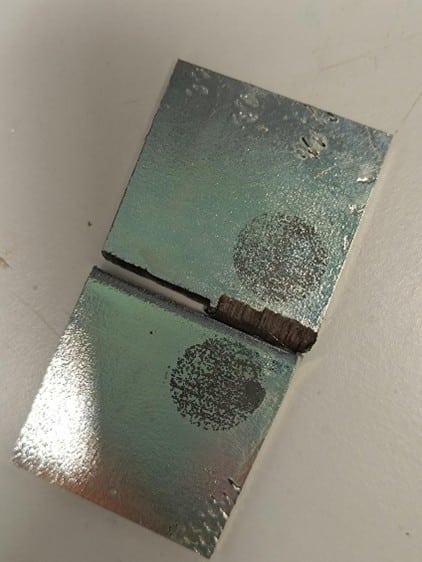
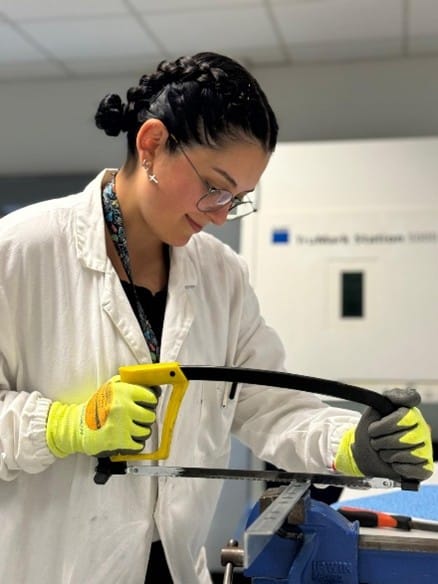
A detailed visual inspection was carried out using optical magnification to identify possible irregularities in the coatings. In parallel, samples were prepared through controlled cutting to ensure suitable dimensions for subsequent testing.
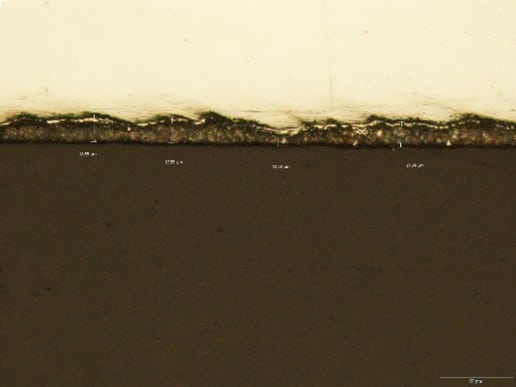
Coating thickness measurements were then performed using optical microscopy. This parameter is particularly relevant, as thickness can directly influence corrosion protection performance.
This initial characterization established a reference baseline, ensuring that both materials were evaluated under comparable conditions.
Evaluation through electrochemical corrosion testing
Once characterized, electrochemical corrosion testing was performed, a widely used technique for analyzing material behavior under corrosive conditions.
This type of test subjects the material to controlled corrosive environments while recording key electrochemical parameters. These include corrosion potential, corrosion rate, and polarization resistance, all of which help evaluate coating performance.
Electrochemical tests allow direct measurement of key corrosion parameters such as corrosion rate and potential.
A potentiostat was used to apply controlled electrical stimuli and record the material’s response. From these measurements, polarization curves were obtained, reflecting the material’s behavior during corrosion processes.
The analysis of these curves provides detailed information about coating stability and its ability to protect the steel substrate in saline environments.
Results of corrosion testing in steel coatings
After completing the tests, the technical team analyzed the data using processing and visualization tools. This included mathematical calculations and interpretation of polarization curves obtained during testing.
The results enabled an objective comparison between the two materials. Differences in electrochemical parameters were identified, providing relevant insights into the protective capability of each coating.
This analysis goes beyond identifying which material performs better in a specific test. It aims to understand the overall behavior of materials under corrosive conditions, enabling technically sound conclusions applicable to real use scenarios.
As a result, the client obtained a solid basis for selecting the most suitable material. Choosing a coating with higher corrosion resistance can lead to increased component durability and reduced maintenance or replacement costs.
From an industrial perspective, this type of study provides value by enabling data-driven decisions and reducing uncertainty in material selection. It also contributes to improving product reliability and optimizing performance under real operating conditions.
INFINITIA’s intervention transformed a situation of technical uncertainty into a decision based on experimental evidence, facilitating optimal material selection and contributing to long-term cost reduction and product durability.