
What was the challenge or problem to be solved?
The safety of materials in contact with food is a critical aspect for manufacturers, distributors, and regulatory bodies. Kitchen utensils, especially those made from natural materials such as wood, are in direct contact with food during everyday use, and therefore must strictly comply with regulations governing the presence of potentially hazardous substances, such as heavy metals in kitchen utensils.
In this context, a distributor of wooden kitchen utensils requested INFINITIA to carry out a study to verify the possible presence of heavy metals in their products. As these utensils are intended for direct contact with food, it was necessary to confirm that they complied with the requirements established by European food safety regulations.
Heavy metals in wooden kitchen utensils
Wooden kitchen utensils are often perceived as natural and safe products. However, the client raised the need to verify the chemical composition of several wooden kitchen utensils. Although these products are generally considered safe, it was necessary to analytically confirm that they did not contain significant levels of heavy metals that could pose a risk to consumers.
As a result, there is a possibility that traces of heavy metals may be present in the material. These elements may originate from the environment in which the wood grew or from subsequent industrial processes, such as surface treatments or contamination during the supply chain.
Kitchen utensils in contact with food must comply with strict regulatory limits for contaminants such as heavy metals.

Given this situation, chemical analysis of the utensils becomes a key tool for identifying potential contaminants. Detecting the presence of these elements makes it possible to assess the potential risk associated with the use of the product in contact with food.
Verifying the presence of heavy metals in kitchen utensils is especially important when products are intended for direct food contact, as European regulations establish strict limits for different contaminants.
Food safety assessment in food contact materials
Ensuring food safety requires a rigorous analysis of the materials used in the manufacture of kitchen utensils. European legislation establishes specific requirements to ensure that these materials do not release substances that could pose a risk to human health.
In this context, analytical studies make it possible to evaluate the chemical composition of the material and determine whether it contains potentially hazardous elements. These assessments are essential to verify compliance with applicable regulatory requirements.
In addition, the results of these analyses allow manufacturers to demonstrate the quality and safety of their products. Having reliable analytical data facilitates decision-making in quality control processes and strengthens the confidence of distributors and consumers.
These types of studies also make it possible to anticipate potential regulatory issues before products reach the market. For this reason, food safety analysis in kitchen utensils is a key tool within quality control processes.
Analytical detection of heavy metals in wood matrices
One of the main technical challenges of the project was detecting the possible presence of heavy metals in a complex matrix such as wood. This material has a heterogeneous structure and variable composition, which can make it difficult to identify contaminants when they are present at very low concentrations.
To address this challenge, it was necessary to apply analytical techniques capable of identifying chemical elements with high sensitivity. The detection of heavy metals requires tools that can accurately characterize the elemental composition of the sample.
The INFINITIA forensic engineering team designed an analytical approach combining complementary characterization techniques. This approach made it possible to identify the elements present in the samples and establish a solid basis for their subsequent quantification.
Thanks to this approach, it was possible to overcome the difficulties associated with analyzing a natural matrix such as wood. The use of advanced techniques provided reliable information on the chemical composition of the analyzed utensils.
How was it addressed or what was the solution?
To respond to the client’s request, the INFINITIA team designed an analytical study aimed at identifying and quantifying the possible presence of heavy metals in the analyzed wooden kitchen utensils. The approach combined different chemical characterization techniques to obtain reliable results regarding the product’s composition.
The study included sample preparation, identification of the metals present, and quantification of their concentration. Finally, the results obtained were compared with the limits established by European regulations to verify that the analyzed utensils met the safety requirements applicable to food contact materials.
Elemental characterization using SEM-EDX electron microscopy
The first step of the study consisted of properly preparing the wooden utensil samples. Different fragments of the material were collected and ground to obtain homogeneous wood shavings. This process ensured a representative sample of the analyzed material.
Sample homogenization is a fundamental step in any chemical analysis. In the case of natural materials such as wood, this process helps reduce variability associated with its internal structure and improves the reliability of the results obtained.
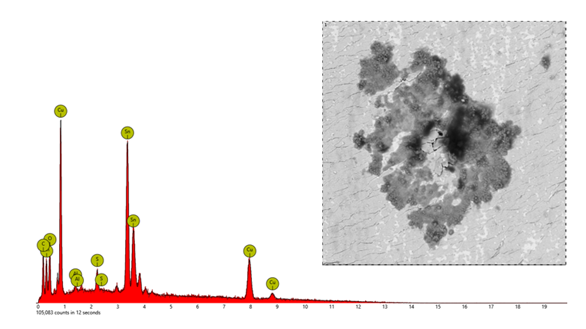
SEM-EDX techniques allow the identification of the elemental composition of a material and the rapid and precise detection of metals.
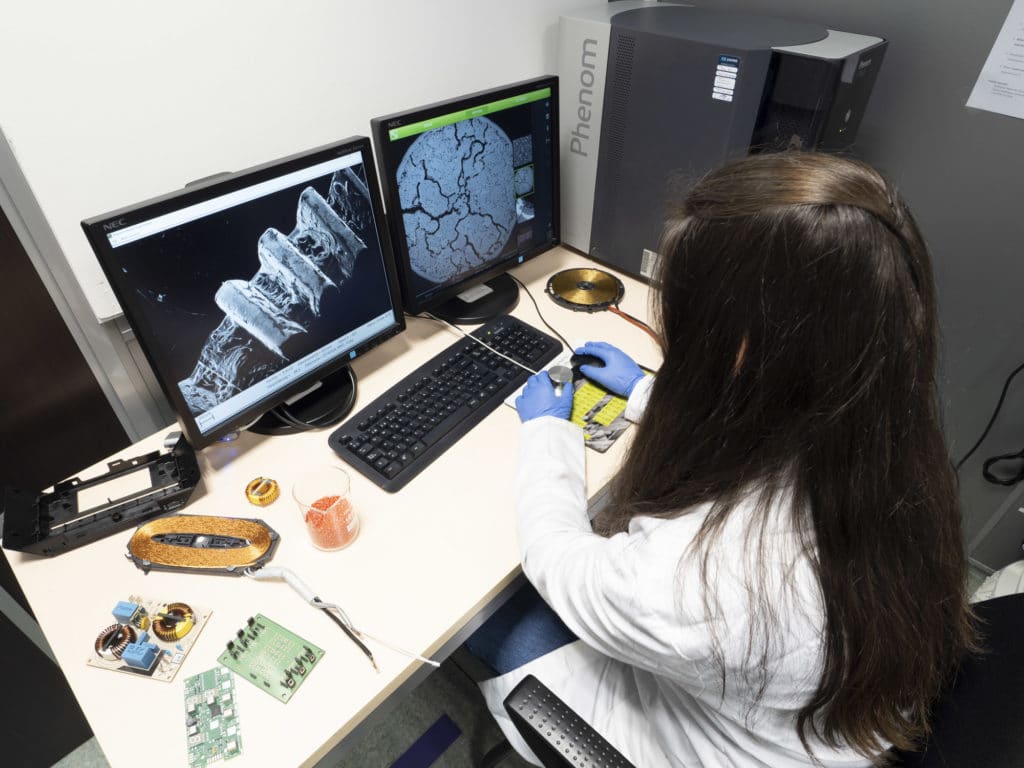
Once the sample was prepared, Scanning Electron Microscopy combined with Energy Dispersive X-ray Analysis (SEM-EDX) was used. This technique allows the elemental composition of a sample to be analyzed and the chemical elements present to be identified.
The use of SEM-EDX made it possible to detect the presence of different metals in the analyzed material. This information was essential to determine which elements should be subsequently quantified using more sensitive analytical techniques.
Accurate quantification of heavy metals using ICP-MS
After identifying the metals present in the samples, the next step was to determine their concentration. For this purpose, Inductively Coupled Plasma Mass Spectrometry (ICP-MS) was used, a widely applied technique in trace metal chemical analysis.
ICP-MS analysis allows the quantification of very low concentrations of chemical elements with high precision. This technique is particularly useful when contaminants are present at low levels, as is typically the case with heavy metals.
ICP-MS spectrometry enables the quantification of trace metals with extremely high sensitivity.
The application of ICP-MS made it possible to determine the exact concentration of the metals previously detected by SEM-EDX. The results obtained provided reliable data on the chemical composition of the analyzed utensils.
These analytical data form the basis for evaluating the product’s regulatory compliance. Without precise quantification of the elements present, it would not be possible to determine whether the utensils meet the applicable regulatory requirements.
Compliance assessment with European food contact materials regulation
Once the concentrations of the detected metals were determined, the results were compared with the limits established by applicable European regulations. This step is essential to interpret analytical data from a regulatory perspective.
The comparison was carried out using Regulation (EU) No 10/2011 as a reference, which establishes requirements related to certain materials in contact with food. This regulation defines limits for different substances to ensure consumer safety.
The analysis of the results made it possible to verify whether the detected concentrations were within the limits permitted by current legislation. This evaluation represents the final step of the analytical process and allows relevant conclusions to be drawn for the client.
The results confirmed that the metals detected in the analyzed utensils were below the limits established by European regulations. This information allowed the client to verify the regulatory compliance of their products and to obtain analytical data supporting their safety for food contact use.