What was the challenge or problem to be solved?
The appearance of non-conformities in parts subjected to aluminium anodising revealed a potential instability in the production process. The intermittent nature of the defect prevented direct identification of its origin and posed both technical and operational risks.
The priority was to carry out a root cause analysis that would distinguish between symptoms and critical factors, ensuring process improvement based on evidence rather than intuitive adjustments.
Anodising defects as a symptom of process instability
Anodising defects manifested as localized surface alterations and differences in coating performance under demanding service conditions. Although they could initially be interpreted as isolated incidents, their recurrence in certain batches suggested the existence of a structural deviation.
From a technical standpoint, this type of issue may be linked to multiple variables: fluctuations in electrolyte concentration, changes in current density, thermal variations, bath contamination, differences in prior surface preparation, or even variations in the base aluminium composition. The complexity of the system prevented attributing the defect to a single cause without rigorous analysis.
Intermittent defects usually indicate uncontrolled variability rather than isolated failures. Identifying patterns is key before taking action.
Moreover, the intermittent nature of the failure increased the difficulty. When a process performs correctly in most cases but fails under specific parameter combinations, the risk lies in intervening on secondary variables rather than addressing the true root cause.
Improvement of the anodising process as a strategic objective
Improving the anodising process was approached as a strategic necessity, not merely a corrective action. The goal was not to apply a punctual fix, but to reinforce overall process stability to ensure repeatability between batches and minimize variability.
Operationally, this involved reducing scrap, avoiding rework, and improving statistical process control. From a broader perspective, the expected benefit was to increase final product reliability and consistently ensure quality across production batches.
This approach required adopting a systemic perspective. Before modifying production parameters, it was essential to understand which variable was acting as the trigger of the defect and under which specific conditions it manifested.
Root cause analysis in complex anodising processes
Root cause analysis constituted the core of the project. In electrochemical processes such as anodising, small variations can produce significant changes in the morphology and properties of the anodic layer. Therefore, identifying the origin of the failure required a structured methodology based on experimental evidence.
The technical challenge lay in distinguishing cause from consequence. Not all differences observed in defective parts were necessarily the origin of the issue; some could simply be the visible result of a prior deviation. This distinction is critical to avoid incorrect conclusions.
Not all observed differences are root causes. Distinguishing between symptoms and origin prevents incorrect decisions.
INFINITIA addressed the study by applying a systematic hypothesis-elimination approach, correlating characterization results with process data and production records. This methodology progressively isolated the determining variable without introducing premature modifications to the manufacturing line.
How was it addressed or what was the solution?
The project was structured into phases aimed at obtaining objective information before proposing production adjustments. The guiding principle was to avoid direct intervention in the process without a technically validated diagnosis.
Industrial failure diagnosis through a structured methodology
The industrial failure diagnosis began with clearly defining the scope of the problem and collecting all available technical information. Production history, operating parameters, and control records were analyzed to identify possible initial correlations.
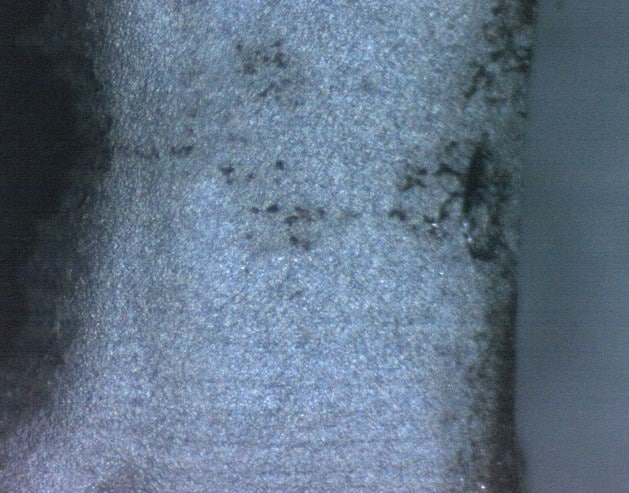
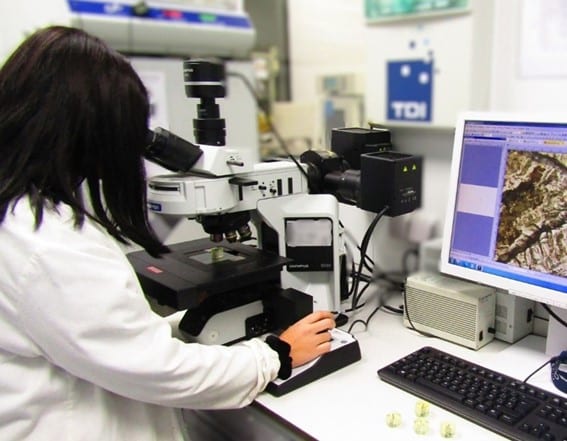
Subsequently, a comparative characterization of compliant and non-compliant parts was carried out. The analysis included observations using optical microscopes to assess surface uniformity, as well as advanced techniques to examine potential discontinuities. This phase established objective indicators that distinguished both conditions.
The applied methodology avoided relying exclusively on visual observations or subjective interpretations. Each intermediate conclusion had to be supported by measurable data, thereby reducing uncertainty in subsequent decision-making.
Comparative sample analysis to isolate the critical variable
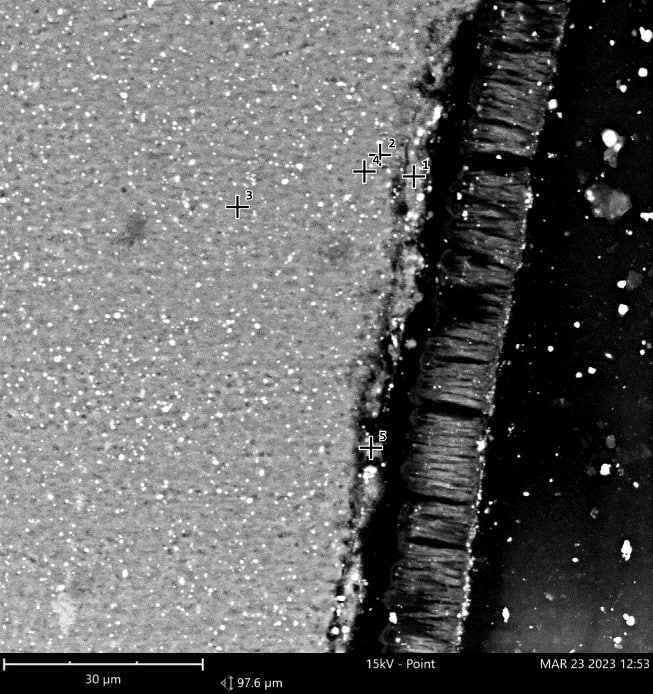
The comparative analysis of OK and NOK samples enabled identification of specific differences in the structure and behavior of the coating. Direct comparison helped determine which parameters showed systematic deviations and which remained within normal ranges. The study was complemented with observations using a scanning electron microscope (SEM), allowing higher-resolution analysis of the anodised layer morphology and detection of differences not visible at a macroscopic level.
Comparing OK vs NOK samples helps reduce hypotheses and focus the analysis on truly critical variables.
This approach proved particularly relevant in ruling out incorrect hypotheses. In complex industrial processes, failures are often attributed to obvious factors such as supplier changes or recent adjustments. However, the evidence obtained demonstrated that some of these assumptions had no real correlation with the observed defect.
The technical work progressively reduced the number of variables involved until identifying the specific condition responsible for the anodising deviation, establishing a clear cause-and-effect relationship.
Industrial process optimization based on technical evidence
Once the root cause was validated, recommendations were defined aimed at industrial process optimization. The proposed actions focused on strengthening control of the critical variable and improving process monitoring to prevent future deviations.
The solution did not require radical changes to the production line, but rather technically justified and well-founded adjustments. This is relevant, as it demonstrates that not all problems require significant investment; in many cases, the value lies in correctly understanding the phenomenon.
As a result, the aluminium anodising process regained stability and consistency between batches. The client not only resolved the detected non-conformity but also gained greater capability to anticipate and control potential future deviations, consolidating a structural and sustainable improvement.