
What was the challenge or problem to be solved?
In industrial systems where air quality and equipment protection directly depend on the performance of filtration elements, any deviation from expected behavior may have significant technical and economic consequences.
In this case, the appearance of unexpected wear required an in-depth analysis of the installed filters in order to understand the origin of the problem and prevent its recurrence through a structured, evidence-based technical evaluation.
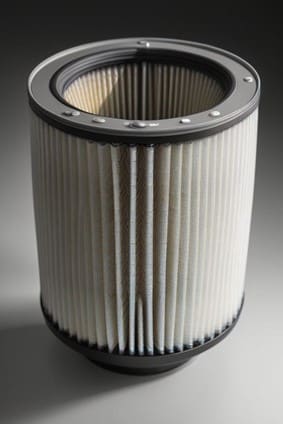
Defective air filters with premature wear
The starting point of the study was the detection of defective air filters exhibiting premature wear compared to their theoretical service life. The degradation did not follow a uniform pattern nor correspond solely to natural material aging; instead, it showed localized areas with more pronounced deterioration and loss of structural integrity in specific zones, raising concerns about the mechanical stability of the filter media under real service conditions.
This abnormal behavior could compromise retention capacity and disrupt the balance of the filtration system. In demanding industrial environments, small variations in filter efficiency may be amplified and affect sensitive downstream equipment. The client needed to determine whether the phenomenon was linked to uncontrolled external conditions, insufficiently robust design, or manufacturing deviations, while also ruling out inconsistencies between batches or raw materials.
Root cause identification of wear in air filters
The main objective of the project was to identify the root cause of the phenomenon observed in the air filters, integrating structural, chemical, and comparative analyses within a technically sound failure analysis approach. The potential influence of chemical agents present in the environment, abrasive particles transported by airflow, and mechanical stresses resulting from the internal configuration of the filter was evaluated, also considering possible synergistic interactions among these factors.
Accurate root cause determination was essential to avoid corrective decisions based solely on visible symptoms. In addition to explaining the degradation mechanism, the study needed to redefine technical validation criteria and establish preventive measures applicable to future developments or procurements.
Technical complexity of contaminant analysis and external contaminants
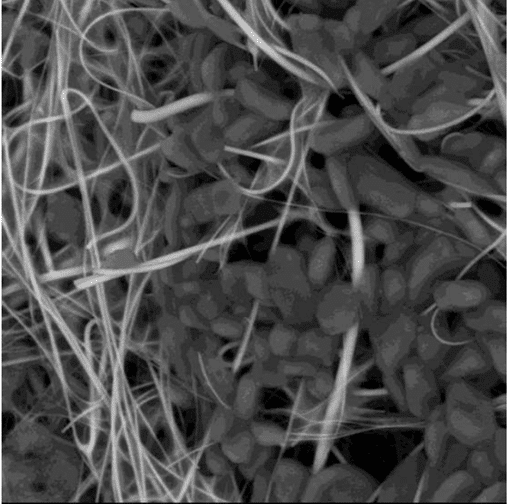
One of the critical aspects was the possible involvement of contaminants and external particles in the degradation process, which required the application of advanced characterisation techniques. Scanning electron microscopy (SEM) enabled detailed analysis of the surface morphology of the filter material, identification of micro-wear patterns, and evaluation of the interaction between detected particles and the filter matrix at high resolution.
In certain areas, metallic particles with irregular morphology and varying sizes were identified, making it necessary to investigate their possible origin. These particles could have originated from the industrial environment, friction processes in adjacent equipment, or even internal degradation phenomena.
Identifying whether a contaminant is a cause or a consequence is key to accurate diagnosis.

Additionally, mass spectrometry (TD-GC-MS) was applied to analyze organic compounds associated with the filter media and detect potential residues or by-products linked to the environment or the manufacturing process itself. During sample preparation, possible volatilization of certain substances was considered, and analytical protocols were adjusted to prevent losses that could bias the final interpretation.
The combination of morphological and compositional analyses made it possible to correlate structural and chemical information, establishing solid causal relationships and ruling out simplified interpretations based solely on the presence of residues.
How was it addressed or what was the solution?
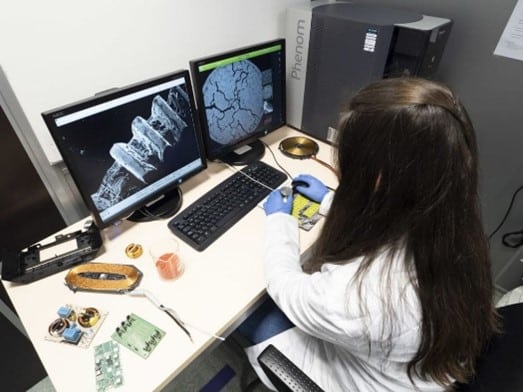
Once the scope of the problem was defined, an integrated strategy was designed combining reverse engineering, comparative analysis, and advanced characterisation techniques, with the objective of reconstructing component behavior from its initial design through in-service degradation, integrating all relevant variables within a single analytical framework.
Reverse engineering applied to industrial air filters
The application of reverse engineering made it possible to analyze in detail the internal architecture of the air filters involved, examining filter layers, structural joints, and potential discontinuities that could promote stress concentrations or localized particle accumulation.
Reverse engineering reveals the real behavior of a component beyond its theoretical specifications.
Controlled disassembly enabled dimensional and structural evaluation of the component, as well as direct comparison with unaffected units, identifying relevant differences in areas where metallic particle accumulation and localized degradation of the filter media were later confirmed.
This structural analysis also allowed assessment of whether the original design was consistent with actual operating conditions or whether mechanical, chemical, or thermal loads had been underestimated, providing technical context for the results obtained through advanced characterization.
Contaminant analysis and comparative particle study
The contaminant analysis integrated morphological and compositional techniques within a comparative approach. Scanning electron microscopy (SEM) enabled in-depth characterization of metallic particle distribution and direct observation of their interaction with the fibers of the filter material, identifying potential wear initiation points.
Mass spectrometry (TD-GC-MS), in turn, provided detailed information on residual organic compounds and possible traces associated with the operating environment or prior manufacturing processes.
Comparing OK and NOK samples is essential to distinguish real wear from normal contamination.
Systematic comparison between affected and unaffected samples made it possible to identify significant differences in particle concentration, typology, and distribution, reinforcing the consistency of the diagnosis and ruling out typical accumulations unrelated to the degradation mechanism.
Value of failure analysis in preventing recurrence
The integration of reverse engineering, advanced characterization using SEM and TD-GC-MS, and comparative analysis enabled the development of a comprehensive failure analysis that went beyond describing visible damage, explaining the physical and chemical mechanisms responsible for premature wear.
The client obtained a solid technical basis to redefine specifications, review supplier selection criteria, and adjust operating conditions, reducing the likelihood of recurrence and increasing the robustness of the filtration system against variations in the industrial environment.