
What was the challenge or problem to be solved?
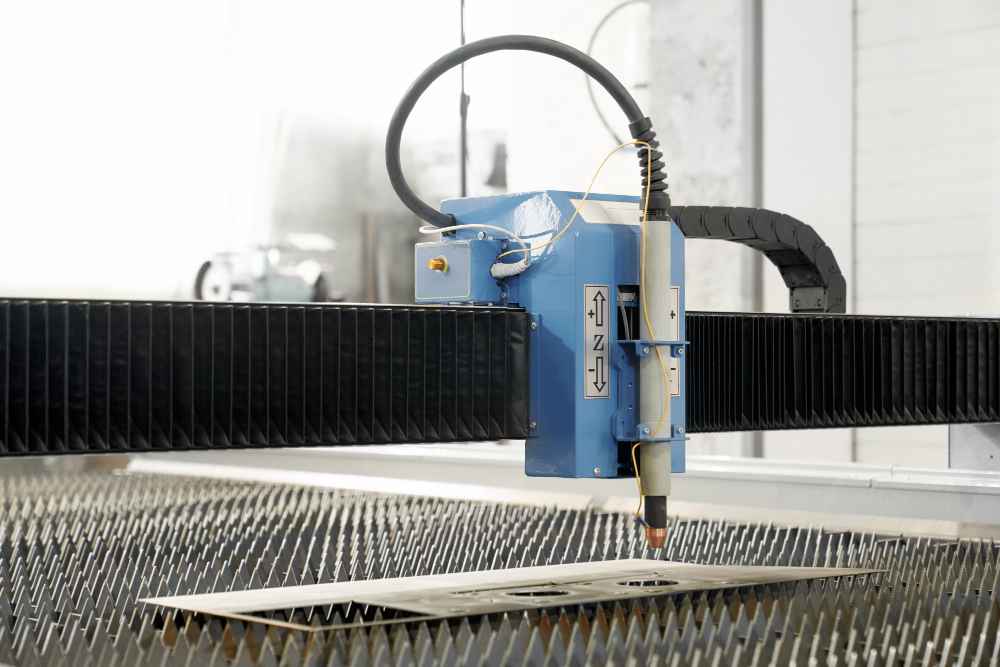
In many industrial sectors, components include permanent markings to ensure identification and traceability. Laser marking is a widely used technology due to its precision and durability, although its long-term performance can be affected by environmental factors, especially in corrosive environments.
In this context, an industrial company needed to determine which marking parameters provided the best long-term performance. To address this, INFINITIA’s Forensic Engineering team designed an accelerated corrosion test to compare different laser marking configurations and evaluate their resistance under simulated aging conditions.
Corrosion resistance in industrial materials
Corrosion resistance is a key factor in the design and validation of industrial materials. Corrosion-related degradation can affect both the functional properties of components and their surface appearance, leading to defects that compromise product reliability and perceived quality.
When surface modifications are introduced, such as laser marking, local changes in microstructure or surface characteristics may occur. Depending on the marking parameters, power, speed, or engraving Depth, these changes can influence the material’s behavior when exposed to corrosive agents.
Corrosion resistance is a key factor in ensuring the durability and reliability of materials in industrial environments.

In certain industrial applications, even small variations in corrosion behavior can have significant long-term consequences. For example, the appearance of pitting or localized corrosion in marked areas may promote the propagation of surface damage or affect the readability of the engraved information. For this reason, evaluating the impact of marking on material durability becomes a critical step in quality control processes.
The objective of the project was precisely to analyze whether different types of marking applied to the reference material could generate differences in corrosion behavior. To achieve this, samples needed to be subjected to conditions that could reproduce, in an accelerated way, the effects observed after long-term exposure in real environments.
This type of analysis allows industrial companies to make informed decisions about their manufacturing processes, selecting solutions that offer greater robustness and lower risk of degradation over time.
Evaluation of laser marking in quality control
Laser marking has become one of the most widely used technologies for permanent identification of industrial components. Its ability to produce precise, durable, and tamper-resistant engravings makes it a key tool for traceability systems, technical labeling, and production control.
However, laser marking can be performed using different process parameters, resulting in various types of surface engraving. These variations can influence aspects such as marking depth, surface roughness, or the degree of thermal alteration of the material.
In this case, the client had applied several types of marking to evaluate which one performed best under aging conditions. Before selecting a standard solution for production, it was necessary to verify whether any of them showed higher susceptibility to corrosion.
Laser marking enables permanent identification of components, but its parameters can influence the material’s corrosion behavior.
The evaluation of these markings could not rely solely on initial observation. In many cases, surface degradation effects appear after prolonged exposure to aggressive environments. Therefore, the company required a methodology to simulate material aging and objectively compare the performance of different alternatives.
The analysis provided key information for decision-making. By comparing the condition of the samples after testing, it was possible to identify differences between marking types and determine which offered greater corrosion resistance.
This type of study strengthens quality control processes by enabling the validation of manufacturing technologies before full-scale implementation.
Technical challenge in accelerated corrosion testing
One of the main challenges of the project was to design a test capable of reliably reproducing deterioration processes associated with accelerated corrosion. The goal was not simply to induce corrosion, but to do so in a controlled and representative way of real service conditions.
Designing such tests requires careful definition of parameters such as the corrosive environment, exposure time, and evaluation criteria. An inadequate configuration could lead to non-representative results or make comparisons between samples difficult.
In addition, the test needed to be adapted to the specific characteristics of the material and the client’s requirements. This required leveraging the expertise of INFINITIA’s materials team, which specializes in accelerated aging testing and corrosion phenomena analysis.
Thanks to this tailored approach, it was possible to establish a suitable testing protocol that allowed objective comparison between different laser marking types. The result was a solid experimental basis for drawing reliable conclusions.
How was it addressed or what was the solution?
To address the client’s needs, INFINITIA designed a study based on accelerated corrosion testing to evaluate the performance of different laser marking variants. The approach focused on reproducing environmental conditions that promote corrosion in a controlled manner, enabling comparison within a reduced timeframe.
The strategy combined widely recognized testing techniques with the expertise of INFINITIA’s materials specialists, providing reliable and easily interpretable results to support decision-making.
Technical approach to accelerated aging
The first step of the project was to thoroughly understand the client’s requirements and define the testing conditions. This involved analyzing factors such as test duration, corrosive atmosphere, and evaluation criteria.
The expertise of INFINITIA’s specialists was essential at this stage. Their experience in accelerated aging projects enabled the design of a test tailored to both the material and the study objectives.
The aim was to reproduce, in a short period of time, the effects that would normally appear after prolonged environmental exposure. This allowed the client to obtain valuable insights without waiting years for degradation to occur.
Such methodologies are commonly used in material and product validation processes, as they help anticipate potential issues and improve design robustness before market launch.
Salt spray test for corrosion evaluation
Once the test design was defined, the samples were subjected to a salt spray test, one of the most widely used methods to study accelerated corrosion in materials.
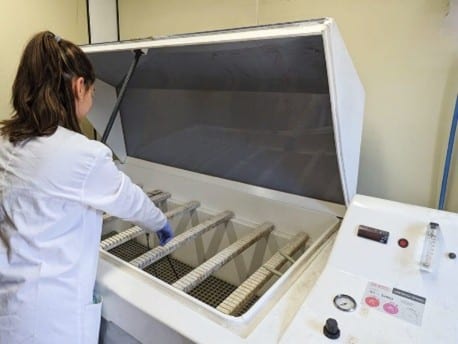
In this type of test, samples are placed inside a chamber designed to generate a corrosive atmosphere through continuous spraying of a saline solution. This environment intensifies the conditions that promote corrosion in marine or industrial settings.
The salt spray test is one of the most widely used techniques to evaluate accelerated corrosion of materials in laboratory conditions.
The salt spray chamber ensures controlled conditions over extended periods, guaranteeing uniform exposure for all samples. Its ability to accommodate components of various sizes makes it suitable for real industrial parts.
During the test, samples remained exposed to the corrosive atmosphere for the duration defined in the protocol. This accelerated the onset of surface degradation associated with laser marking, facilitating subsequent analysis.
This methodology enabled a clear comparison between different marking variants, revealing how each responded to intensified corrosive conditions.
Impact of accelerated corrosion on industrial quality control
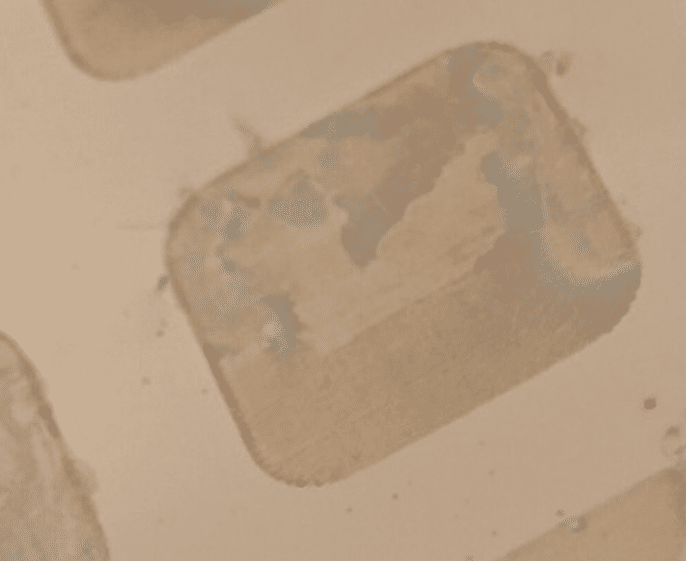
After completing the exposure period, the samples were evaluated. This analysis was carried out by INFINITIA’s technical team through detailed visual inspection, supported by magnification tools such as optical microscopes. Different corrosion indicators were assessed, including oxide formation, surface changes, and defects associated with marking degradation. Comparing the samples made it possible to identify differences in corrosion behavior.
The results provided the client with a clear technical basis for selecting the most suitable laser marking configuration. The study determined which option offered the best corrosion resistance and long-term durability. This type of analysis delivers significant value in industrial processes, as it enables data-driven manufacturing decisions. By anticipating degradation issues, companies can reduce risks and improve component reliability.
INFINITIA’s intervention transformed a technical uncertainty into actionable knowledge, reinforcing material quality control processes through accelerated corrosion testing.