What was the challenge or problem to be solved?
In failure analysis studies of electrical components, correctly understanding the initial problem is essential to avoid incomplete diagnoses or incorrect solutions. In this case, the challenge was not limited to detecting a functional failure, but also involved the presence of unknown residues whose nature and origin were not clearly defined.
The following sections describe the context in which the residues were detected on the electrical component, the client’s specific need to determine their composition and origin, and the technical constraints that made it difficult to establish a direct relationship between the residues and the observed failure.
Analysis of unknown residues in electrical components
In an industrial context, the appearance of unknown residues in electrical components represents a direct risk to system reliability. These residues, detected on surfaces or functional areas of the component, could compromise proper operation, cause premature electrical failures, or reduce service life. The issue was not limited to the presence of the residue itself, but to the uncertainty regarding its nature, origin, and possible interaction with the constituent materials of the electrical component.
Identifying the residue is key to avoiding decisions based on assumptions.
The detection of these residues created the need to perform a rigorous chemical residue analysis, aimed not only at identifying them, but also at determining whether they were related to operating conditions, the production process, or potential external contamination. Without this information, it was not possible to make technically sound decisions to prevent future failures.
From the client’s perspective, the expected benefit was clear: to avoid functional failures, improve the reliability of the electrical component, and reduce the risk of incidents during service.
Prevention of electrical failures through chemical analysis
The objective of the project focused on applying chemical residue analysis to identify the chemical composition of the detected contaminants and assess their potential role in the failure of the electrical component. This approach enabled the transition from a visual or superficial observation of the issue to a technically substantiated diagnosis.
A dual approach was proposed in the study. On the one hand, to prevent recurrence of the failure by providing objective information to introduce improvements in design, process, or quality control. On the other hand, to reduce technical uncertainty and avoid decisions based on unverified assumptions.
Chemical analysis transforms a visible issue into a reliable technical diagnosis.
This type of analysis is particularly relevant when residues are not easily identifiable and may originate from multiple sources, such as material degradation, chemical interaction between components, manufacturing process residues, or exposure to external agents during service.
Failure diagnosis related to contamination in electrical components
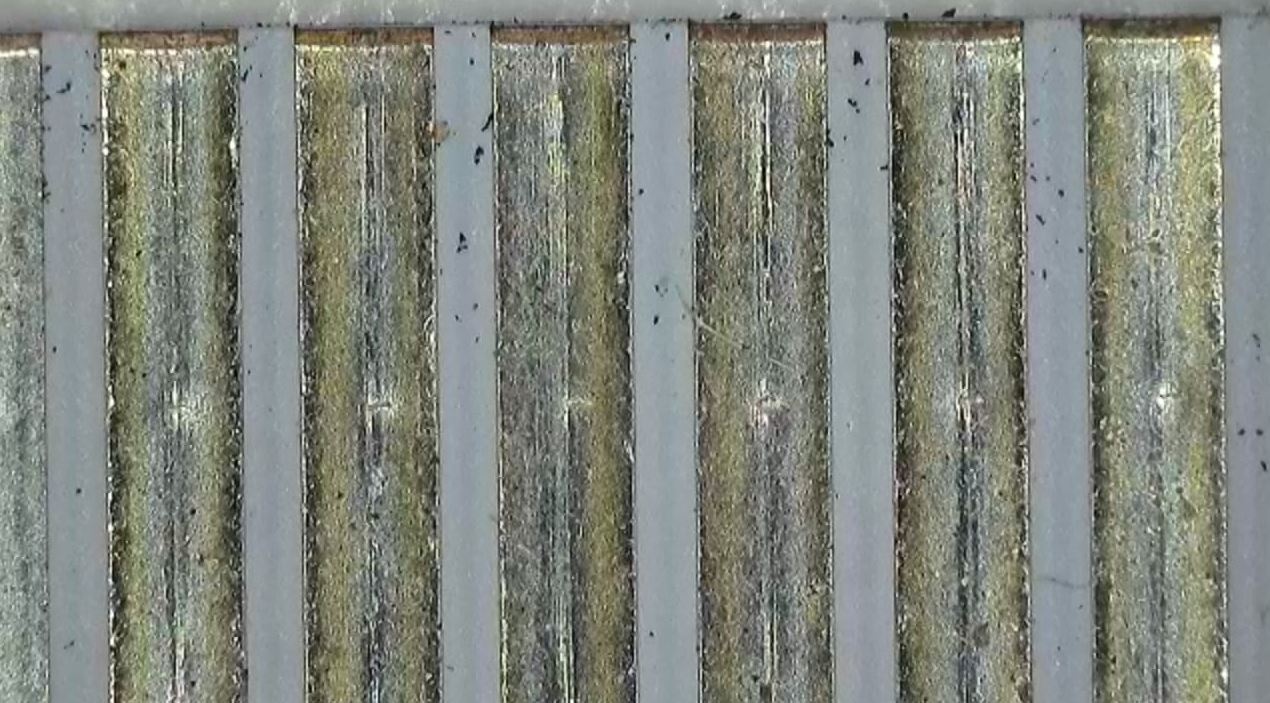
The main technical challenge lay in the fact that the unknown residues could not be directly attributed to an obvious cause. Their morphology, location, and quantity required comparative analysis and detailed characterization to avoid misinterpretation.
Furthermore, the project required a careful balance: obtaining sufficient information to diagnose the root cause of the failure without revealing sensitive details about the component or the production process. In this context, INFINITIA’s role was to provide an independent technical perspective, supported by chemical and materials analysis techniques focused on failure prevention rather than solely on identifying already manifested damage.
How was it addressed or what was the solution?
To address the identified problem, it was necessary to apply a technical approach based on residue analysis and materials characterisation, combining several analytical techniques already well established in the industrial field.
The objective was not only to identify the residue and analyse the cause of the failure, but also to propose practical solutions to prevent future failures and improve the quality of the electrical system. The following sections describe the adopted approach, the execution of the analysis, and the value provided by the study.
Methodology for residue analysis in electrical components
The study was carried out using a progressive residue analysis approach, combining inspection techniques, chemical characterization, and microstructural analysis. In a first phase, a detailed inspection of the component was performed using an optical microscope, allowing identification of residue location, surface distribution, and their relationship with critical functional areas of the electrical component. This stage was key to guiding subsequent analysis and ruling out interpretations based solely on macroscopic observations.
Following this initial inspection, residue characterization was further developed using techniques capable of providing both morphological and compositional information. The objective was not only to identify the contaminant, but to understand its possible origin and interaction with the component materials, within the context of use and the manufacturing process.
Chemical and microstructural analysis using FTIR and SEM-EDS
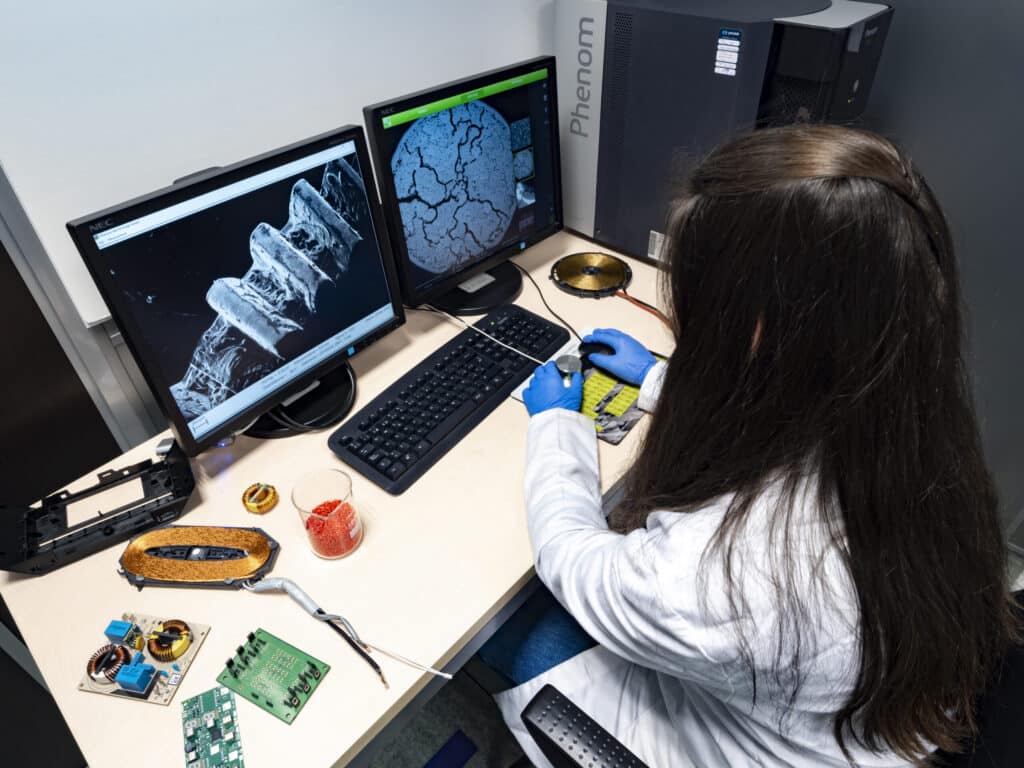
The project execution was carried out by INFINITIA’s technical team, applying complementary analytical techniques. To identify the chemical composition of the residues, Fourier Transform Infrared Spectroscopy (FTIS) was used, a technique particularly suitable for detecting organic compounds and certain contaminants commonly found in electrical components.
Additionally, further analyses were performed using Scanning Electron Microscopy (SEM), which made it possible to determine the presence of metals and oxides that could be interfering with electrical connections. This method completed the study by identifying specific chemical elements present in the residues that contributed to corrosion effects and residue formation. This comprehensive approach not only enabled precise identification of the chemical composition of the residues, but also provided an understanding of how they were affecting the electrical system.
Combining analytical techniques is essential to understand both composition and impact of the residue.
Through detailed and exhaustive technical analysis, INFINITIA successfully identified the origin and composition of the residues compromising the electrical system, enabling the client to implement effective solutions to prevent future failures.
This approach not only resolved a critical issue, but also contributed to optimizing product quality and reinforcing reliability and confidence in the electrical component manufactured by the client, demonstrating INFINITIA’s commitment to technical excellence and results-oriented work.
Value of residue analysis in electrical failure prevention
The combined use of these analytical techniques enabled reliable identification of the unknown residues and contextualization of their presence within the functional behavior of the electrical component. Based on this information, it was possible to evaluate whether the residues were associated with deficiencies in the production process, material degradation phenomena, or specific service conditions.
This technical approach provided a solid foundation for preventing future failures, allowing the client to make informed decisions and reduce the risk of recurrence. The project demonstrated how the application of advanced chemical and microstructural analysis techniques is essential to improving the reliability of electrical components and addressing complex contamination and failure issues from a preventive perspective.