
What was the challenge or problem to be solved?
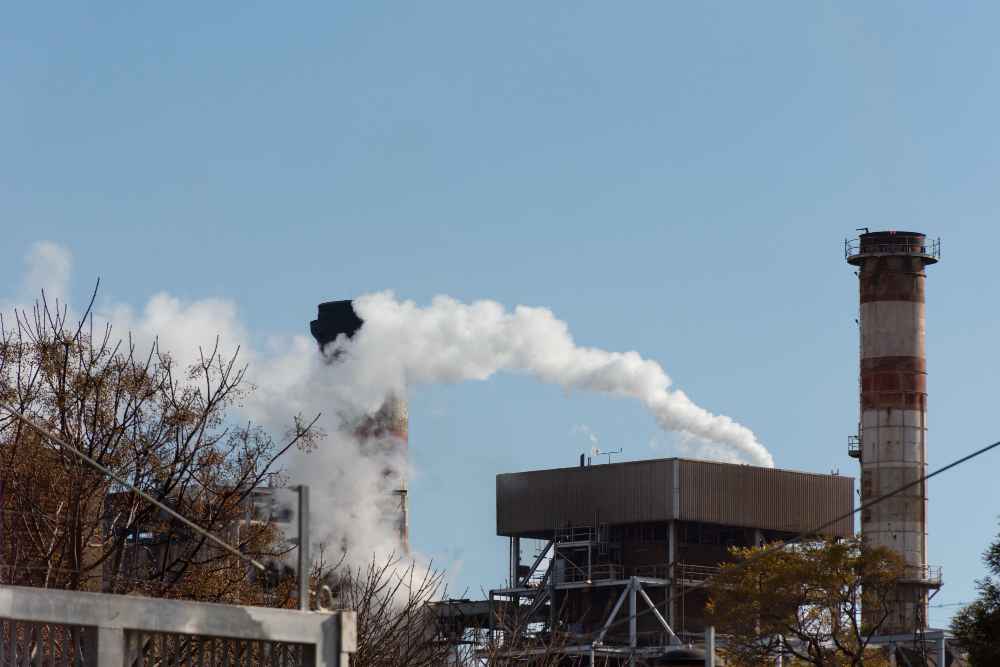
In certain production environments, the presence of industrial odors can become a technical, environmental, and reputational issue. They not only affect the immediate surroundings of the facility, but can also lead to complaints, regulatory pressure, or operational constraints.
In this context, choosing the right technology to address the problem is not a trivial decision, as it involves significant investments and long-term commitments.
Industrial odors and the need for objective evaluation
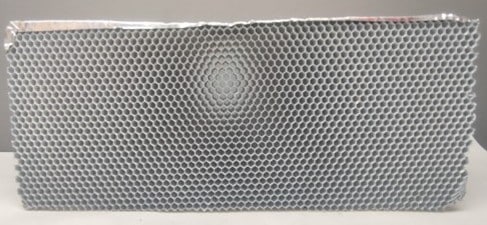
An industrial company needed to determine which solution was most suitable for treating the odor emissions generated in its process. The market offers multiple odor removal technologies based on different operating principles, ranging from adsorption systems to oxidation-based solutions or combinations of physico-chemical processes.
The problem was that the data provided by manufacturers were not directly comparable. Each supplier presented results obtained under different conditions, using methodologies that were not necessarily standardized and with testing parameters that were not always transparent. This made it impossible to carry out an objective comparison or translate those results to the client’s real operating conditions.
Comparing supplier data without equivalent conditions can lead to incorrect decisions.

The company needed to reduce uncertainty before making an investment decision. The goal was not only to reduce odor perception but to ensure a measurable and sustained reduction of the compounds responsible for the odor load, with stable performance over time and compatibility with the production process.
Comparative technology testing for technical selection
The objective of the project was to develop a comparative technology testing approach that would allow the real performance of each proposed system to be evaluated under homogeneous conditions.
The purpose was not to validate commercial claims, but to generate independent data that could establish a common technical basis. It was necessary to quantify removal efficiency under identical conditions, avoiding differences in initial concentration, flow rate, or contact time that could bias the results. Only in this way could the most suitable technology for the client’s specific scenario be identified.
This approach allowed a decision based on marketing documentation to be transformed into one supported by reproducible experimental evidence.
Technology characterization using standardized methodologies
The main technical challenge was the characterization of technologies that operate under different principles and therefore respond differently to variations in concentration or flow regime. Comparing them without a controlled environment would have led to biased or poorly representative conclusions.
Furthermore, the client’s real emissions could not be used directly in the initial testing phase due to control and repeatability constraints. It was necessary to reproduce representative conditions using an artificially generated contaminated stream, whose composition and concentration could be precisely adjusted.
Through the Materials Innovation service, specifically within R&D consulting, the INFINITIA team proposed the design of a dedicated experimental test bench capable of ensuring reproducible generation of volatile organic compounds, accurate measurement, and control of critical process variables. The challenge was not simply to measure performance, but to do so in a way that ensured technically robust, comparable results that could be extrapolated to the real industrial environment.
How was it addressed or what was the solution?
The solution was structured around an experimental approach designed to ensure comparability, traceability, and technical rigor. From the outset, it was assumed that the only way to obtain reliable results was to eliminate variability associated with different testing methodologies and create a common evaluation environment.
Benchmarking environmental technologies under controlled conditions
The approach was based on benchmarking environmental technologies within a laboratory environment specifically configured for the project. A system was designed to generate a gas stream with a known and stable concentration of volatile organic compounds, representative of the client’s industrial scenario. This controlled generation made it possible to repeat tests under identical conditions, ensuring consistency in the data obtained.
Measurements were carried out using different types of calibrated sensors capable of continuously quantifying the concentration of volatile organic compounds (VOCs) both at the inlet and outlet of each technology being evaluated. This continuous monitoring allowed not only the determination of specific efficiency values but also the analysis of the dynamic behavior of each system under controlled variations in contaminant load. As a result, the study provided information not only about isolated performance values but also about operational stability and response capability.
Test repeatability is key to ensuring reliable and comparable results.
The experimental environment was configured to keep critical variables such as flow rate and residence time constant, preventing external factors from distorting the comparison. This standardization was essential to ensure that observed differences reflected the intrinsic performance of each technology.
Custom test bench for odor removal technologies
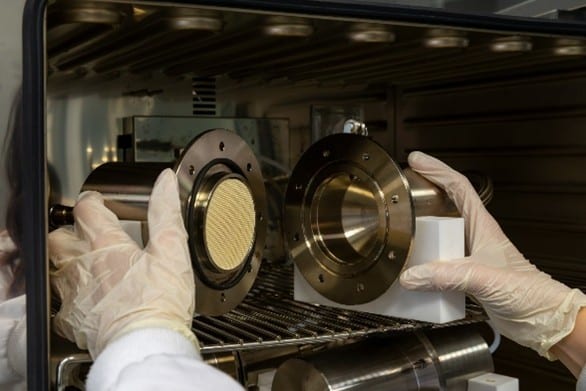
One of the key elements of the project was the development of a custom test bench for odor removal technologies, specifically designed to allow the sequential integration of the different systems proposed by the client.
Testing all technologies under the same conditions removes comparison bias.
This infrastructure enabled each technology to be evaluated under exactly the same operating conditions, eliminating methodological differences. The INFINITIA team was responsible for the design, integration, and validation of the experimental system, ensuring that the data generated were traceable and reproducible.
The test bench made it possible not only to measure overall efficiency but also to observe phenomena such as potential saturation, performance variations over time, or non-linear behavior when concentrations increased. This level of detail provided a more realistic understanding of how the technologies would behave under industrial operating conditions, avoiding simplified extrapolations based solely on theoretical data.
In addition, the modular configuration of the system allowed direct comparison between technologies of different nature without introducing bias related to their operating principle. This methodological neutrality was essential to ensure independence in the evaluation.
VOC removal efficiency and validation for real application
Based on the experimental data obtained, the removal efficiency of VOCs for each technology was analyzed under comparable conditions. The evaluation considered not only the percentage of reduction achieved, but also the consistency of performance and its suitability for the emission profile expected in the real application.
The analysis revealed significant differences between solutions that, according to commercial documentation, initially appeared equivalent. In some cases, variations in performance stability were observed when concentrations changed, which proved to be particularly relevant for the client’s operational scenario.
The project concluded with the preparation of a detailed technical report including the experimental results, their interpretation, and a technically justified recommendation. This document enabled the client to make a strategic decision based on independent data, reducing technical uncertainty and minimizing the risk associated with the investment.
This case illustrates how the application of a structured experimental approach within INFINITIA’s Materials Innovation service can provide clarity when selecting solutions for odor emission treatment, transforming a subjective comparison into a rigorous technical evaluation.