
What was the challenge or problem to be solved?
Flexible circuits are widely used in electronic devices where components must be integrated into limited spaces or complex geometries. Their structure, based on very thin conductive tracks on polymer substrates, enables compact and lightweight designs, but also introduces new challenges related to material reliability and the integrity of electrical connections.
In this context, the client detected anomalous behavior in certain devices incorporating this type of circuit. The occurrence of electrical interruptions created uncertainty about the root cause of the issue and made it necessary to carry out a technical analysis to understand the origin of the failure and evaluate potential actions to prevent its recurrence.
Failures in flexible circuits in electronic devices
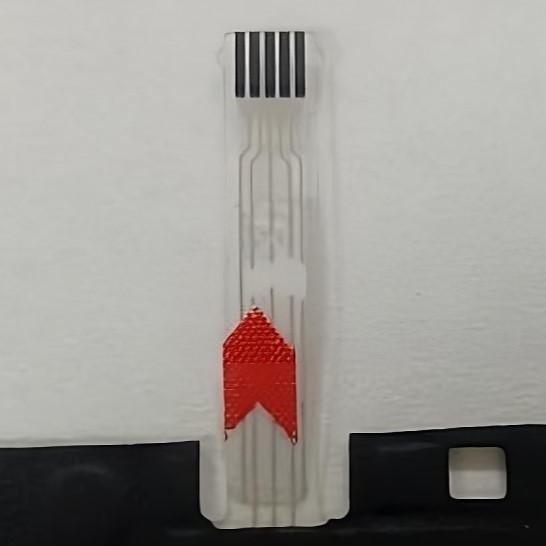
The project began after anomalies were detected in the operation of an electronic device incorporating a flexible circuit based on silver conductive tracks. During system operation, electrical interruptions were observed, affecting performance and compromising the reliability of the equipment. These incidents required stopping the device and raised concerns about component stability.
Failures in flexible circuits can have multiple origins. In some cases, they are related to defects generated during the manufacturing process, such as irregularities in conductive material deposition or adhesion issues between circuit layers. In other cases, the origin may be linked to mechanical stresses generated during device assembly or to usage conditions that lead to fatigue or microcracking in the conductive tracks.
Flexible circuits combine conductive materials and polymers, making them particularly sensitive to microcracks, mechanical stress, and manufacturing defects that are difficult to detect.
One of the most common challenges in this type of component is that defects may exist at microscopic scales and remain undetectable through conventional inspection methods. Small discontinuities in conductive tracks or alterations in the material microstructure can lead to conductivity losses, manifesting as intermittent failures or circuit interruptions.
Under these conditions, a detailed study was required to accurately identify the nature of the defect present in the flexible circuit and understand the factors that contributed to its occurrence.
Failure in electronic components and need for technical diagnosis
When a failure occurs in electronic components, one of the main challenges is determining whether it is an isolated incident or a potentially systematic issue. This distinction is particularly relevant in industrial environments, where defect recurrence could affect a large number of produced units.
In this case, the client needed to understand whether the observed breakage in the flexible circuit was related to a design issue, a deviation in the manufacturing process, or a phenomenon associated with the operating conditions of the device. Each of these scenarios implied different levels of risk and required different corrective actions.
To address this uncertainty, a study based on comparative analysis between a defective sample and a reference (non-defective) sample was proposed. This approach makes it possible to identify differences in morphology, material structure, or continuity of conductive tracks that may explain the observed behavior.
The objective of the study was to obtain reliable technical information to understand the origin of the defect and provide the client with an objective basis for decision-making regarding product reliability.
Diagnosis of electronic failures in conductive structures
The analysis of flexible circuits presents specific characteristics that differentiate it from other conventional electronics studies. Conductive tracks typically have very small dimensions and are integrated into multilayer structures composed of materials with different mechanical and chemical properties.
In this type of configuration, defects may appear as microcracks, discontinuities in conductive tracks, or adhesion issues between different layers of the circuit. These alterations can develop progressively and lead to loss of component functionality without any visible damage at a macroscopic level.
In multilayer electronic structures, small microscopic defects can cause intermittent electrical failures that are difficult to reproduce under laboratory conditions.
Diagnosing electronic failures in these systems requires analytical techniques capable of examining both the surface and the microstructure of the material with a high level of detail. The combination of visual inspection, microscopy, and chemical analysis enables the identification of damage patterns and the reconstruction of the process that led to component failure.
In this context, the INFINITIA technical team conducted a study aimed at characterizing the damaged area of the flexible circuit and determining which material or process-related features could be associated with the observed defect.

How was it addressed or what was the solution?
To investigate the origin of the issue, a study was designed based on the comparison between defective samples and reference samples in good condition. This approach makes it possible to identify relevant differences in morphology or material composition and is a common methodology in electronic failure analysis.
The work was carried out by combining microscopy and chemical characterization techniques, allowing precise examination of the affected areas of the flexible circuit and providing detailed information about the characteristics of the defect.
Forensic engineering of electronic components applied to diagnosis
The study was conducted following a methodology typical of forensic engineering of electronic components, aimed at identifying the causes that led to component failure and reconstructing the process that generated the observed damage.
In an initial phase, a detailed visual inspection of the available samples was carried out. This preliminary analysis made it possible to locate the area where the discontinuity in the conductive track of the flexible circuit was present and to define the region of interest for subsequent analyses.
Optical microscopy techniques were then applied to examine the morphology of the damaged area in greater detail. This type of analysis facilitates the identification of surface irregularities, discontinuities in the conductive material, or possible fracture patterns associated with the failure.
The comparison between the defective sample and the reference sample allowed the identification of relevant differences in the circuit structure. This comparative analysis is a key tool in forensic engineering, as it helps contextualize the observed defect and guide the interpretation of the results obtained.
SEM EDX analysis in electronics for microstructural characterization
To further investigate the defect, scanning electron microscopy (SEM) combined with chemical analysis using EDX was employed. These techniques enable high-resolution imaging of the material surface and allow analysis of the elemental composition of the studied areas.
The use of SEM EDX analysis in electronics is particularly useful when investigating defects in conductive tracks, as it allows precise examination of fracture morphology and detection of possible variations in material composition. This information is essential for identifying contamination, inclusions, or alterations in the conductor structure.
SEM microscopy enables the observation of defects in conductive tracks at microscopic scales that cannot be detected through conventional inspection.
Through microscopic-scale observation, it was possible to analyze in detail the surface of the flexible circuit and characterize the shape of the discontinuity present in the conductive track. The high resolution of SEM made it possible to identify morphological features that could not be observed using conventional microscopy techniques.
EDX analysis complemented this information by providing data on the distribution of elements present in the analyzed area. The combination of both techniques enabled a comprehensive understanding of the material characteristics in the region where the failure occurred.
Failure analysis in industrial electronics to understand the origin of the defect
The integration of the results obtained through the different analytical techniques made it possible to reconstruct the behavior of the flexible circuit and better understand the characteristics of the damage observed in the component.
This type of failure analysis in industrial electronics is not limited to identifying the defect present in a material or component. Its main objective is to interpret the results obtained in order to understand which mechanisms may have contributed to the occurrence of the problem.
The study made it possible to characterize the differences between the analyzed samples and establish a technical interpretation of the phenomenon that caused the interruption in the conductive track. This information provided a solid basis for evaluating the possible causes of the failure and its relationship with the manufacturing process or the operating conditions of the component.
Thanks to this approach, the client was able to better understand the behavior of the flexible circuit and obtain useful technical information to guide future actions aimed at improving the reliability of the electronic system.