
What was the challenge or problem to be solved?
In certain industrial applications, adhesive systems are exposed to severe thermal conditions that may compromise their structural integrity, chemical stability or long-term bonding performance. When the adhesive is part of a critical assembly, any premature degradation can lead to functional failures, rework, unplanned downtime or safety risks.
In this context, the project arose from the need to select and validate high temperature adhesives capable of maintaining their performance under demanding thermal loads. Relying solely on technical datasheets or manufacturer-provided data was not sufficient. Comparative experimental evidence was required to reduce uncertainty prior to industrial implementation.
High-temperature adhesives in demanding industrial applications
The client needed to ensure reliable performance of the adhesive system in an operating environment with elevated temperatures, significant thermal gradients and potential heating and cooling transients. The application required a stable joint over time, without significant loss of mechanical properties or alterations at the adhesive–substrate interface.
The issue was not limited to static resistance at constant temperature. In many real applications, materials are subjected to thermal shock cycles, which generate internal stresses due to differential expansion between bonded materials. These loads may accelerate the formation of microcracks, adhesion loss or structural changes in the polymer matrix.
Therefore, the analysis had to consider not only the initial behaviour of the adhesive, but also its cumulative response to repeated thermal loads representative of real service conditions.
Thermal durability of adhesives as the project objective
The purpose of the study focused on evaluating the thermal durability of adhesives under controlled conditions designed to accelerate the ageing expected in service. The main interest was not only to measure initial properties, but to analyse their evolution after prolonged exposure to elevated temperatures.
The assessment considered phenomena associated with thermal degradation, such as changes in the chemical structure of the polymer, loss of internal cohesion or variations in the stiffness of the adhesive system. These processes may not be visible to the naked eye, yet they directly affect the load-bearing capacity of the joint.
Loss of properties is not always visible, but it can directly compromise the structural strength of the joint.

To quantify mechanical behaviour after thermal exposure, the ageing stages were complemented with mechanical testing aimed at measuring the residual strength of the joint. This approach made it possible to link thermal exposure with an actual loss of structural performance, avoiding conclusions based solely on visual inspection or qualitative assessment.
Accelerated life testing in response to the complexity of real ageing
One of the main technical challenges was to design accelerated life testing capable of simulating, within a reasonable timeframe, the cumulative effects of high-temperature service.
The protocol included phases of accelerated ageing through controlled exposure to representative temperatures for defined periods, as well as sequences integrating thermal variations to approximate real operating scenarios. The combination of sustained temperature and cyclic loading made it possible to evaluate both the chemical stability and structural integrity of the joints.
Accelerated ageing simulation makes it possible to anticipate failures in weeks instead of years, reducing risks before industrial implementation.
After each exposure phase, samples were assessed to identify dimensional changes, cracking, adhesion loss or modifications in failure mode. This approach provided a comprehensive view of adhesive behaviour, integrating thermal and mechanical variables within a coherent validation framework.
INFINITIA structured the experimental design so that results were comparable between alternatives, ensuring reproducibility and traceability at every stage of the study.
How was this approached or what was the solution?
The project was structured around a comparative approach focused on supporting technical decision-making. The objective was not to characterise in depth the chemistry of each formulation, but to generate objective evidence enabling the selection of the adhesive with the best thermal performance within the defined application framework.
Technical selection of adhesives based on comparative criteria
The first step consisted of defining evaluation criteria consistent with real operating conditions. The technical selection of adhesives could not rely exclusively on manufacturer-declared parameters, but rather on their response under thermal loads equivalent to those expected in service.
Different candidate alternatives were identified and controlled thermal exposure conditions were established, including representative temperatures, exposure times and thermal sequences reproducing the severity of the final environment.
The comparative approach allowed the analysis of behavioural trends between formulations, identifying differences in stability, stiffness or sensitivity to accumulated thermal stresses. This methodology reduced reliance on subjective criteria and enabled an objective evaluation between available options.
Validation of industrial adhesives through accelerated ageing
The validation of industrial adhesives was carried out through thermal exposure programmes designed to intensify service conditions. After each thermal stage, samples underwent mechanical characterisation to determine the evolution of their strength.
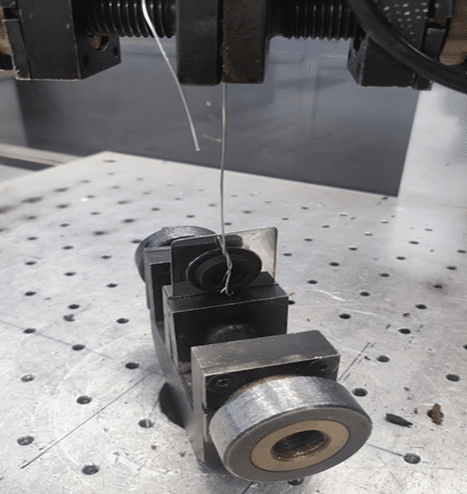
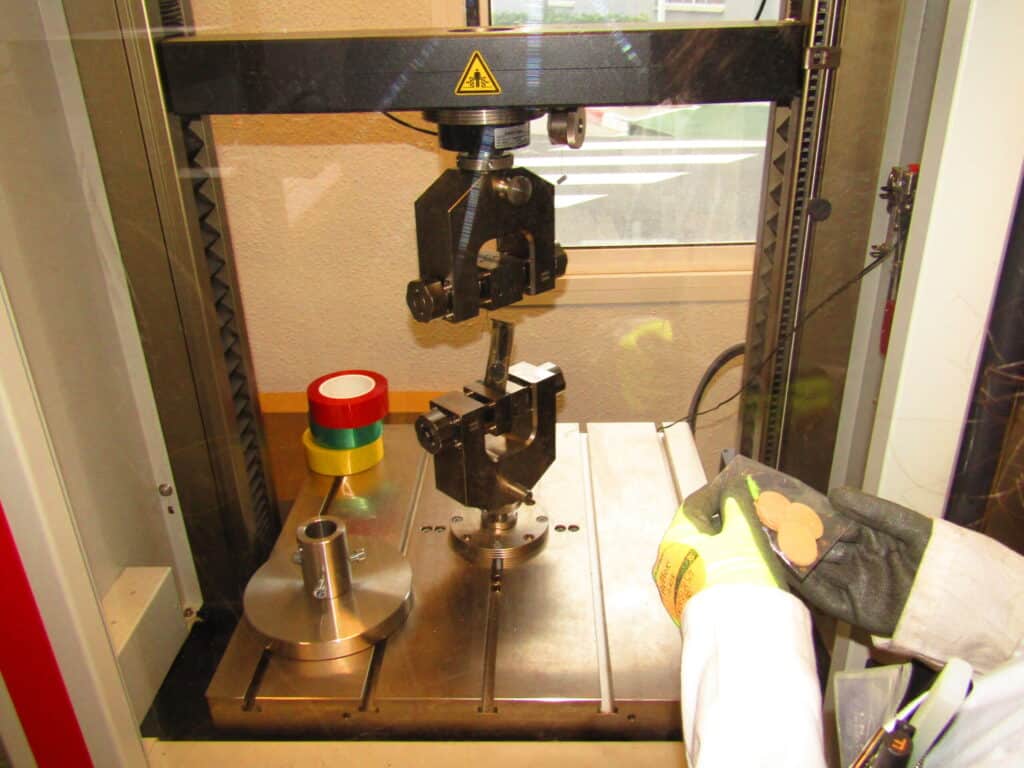
A universal testing machine (UTM) was used to measure the response of the bonded joints under controlled loading conditions. This analysis provided quantitative data on residual strength and failure mode after thermal exposure.
Mechanical testing after thermal exposure makes it possible to quantify the actual degradation of the adhesive under service conditions.
INFINITIA’s Forensic Engineering team participated in defining the protocols, controlling critical variables and performing the technical analysis of the results. Interpretation was consistently conducted from a comparative perspective, identifying not only which alternative showed greater stability, but also how its behaviour evolved according to the applied thermal severity.
This approach directly linked thermal conditions with the loss or retention of mechanical performance, providing a solid basis for decision-making.
Qualification of adhesives supported by solid experimental evidence
Based on the results obtained, it was possible to move forward with adhesive qualification grounded in experimental data rather than solely on theoretical specifications.
The study enabled the identification of alternatives with greater stability under prolonged thermal exposure, the elimination of formulations with unstable behaviour and the reduction of uncertainty associated with industrial implementation.
Beyond selecting the most suitable option, the project established a replicable methodological framework for future evaluations of materials subjected to demanding conditions. The combination of controlled thermal exposure, objective mechanical assessment and structured comparative analysis transformed a complex technical decision into an evidence-based process.
The success of the project lay in converting uncertainty regarding thermal behaviour into quantified knowledge, aligning operational requirements and long-term reliability through accelerated life testing.